Showing posts with label George Sanders. Show all posts

December 23, 2011

All About Eve

All About Eve (1950) is just about the bitchiest movie ever made. It's chock full of delicious dialogue (including the famous "Fasten your seatbelts. It's going to be a bumpy night.") and features Bette Davis in top form. She plays an aging Broadway star named Margo Channing. Anne Baxter plays Eve Herrington, an adoring young fan who cons her way into Margo's inner-circle in order to foster her own acting ambitions. She wants to be the new Margo. It's smashing good fun: overdramatic to the point of self-parody, but also a clever critique of Hollywood culture and the double-edged sword that is Fame.

Written and directed by Joseph L. Mankiewicz, All About Eve's impact on pop culture cannot be underestimated. Countless movies and television shows have borrowed its theme of the star being manipulated by a young and devious imposter, but none of these has ever come close to equaling it. 

Bette Davis had been the Queen of Warner Bros. in the 30s and early 40s, but in the years following Now Voyager (1942) her career sagged, and she had just about been written off as a performer. Her performance as the volatile, vicious and vulnerable Margo is perfection, and it briefly revitalized her career. And it's the performance you think of when you think of Bette Davis (unless it's What Ever Happened to Baby Jane, but that role moves beyond self-parody into something positively uncanny and even undignified).

With George Sanders, who won an Oscar for his performance as a witty, acerbic drama critic, Celeste Holm, Gary Merrill, Hugh Marlowe, Thelma Ritter, and, in a small role, Marilyn Monroe. Based on the short story "The Wisdom of Eve" by Mary Orr. ★★★★
December 11, 2010

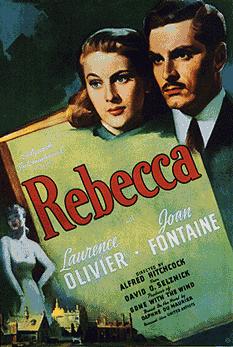
Rebecca


Alfred Hitchcock's first American film, based on an English novel (by Daphne du Maurier) with an English cast (Laurence Olivier, Joan Fontaine, Judith Anderson, George Sanders, Nigel Bruce, Reginald Denny, Gladys Cooper and Florence Bates) and set in Cornwall. It's a modern-era Gothic and a camped up, tighter version of Jane Eyre. Fontaine is a pathetic little thing who falls in love with a millionaire in Monte Carlo named Maxim De Winter (Olivier). Maxim's first wife, Rebecca, died tragically a year before. When Maxim takes his young bride back to Manderley, his lavishly decorated family estate in Cornwall (right on the sea), she finds herself constantly being compared to Rebecca by the staff, especially the sinister head housekeeper, Mrs. Danvers (Judith Anderson) whose long black dress accentuates her long arms and tall figure, making her a shape right out of Dracula or The Monk.

Rebecca is a story that displaces its heroine (she is awkward and naive and clumsy in such an elegant, sophisticated milieu) so that she can rescue respectable English society from wild women by being submissive and trusting to her husband, who may not have loved his wife as much as is indicated by popular gossip and speculation. The second Mrs. De Winter (she has no other name in either the book or the movie) pretty much goes along with things as they are, and while she doesn't fit in on the basis of her class and her mannerisms, she is forthright and obliging and caring. Perhaps breaking class barriers isn't as bad as marrying a woman who's completely deceiving and adulterous and insincere. Well, which is it? The movie is ambiguous, but the house burns down and Rebecca is dead before the story even begins, so perhaps it's a tie.

Regardless, Rebecca the movie is a fascinating and visually exciting tale, one that accentuates the creative style of its director Alfred Hitchcock, and is propelled by a finely crafted tale of suspense from the pen of Daphne du Maurier and the writers who adapted it for the screen (Philip MacDonald and Michael Hogan). It's such a good example of the Gothic that one can hardly care about its histrionics--they are part of the fun, and Hitch seems to be having quite a good time with the scowling Olivier and the simpering Fontaine and the positive uncanniness of Judith Anderson's performance. Franz Waxman's music score provides a perfectly syncopated pulse to this body, which is one of the best examples of 40s Hollywood gloss. 1940 ★★★★