Showing posts with label Judith Anderson. Show all posts

February 16, 2014

The Furies

Barbara Stanwyck is one of the few actresses of her era that could be convincing in either an evening dress or a pair of cowboy boots, and in Anthony Mann's 1950 Western The Furies, she gets to do both. Stanwyck plays Vance Jeffords, the tenacious daughter of an arrogant, domineering, but likable rancher named T.C. Jeffords (Walter Huston, in his last film). Theirs is an explosive relationship, one that teeters between giddy, good-natured understanding and fiendish backstabbing. The Furies is the name of the ranch, which is situated in 1870's Texas, when the Mexicans were still making outrageous claims like, "Stop taking our land." (I know, really out of line. Just because they were there first they get to keep it?) Vance has a unique position in the ongoing quarrel between her father and the "squatters," a Mexican family named Herrera: she's in love with the eldest son, Juan (Gilbert Roland), although she's too aware of the realities of her world to do anything about it.

But don't misunderstand: The Furies isn't a weepy commentary on philistine social traditions. It's a study in the unfettered and usually cross-purposed ambitions of a father and daughter. T.C. has a son--played by the blandly hunky John Bromfield--but he's mostly in the background, doing what's expected, not making any waves. It's never even hinted that T.C. would entrust the Furies to him, because Vance always shows herself to be the most obvious and capable successor. That is until T.C. goes too far in his efforts to control his daughter, a struggle she constantly refuses to let him win.

People who think they understand gender roles or gender politics, both in real life and in the movies, should watch The Furies. If you think of old movies as purveyors of traditional gender roles, you should watch The Furies. You should take a good hard look at actresses like Barbara Stanwyck and Bette Davis and Olivia de Havilland, who almost always played strong women who refused to defer to the ignorant or just plain stupid designs of certain men in their lives.

The Furies also holds up quite well sixty-plus years later. It's an elegant western boasting some lovely night scenes in which the impressive Jeffords ranch is outlined by the rolling Texas canyons. There's something kind of gorgeous about that image, and it recurs throughout the Western genre. Director Anthony Mann and screenwriter Charles Schnee are smart enough to recognize the merits of their actors, and we get lots of good moments with them: the scissors Barbara Stanwyck clutches at the beginning of the movie (they're later brought back into the plot, making that little bit of foreshadowing almost Hitchcockian); the scene where Stanwyck sort of glides down the stairs in a daze after committing a particularly violent act, and the entire household watches in a kind of stunned reverential silence; the delightful Herrera matriarch (played by Blanche Yurka) cackling as she pushes boulders down a steep canyon onto the ranchers who have decided to oust the squatters for good; the delicious bits of dialogue that Stanwyck gets to say, like, "I hope you can chew what you just bit off."
 
With Wendell Corey, Judith Anderson, Thomas Gomez, and Beulah Bondi.


July 04, 2012

Laura

In Laura (1944), a gruff detective lieutenant (Dana Andrews) falls in love with the dead woman whose brutal murder he's investigating. People have often gotten perhaps too much giddy excitement about the cop who "fell in love with a corpse," but then, it's essentially the same obsessive fascination that has made Vertigo one of Alfred Hitchcock's most talked about films. The girl, Laura, is first introduced to us via flashback, through the memories of her acquaintances, a ruthless assortment of nasty characters that includes Clifton Webb as a prissy columnist (whose performance captures brilliantly the essence of a highfalutin literary snob); Vincent Price as an opportunistic Southern heel who lacks the money to be a playboy on his own, and must milk the purses of his wealthy female companions; and Judith Anderson as Laura's self-serving aunt, who's in love with Price even though he mistreats her. Gene Tierney, as Laura, has a chic beauty that draws the camera to her face and her features. It's easy to see how Andrews' character would become retroactively obsessed with her. The movie itself is of that old-fashioned society murder mystery variety. You don't so much care about the mystery being solved, as long as you can revel in the nastiness of these conniving people, all of them motivated by their little private agendas. The scene where Andrews spends the night staking out Laura's apartment is memorable, because, without losing his tight-lipped demeanor of professional self-control, Andrews displays just how much Laura consumes his thoughts.

David Raksin composed the sentimental score, which includes the now classic title song (it lingers over every dramatic scene like smoke from a blown out candle, tainting the atmosphere). The music turns Laura into some kind of grand soap opera, kept in check by Andrews, who's as hard and unflowery as Laura is soft and beautiful. That may be why Laura remains a popular example of silky, melodramatic film noir: it has a perfect mixture of overindulgence and efficiency. It was directed by Otto Preminger, and adapted from Vera Caspary's novel by Jay Dratler, Samuel Hoffenstein, and Elizabeth Reinhardt.

December 23, 2011

Cat on a Hot Tin Roof

Cat on a Hot Tin Roof (1958) is a Southern-fried family drama, adapted from the Tennessee Williams play and directed by Richard Brooks (James Poe co-wrote the script). It's one of the better films to come from Tennessee Williams, despite the fact that MGM completely removed the play's most controversial subject matter in the adaptation.

Paul Newman and Elizabeth Taylor play a not-so-happily-married couple. Taylor is electric, even when she climbs into histrionics, as the sexually frustrated Maggie. She's stunning in this, and Brooks frames her in doorways to heighten her allure. Newman is intense but vulnerable as Brick, the alcoholic ex-football hero who claims Maggie slept with his now dead BFF, Skipper. Brick's repugnance with his wife is half-hearted at best. In one scene, after he pushes Maggie away, only to be confronted with her nightgown hanging on the bathroom door, he lets down his guard, drinking in her aroma. You know he wishes he could stop playing the offended husband. He's at his best when he's laughing--his sense of humor humanizes him. Newman was always at his most appealing when he was clearly having a good time with his performance, even if he was playing a heel like in Hud (1963).

As with any Tennessee Williams story, the room is always thick with raw emotion, and skeletons are lining up behind the closet door waiting to tumble out. But you can forgive it for being over the top. It's lusciously entertaining, full of self-loathing and big revelations, like nine months of therapy condensed into 100 minutes with a glossy MGM sheen over it and beautiful people on the screen. When I first saw it years ago, I was so stunned that I immediatately rewound the VHS and watched it straight through again. Almost every character has a moment of self-awareness that is actually quite touching. The veneer is lifted even if only momentarily, and a kind of inner-truth is revealed--one that's deeply broken and human.

With Burl Ives as Brick's father, Big Daddy (yes, really), the booming-voiced Southern tycoon who likes controlling everything from his plantation to his sons, and is confronting his own mortality when he learns that he has inoperable cancer. Judith Anderson plays Big Mama, the stereotypical Southern matriarch with a big voice and a short fuse. Jack Carson plays Brick's brother, Gooper, the dutiful firstborn who's doing everything he can to please Big Daddy and assume control of the family fortune when the inevitable happens. He's got an obnoxious, conniving wife (Madeleine Sherwood) and a litter of plump, rude, ruddy-faced little imp-children. ★★★★

December 11, 2010

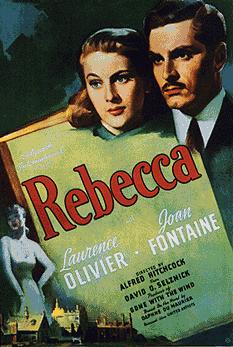
Rebecca


Alfred Hitchcock's first American film, based on an English novel (by Daphne du Maurier) with an English cast (Laurence Olivier, Joan Fontaine, Judith Anderson, George Sanders, Nigel Bruce, Reginald Denny, Gladys Cooper and Florence Bates) and set in Cornwall. It's a modern-era Gothic and a camped up, tighter version of Jane Eyre. Fontaine is a pathetic little thing who falls in love with a millionaire in Monte Carlo named Maxim De Winter (Olivier). Maxim's first wife, Rebecca, died tragically a year before. When Maxim takes his young bride back to Manderley, his lavishly decorated family estate in Cornwall (right on the sea), she finds herself constantly being compared to Rebecca by the staff, especially the sinister head housekeeper, Mrs. Danvers (Judith Anderson) whose long black dress accentuates her long arms and tall figure, making her a shape right out of Dracula or The Monk.

Rebecca is a story that displaces its heroine (she is awkward and naive and clumsy in such an elegant, sophisticated milieu) so that she can rescue respectable English society from wild women by being submissive and trusting to her husband, who may not have loved his wife as much as is indicated by popular gossip and speculation. The second Mrs. De Winter (she has no other name in either the book or the movie) pretty much goes along with things as they are, and while she doesn't fit in on the basis of her class and her mannerisms, she is forthright and obliging and caring. Perhaps breaking class barriers isn't as bad as marrying a woman who's completely deceiving and adulterous and insincere. Well, which is it? The movie is ambiguous, but the house burns down and Rebecca is dead before the story even begins, so perhaps it's a tie.

Regardless, Rebecca the movie is a fascinating and visually exciting tale, one that accentuates the creative style of its director Alfred Hitchcock, and is propelled by a finely crafted tale of suspense from the pen of Daphne du Maurier and the writers who adapted it for the screen (Philip MacDonald and Michael Hogan). It's such a good example of the Gothic that one can hardly care about its histrionics--they are part of the fun, and Hitch seems to be having quite a good time with the scowling Olivier and the simpering Fontaine and the positive uncanniness of Judith Anderson's performance. Franz Waxman's music score provides a perfectly syncopated pulse to this body, which is one of the best examples of 40s Hollywood gloss. 1940 ★★★★