Showing posts with label Julia Roberts. Show all posts

May 25, 2016

Jodie Foster's "Money Monster" is a compact and compelling thriller about corporate greed and class rage.


Money Monster, Jodie Foster’s fourth film as director (following 2011’s The Beaver), is a compact, delectable, indignant thriller that takes place within the span of about ten hours, but has all the power of a three-volume Charles Dickens novel. Dickens understood how the class system, succored by greed, devalues our humanity, and in its own way Money Monster bristles with indignation at the ways human beings stomp all over each other for the sake of greed. Perhaps Money Monster is ultimately a shallow dream about social change, because I don’t think any of us expects a Hollywood movie to summon some new classless society. But the film dramatizes all the rage that is bubbling up in real people right now, and in that sense, Money Monster is urgent and compelling. It’s also funny and touching and sad, and populated with a dozen or more characters, all of whom have, by the end, seized our attention either by their loathsomeness or their lovableness (or both, as in the case of George Clooney’s character).

George Clooney plays Lee Gates, the obnoxious host of a weekly show called “Money Monster”, on which he gives viewers hyped-up, often reckless advice—steeped in the false security of statistics and the force of his own personality—about how to invest their money. It’s really a sideshow: Gates, who often enters each episode garnished with some ridiculous accessory—like a golden top hat— enters the stage dancing to some ridiculous hip hop song, accompanied by two young women dancing on either side of him. Gates is essentially Ebenezer Scrooge for the digital age: he loves money and himself, although he hates being alone (because really, he hates himself). “I haven’t eaten alone since the 90s,” Gates says after a dinner engagement cancels on him. (He’s shocked that anyone would cancel on him.) He has a friendly but complicated relationship with the show’s producer, a seasoned broadcasting show-runner named Patty Fenn (Julia Roberts), but even she has gotten sick of his annoying personality. She’s about to leave the show for a competitor, only she hasn’t told him so yet.

It’s initially a shock to see Clooney playing such an ugly human being, but that’s the point, of course. We know from the get-go that this is a film about one man’s transformation. This may be the movie’s biggest misstep, because making the story all about Lee Gates’s change of heart feels meaningless in 2016. But it’s also a classic way to grab the hearts of an audience, and Money Monster never loses sight of this second goal: to be a crowd-pleasing piece of entertainment, which it is.

The drama, of which readers are probably aware by now, involves an angry young man named Kyle (played by Jack O’Connell) who’s lost his life savings because of a bad investment deal he made based on Gates’s recommendations. It turns out, Gates was plugging the stock of a massive corporation called Ibis, which suddenly “misplaced” 800 million dollars. We see the show’s technicians cue up a previous episode, where Lee urged: “It’s safer than a savings account.” Not so safe, as it turns out, for Lee, who finds himself strapped to a bomb, and Kyle threatening to blow the whole building to smithereens unless he gets some answers.

Money Monster is an exciting thriller, one that doesn’t let go of our attention once it’s grabbed hold. Much of this film’s appeal is, surely, linked to its two stars: But Clooney’s character is utterly unlikable for at least the first half of the movie. It’s only when we see how insignificant he really is to other people—except as a ratings bump—that we start to feel for him. Julia Roberts, who knows how to be mouthy and in-control, offers up a pleasing performance, and her character Patty is ultimately the one we most sympathize with, at least at the beginning. Patty decides to stay in the control room despite the impending bomb, and she desperately feeds Lee with information through his earpiece, hoping something will quell Kyle’s anger.

The film succeeds more on the level of a satisfying thriller, perhaps less as a provocative critique of American values. It’s hard to really buy what they’re selling when you know that Jodie Foster, George Clooney, and Julia Roberts are all millionaires. However, it’s hard not to be affected by Jack O’Connell’s performance as Kyle: He’s a working man who has had too many bad things happen to him, and now he’s lost control of his rage. How many suffer in silence in the real world, until they’re consumed by the years and decades of calcified anger? (O’Connell represents smart casting: he’s relatively unknown, which helps him embody the working man persona of his character.)

Kyle is a man who’s lost everything he values. When Kyle’s pregnant girlfriend confronts him (she’s summoned by police to try and talk some sense into him via Skype), she completely belittles him (and her piercing, embittered insults are broadcast to millions). Conversely, Lee is a man who has nothing of real value. That sort of makes these two a perfect match: The bond that forms between them—which is surely deeper than mere Stockholm Syndrome—is one of the most interesting elements of the movie. It’s not long before Gates himself joins in Kyle’s quest, which leads them to the CEO of Ibis, played by Dominic West.

The confrontation, incidentally, is pretty fantastic. West plays the CEO villain with icy pompousness. He’s exactly the kind of rich, privileged, arrogant prick that we can project all of our own class rage onto. (And maybe this is a weakness, because maybe it lets Lee Gates off the hook too much.)

Director Jodie Foster may be striving for some kind of Frank Capra-esque indictment of our monetary system, but she doesn’t let prestige hamper the power of her story. Nor does she squander opportunities for levity. The film is sprinkled with funny, tension-relieving moments, and it’s to her credit that Money Monster, which sat on the vine for a while in production deals, is as riveting and emotionally powerful as it is. It’s not perfect, but Money Monster is a corporate concoction with brains and heart, anchored by the force of three of our best stars.

With Caitriona Balfe, Christopher Denham, Giancarlo Esposito, Condola Rashad, Lenny Venito, and Emily Meade. Written by Alan Di Fiore & Jim Kouf, and Jamie Linden.

November 22, 2015

Julia Roberts as Grim Reaper

As depressing as it is to see an actress like the ebullient Julia Roberts transformed into a droopy-faced, grief-stricken shell, her new movie, Secret in Their Eyes is pretty entertaining. In fact, she's sort of the female equivalent to one of those characters played by Liam Neeson of late (in films such as Taken and Non-Stop). Roberts plays a Los Angeles detective whose daughter is murdered. By a cruel coincidence, Roberts and her partner, played by Chiwetel Ejiofor (12 Years a Slave) are the detectives called to investigate the crime scene, never suspecting the identity of the victim. The film jumps back and forth between 2002, during the immediate investigation of the murder, and the present day, after the case has gone cold.

Secret in Their Eyes isn’t by any means a perfect thriller. And it’s hard to say if anything you’ll see in this grim procedural drama will differ much from any number of investigation-themed television dramas like Criminal Minds. But the yarn it unspools is compelling enough, and the film is bolstered by the performances of its three leads, especially Nicole Kidman as the district attorney who’s caught between her obligation to follow the law and her devotion to her friend and colleague.

Secret in Their Eyes is in essence a revenge fantasy. As a culture, we've been primed for this kind of movie based on our incessant consumption of true crime TV. We're constantly fascinated by stories of murder and the devastation wrought on the victims' family members. We yearn for justice, yet we know that not even execution of the killer will bring back the dead. Revenge fantasies are deceptive, because they're a heightened version of a longing that cannot be fulfilled. Writer-director Billy Ray understands the double-edged nature of revenge, but he's also happy to milk the fantasy all the way to the bank.

One of the most intriguing aspects of this movie is the role of the September 11th attacks in halting the investigation. The prime suspect in the case is a valued informant, who’s been feeding info to counter-terrorism detectives about a local mosque, a hub for suspected terrorists. The film tries to delve into a surprisingly complex moral problem: Is it morally right to keep a killer on the streets if doing so can prevent more deaths? (I'm not sure the movie satisfactorily answered this question; but it gets points for asking.)

Billy Ray favors convenient plotting, so every scene is primed for maximum plot juice, like an overripe orange. Ray likes his pulp extra-pulpy, and so we get such dramatic wallops as Julia Roberts sobbing over the dead body of her daughter, inside a dumpster; or the ongoing plot complication of a conflicted crush between Ejiofor and Kidman, who’s married; or scenes of Roberts, now hardened by her grief, contemplating a little vigilante justice. “My daughter was the thing that made me me.” This logic is unhealthy, and what’s more, I think it is a truthful observation about too many parents. Of course, the loss of a child is a tragedy that probably no one can recover from fully, but the idea that your kids define you is troubling nonetheless.

Nicole Kidman stands out in her controlled, commanding performance as the D.A. In a scene in which she chides her colleague (Ejiofor) for badgering a suspect despite having no sufficient evidence against him, she goads the suspect into angrily striking out at her. It’s a masterful bit of manipulation, and a reminder of Nicole Kidman’s particular brand of deceptive power. She’s seductive and the smartest person in the room. (But it's also decidedly sexist, because she insults his manhood, hoping it will anger him. When it does, he whips out his member in an act of pure brutishness. Earlier, though, Kidman congratulates Ejiofor on his gender sensitivity.)

Julia Roberts is very good—she has always had an earthy quality that’s made her someone you can root for under any circumstances—but this character feels like a downer in light of her repertoire. It would be like seeing Cary Grant play the creepy pedophile Humbert Humbert in Lolita. We love Cary Grant for being Cary Grant, and we love Julia Roberts for being Julia Roberts. There’s a little bit of that Julia Roberts here, but not much. And even though it feels wrong-headed to criticize an actress for doing something different, especially if she's proficient at it, I always wonder about the motivations of taking on such a role. Are we as a culture so dead to the Julia Roberts of Pretty Woman and Erin Brockovich (a great performance)? Will we turn Julia Roberts into an angry sociopath as we have done Liam Neeson, who went from saving thousands of Jews during the Holocaust to becoming a taciturn, rich man's Rambo?

But all of these quibbles don't undercut the fact that I had a good time at this movie. Secret in Their Eyes has surprising moments of humor and some well-staged moments of suspense, even if it’s an essentially dumb and emotionally manipulative experience. But the dumpster scene gave me chills; but I also felt irritated by it. Which kind of cinematic manipulation is acceptable, and which crosses a line? I’m not sure myself.


With Dean Norris (who’s funny as Ejiofor’s scrappy counterpart), Michael Kelly, Alfred Molina, Zoe Graham.

January 30, 2011

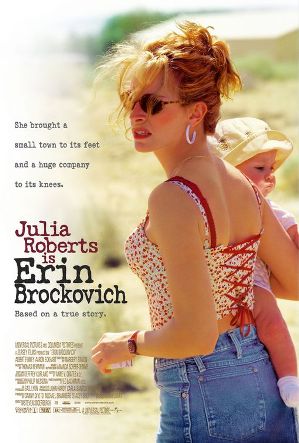
Erin Brockovich


Seeing Between the Lines. Movies that are "based on a true story" should never be evaluated for their historical accuracy, but as narrative, fictional accounts with a whimsical attachment to an event which happened to take place in real life. We've seen this to be true with the reaction to The Social Network, as people portrayed in the movie have come out and said that much of it was a fabrication on the part of the writer and the director. We may never get to the truth with all the angles confronting us incessantly, so as moviegoers and critics we ought to consider the importance of the movie and not the event that studios are capitalizing on in an effort to generate more revenue. "Based on a true story" is, after all, nothing more than a marketing ploy.

With that out of the way, I want to take a look back at Erin Brockovich (2000), the movie that gave Julia Roberts an Oscar for her performance as an abrasive single mother who used her looks and her gutsy personality to take aim at a corrupt corporation. Apparently, PG&E was poisoning the wells of a small town and lying to the residents about it, and only a woman who'd been on the short of end of the stick as many times as Erin Brockovich could do them justice. She corners a lawyer named Ed Masri (Albert Finney) into giving her a job after he fails to deliver for her in court. Erin is the epitome of the down-on-her-luck American single mother who has a perfect figure and an unshakably tenacious spirit. The movie is perhaps ludicrous, but Julia Roberts's performance is so much fun you can hardly fault it.

 In 2000, critics were mourning the death of American Cinema. They do that a lot. I've done it too. Erin Brockovich isn't the type of movie that typically attracts Academy Award attention, but if memory serves, it seemed like people were pulling for Roberts because this was the best role she might ever get, or rather, the most important role she might ever get. It was more important if not pop-culturally less significant than Pretty Woman, and far more memorable than just about anything she'd done in the 10 years between that film and this one.

And indeed, director Steven Soderbergh and screenwriter Susannah Grant have fashioned an entertaining movie. It has a noirish feel to it that inflates the mystery/thriller/courtroom drama aspects of the plot (it is really none of these genres but it seems that Soderbergh wanted to lend that kind of feel to the movie as a means of maintaining the audience's interest). Erin Brockovich is a good movie, a finely crafted piece of entertainment, and yet it's incredibly calculated. Every emotional reaction has been anticipated by the makers. There's a repetitive buildup where Erin encounters crummy, sleazy, or even ignoble characters and then unleashes her witty, profanity-laced speechifying upon them, and then they generally back down meekly--shocked into coercion by the high-heel-adorned hooker from Pretty Woman with an infant clutched under one arm and sunglasses perched over a nest of thick auburn hair. Her entire demeanor seems to say, "watch out...beauty, brains and bad-ass travel in these shoes, and you will be stepped on."

But in the intervals, when Roberts is reacting to what's going onscreen, you wonder if there's really anything beneath Erin Brockovich. It's a movie that has a richly layered crust but nothing inside at its core but gushy emotionalism. We have clear-cut villains (evil corporate executives in business suits...one of whom reminds you of Mark Zuckerberg in his youthful awkwardness) and clear-cut victims (moms and kids who have been ravaged by poisonous, cancer-causing water), and a heroine who will cut the balls off anyone in her way. Of course it's a fun and enticing mythology, but you wish that beneath the surface there was an underlying richness to which the exterior could have been fastened, pinned down as though a real and truly organic tale was unfolding.

Perhaps this is harping, but it's worth considering, especially for movies that flaunt their "based on a true story" subject matter. This one made the real Erin Brockovich a star, and made its star an Oscar-winner, but does seeing beneath the lines make everything else seem hollow and cheap?

With Aaron Eckhart and Marg Helgenberger. The moody, arresting music was composed by Thomas Newman.