Showing posts with label Aaron Eckhart. Show all posts

July 17, 2011

The Black Dahlia

The murder of Elizabeth Short in Los Angeles in January of 1947 still fascinates people today, including James Ellroy, whose novel this was based on. However, this 2006 crime-thriller, which promises to be akin to the knockout noir L.A. Confidential (1997), is a freaking mess. Brian De Palma directed, without the kinky excitement he brought to his early thrillers (Dressed to Kill and Carrie come to mind). The cinematography by Vilmos Zsigmond is first-rate. He captures beautifully the fact that there's nothing going on in this movie that you should care about. As luridly tingling as the Black Dahlia case is, this movie should have been an easy success. Instead, The Black Dahlia looks the other way, on purpose, as a matter of "style." Rather than focusing on the Elizabeth Short murder, it veers into other, fabricated directions.

Why, I'll never know.

Everything is contrived. If you come to this movie expecting an absorbing retelling of a scintillating true crime tale (even with the knowledge that Hollywood typically tinkers with historical fact), you've come to the wrong movie. If you've come looking for even a whisper of narrative logic, you'll also be left wanting. It's nonsensical. Big dramatic scenes are inflated and unexpected even. When they unfold, we laugh because they're so poorly conceived. (In one scene, Josh Hartnett, as one of the detectives investigating the Dahlia murders, pulls a table cloth off a table in a fit of passion with Scarlet Johansson. It seems a pity to make such a mess with a movie that's so carefully dull.)

De Palma has always been a manipulative little cheat of a director, playing with the audience in obvious ways, but in The Black Dahlia he doesn't even do that. We're supposed to sit back in awe of the "master" at work, but he isn't working, and neither is the movie. The blame should probably go also to the screenwriter, Scott Friedman, as well as James Ellroy (assuming his book is akin to Friedman's adaptation).

The main characters, two LAPD detectives (Hartnett and Aaron Eckhart) are involved in a love triangle with the boring, flirtatious Scarlet Johansson. Johansson was best in Woody Allen's Scoop. He brought out the passion in her, and the curious little pixie that she can turn into, the one who wooed Hugh Jackman, the handsome killer. But she tends to be uninteresting without a good director, and in The Black Dahlia, De Palma doesn't know what to do with her. Perhaps to him, her beauty is enough to maintain the audience's interest in her acting. But for anyone looking beyond the surface, there's little satisfaction.

De Palma is at a loss with the other actors, too. Eckhart's character becomes obsessed with the Dahlia case (he's the only aspect of this movie that stays focused on the Elizabeth Short murder, when the entire film should be reveling in Black Dahlia mania). And so quickly does he go bananas that we as an audience don't feel invested in his transformation. We can only jeer and laugh at a performance that falls flat and looks out of place. He's in the wrong movie. He's in the movie about the Black Dahlia murder, not the movie that pretends to be about the Black Dahlia murder.

As for Hartnett, he's never been that compelling of an actor, and using him in the lead is a miscalculation. He narrates clumsily the clumsy narration (not to mention the clumsy dialogue), and he's so scrawny and young that you don't really buy him as a detective--or as a contender in a boxing match that occurs early in the film (and feels just as out of place as everything else in this misfired movie).

There are some scenes where the police view screen tests of Elizabeth Short. They're meant to humanize the disfigured corpse left in grisly exhibition in an overgrown lot, but instead they just turn her into a bimbo who told fairy tells to get what she wanted. And maybe that's true of the real Elizabeth Short, but for a movie that gives little attention to the subject of its title, this adds yet another nail in the coffin. And Hilary Swank, who's desperately in need of a meal, shows up as another bimbo, someone for Josh Hartnett's character to sleep with in lieu of Johnasson, from whom he feels an obligation to abstain (since she's living with his partner).

Fiona Shaw gives the most overwrought performance as Swank's hopped up mother, a society woman who knows more than a bit about the Short murder. In fact, her performance is so hysterically bad, that I recommend watching this movie now. It was earth-shattering. The always exciting Rose McGowan has a cameo as one of Elizabeth Short's roommates. It's a pity that she had such a small part. She's far more interesting an actress than either Scarlet or Swank.

If only The Black Dahlia were as exciting as L.A. Confidential, or any of the old 1940's film noirs that it was modeled after. Instead, we're left with a labyrinthine mess of a movie that's shooting blanks after promising a bang.
January 30, 2011

Erin Brockovich


Seeing Between the Lines. Movies that are "based on a true story" should never be evaluated for their historical accuracy, but as narrative, fictional accounts with a whimsical attachment to an event which happened to take place in real life. We've seen this to be true with the reaction to The Social Network, as people portrayed in the movie have come out and said that much of it was a fabrication on the part of the writer and the director. We may never get to the truth with all the angles confronting us incessantly, so as moviegoers and critics we ought to consider the importance of the movie and not the event that studios are capitalizing on in an effort to generate more revenue. "Based on a true story" is, after all, nothing more than a marketing ploy.

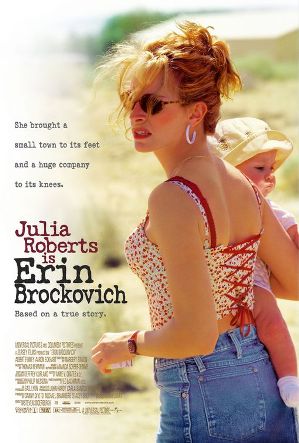
With that out of the way, I want to take a look back at Erin Brockovich (2000), the movie that gave Julia Roberts an Oscar for her performance as an abrasive single mother who used her looks and her gutsy personality to take aim at a corrupt corporation. Apparently, PG&E was poisoning the wells of a small town and lying to the residents about it, and only a woman who'd been on the short of end of the stick as many times as Erin Brockovich could do them justice. She corners a lawyer named Ed Masri (Albert Finney) into giving her a job after he fails to deliver for her in court. Erin is the epitome of the down-on-her-luck American single mother who has a perfect figure and an unshakably tenacious spirit. The movie is perhaps ludicrous, but Julia Roberts's performance is so much fun you can hardly fault it.

 In 2000, critics were mourning the death of American Cinema. They do that a lot. I've done it too. Erin Brockovich isn't the type of movie that typically attracts Academy Award attention, but if memory serves, it seemed like people were pulling for Roberts because this was the best role she might ever get, or rather, the most important role she might ever get. It was more important if not pop-culturally less significant than Pretty Woman, and far more memorable than just about anything she'd done in the 10 years between that film and this one.

And indeed, director Steven Soderbergh and screenwriter Susannah Grant have fashioned an entertaining movie. It has a noirish feel to it that inflates the mystery/thriller/courtroom drama aspects of the plot (it is really none of these genres but it seems that Soderbergh wanted to lend that kind of feel to the movie as a means of maintaining the audience's interest). Erin Brockovich is a good movie, a finely crafted piece of entertainment, and yet it's incredibly calculated. Every emotional reaction has been anticipated by the makers. There's a repetitive buildup where Erin encounters crummy, sleazy, or even ignoble characters and then unleashes her witty, profanity-laced speechifying upon them, and then they generally back down meekly--shocked into coercion by the high-heel-adorned hooker from Pretty Woman with an infant clutched under one arm and sunglasses perched over a nest of thick auburn hair. Her entire demeanor seems to say, "watch out...beauty, brains and bad-ass travel in these shoes, and you will be stepped on."

But in the intervals, when Roberts is reacting to what's going onscreen, you wonder if there's really anything beneath Erin Brockovich. It's a movie that has a richly layered crust but nothing inside at its core but gushy emotionalism. We have clear-cut villains (evil corporate executives in business suits...one of whom reminds you of Mark Zuckerberg in his youthful awkwardness) and clear-cut victims (moms and kids who have been ravaged by poisonous, cancer-causing water), and a heroine who will cut the balls off anyone in her way. Of course it's a fun and enticing mythology, but you wish that beneath the surface there was an underlying richness to which the exterior could have been fastened, pinned down as though a real and truly organic tale was unfolding.

Perhaps this is harping, but it's worth considering, especially for movies that flaunt their "based on a true story" subject matter. This one made the real Erin Brockovich a star, and made its star an Oscar-winner, but does seeing beneath the lines make everything else seem hollow and cheap?

With Aaron Eckhart and Marg Helgenberger. The moody, arresting music was composed by Thomas Newman.