Showing posts with label Albert Finney. Show all posts

November 20, 2012

Skyfall

I groaned inwardly at the beginning of the latest Bond picture, Skyfall: Yet another mindless chase scene where rich people in business suits and fancy cars destroy an entire district of middle and lower class people trying to sell fruits and vegetables. Happily, the rest of the movie eschews that drawn-out bit of chaotic action bosh in favor of a more elegant kind of spy thriller. Surely the James Bond movies have become less-Bond-more-Bourne in the last six years (a disappointing evolution, or devolution, actually). Casino Royale was an exciting debut for Daniel Craig as 007, but the movie was overlong and sloppy at times when it should have been taut. Quantum of Solace was mercifully shorter, and entertaining, but slight, unimpressive and far too Bourne-ish to feel like a real Bond installment. 

Skyfall unites these two warring aspects of the Bond franchise: it's sort of a return, sort of a departure. Some may have found such ambiguity frustrating. (It's understandable.) But I enjoyed myself through to the ridiculous finale, which, as a friend pointed out, was lifted from the Home Alone playbook. It gets a little bit more personal, although one of the things that has made the Bond movies entertaining is their lack of a sense of tangible reality. They were never particularly rooted in time, except when it came to the technology and the villains, who always reflect real-life political anxieties. Here, the threat is terrorism but more specifically cyber-terrorism, and the villain is Javier Bardem, who's good in a cheap sort of way: he's just a tamer version of the psychopath he played in No Country For Old Men, and a more predictable version of the Joker in The Dark Knight. Bardem needs to play a dad in a Disney movie next if he's going to surprise us ever again. But that won't be a very good surprise.

Judi Dench, as M, gets more story time in Skyfall. M's showing her age, and her ability to lead such an important--or at least, established--wing of British intelligence comes into question after some bad judgment calls. It's always fun to see Judi Dench stand firm and icy like the Queen Mother, which she's sort of becoming. At least, the Queen Mother of British movies. (Sorry Maggie, Helen.) Ralph Fiennes steps in as another Bond boss, Mallory, who's going to oversee M's "voluntary" retirement in a few months. Not to be bested, M throws the British PM the finger with regal precision, determined to see her latest job to the end, whatever that may be.

The director, Sam Mendes, does a good job capturing the visual opulence of the various locations, from Shanghai to rural Scotland. Shanghai comes to life in Skyfall, a neon palace full of dancing lights and eye-popping skyscrapers. It's also the scene of a particularly entertaining--because it's relatively subtle and quiet--confrontation between Bond and a hitman, whom he follows up to the top of one of the skyscrapers by grabbing onto the bottom of the elevator. The finale, which takes place at Bond's childhood home in Scotland--and features an enjoyable performance by Albert Finney as the grizzled caretaker of the place--isn't all that smart, but it's enjoyable anyway.

I also really enjoyed the performance of Naomie Harris, an agent who engages in some amusing banter with James. She's game for anything, and invests her scenes with a sense of fun. Daniel Craig is his usual stoic self, but slightly more vulnerable and bruised up. He remains one of the franchise's best incarnations by not giving too much or too little.

With Berenice Marlohe, Ben Whishaw as a Harry Potterish Q, Helen McCrory, Rory Kinnear, and Ola Rapace. Written by Neal Purvis, Robert Wade, and John Logan. 143 min. ★★★½

August 11, 2012

The Bourne Legacy

It's a bad movie with good moments. Jeremy Renner is a much more believable action hero than the academic-looking Matt Damon, who appeared in the first three Bourne movies. Renner looks like he could be the leader of a militia (I'm having flashbacks of The Hurt Locker, which I loved), and he's got a subdued temperament that provides occasional relief from this big, brutal, mechanical thriller.

The movie opens with Jeremy Renner wandering through snow-capped mountains somewhere in the Rockies. He's "gone rogue" and is on the run from his own government. Director Tony Gilroy cuts between scenes of Renner the Wilderness Man and scenes of high-security CIA wonks who are searching for him with their fancy computers, simultaneously conjuring up ways to combat a forthcoming newspaper story that will threaten them. Edward Norton heads these scenes, and he's perhaps as unappealing in this role as he was in Moonrise Kingdom. There's something utterly pathetic about his character: the runty, pencil-necked technophile who's pulling the strings from the safety of a computer desk and a cell phone. He's much more interesting in movies where he's portrayed as strong and threatening and vital, as in American History X. Here he seems like a younger version of the always slimy David Strathairn, who has a small role as another government guru.

There is one particularly disturbing scene of a gunman mowing through some scientists in a lab (where the heroine, played by Rachel Weisz, works as a researcher.) It's probably all the more frightening because these kinds of seemingly random outbursts of workplace violence have become so commonplace in real-life. There are several smashingly directed sequences, such as one scene where Weisz is accosted by agents in her own home, who are ostensibly there to question her, but who we later find out have far more insidious intentions.

The chase scene at the end is a good example of where The Bourne Legacy goes all wrong. It's the cinema of exhaustion. Motorcycles weaving through bumper to bumper traffic in downtown Minela, Phillipines, and somehow nobody important is seriously injured by the onscreen chaos. These are the moments in movies when you withdraw your emotional investment from the plot and the characters, partly because you can't really tell what's going on because of the editing, which cuts fast on purpose, probably to hide mistakes (either in logic or in execution).

Stacy Keach livens things up in Washington, briefly, with his particular brand of blowhard tough-guyness. He looks like a more macho version of Dick Cheney: the Dick Cheney who wouldn't accidentally shoot someone on a hunting trip. But Keach doesn't have enough screen time to save those scenes, which are virtually half the movie for the first hour, from their abject mediocrity. The banter between government officials is blandly written, badly worked out by the director and the actors, and shimmers with the falseness of self-importance.

It's only Renner and Rachel Weisz, who herself becomes a target of the government via her involvement in Renner's Outcome program (she was the one who, somewhat unwittingly, injected the spies with drugs that caused strange neurological and chemical changes inside them), who give this movie any appeal. Their scenes together are interesting enough to keep you from wanting to leave the theater. It's the Renner and Rachel Show by the end, at least until the chase scene, when the movie reverts to all the reliably dull cliches in the genre playbook.

Oscar Isaac shows up at the beginning of the film, when Renner is still on the lam in the Rockies, and he turns out to be a fellow "Outcome agent," holed up in an isolated cabin. Isaac is an actor who continues to deliver good performances in small roles, and it would be nice to see him land bigger parts. With Joan Allen, Scott Glenn, and Albert Finney (briefly). Written by Tony and Dan Gilroy.

January 30, 2011

Erin Brockovich


Seeing Between the Lines. Movies that are "based on a true story" should never be evaluated for their historical accuracy, but as narrative, fictional accounts with a whimsical attachment to an event which happened to take place in real life. We've seen this to be true with the reaction to The Social Network, as people portrayed in the movie have come out and said that much of it was a fabrication on the part of the writer and the director. We may never get to the truth with all the angles confronting us incessantly, so as moviegoers and critics we ought to consider the importance of the movie and not the event that studios are capitalizing on in an effort to generate more revenue. "Based on a true story" is, after all, nothing more than a marketing ploy.

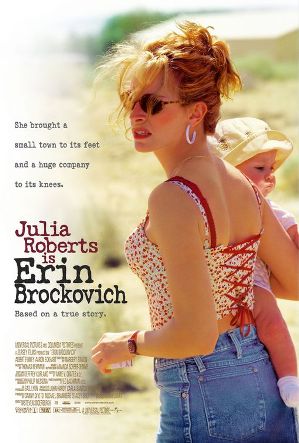
With that out of the way, I want to take a look back at Erin Brockovich (2000), the movie that gave Julia Roberts an Oscar for her performance as an abrasive single mother who used her looks and her gutsy personality to take aim at a corrupt corporation. Apparently, PG&E was poisoning the wells of a small town and lying to the residents about it, and only a woman who'd been on the short of end of the stick as many times as Erin Brockovich could do them justice. She corners a lawyer named Ed Masri (Albert Finney) into giving her a job after he fails to deliver for her in court. Erin is the epitome of the down-on-her-luck American single mother who has a perfect figure and an unshakably tenacious spirit. The movie is perhaps ludicrous, but Julia Roberts's performance is so much fun you can hardly fault it.

 In 2000, critics were mourning the death of American Cinema. They do that a lot. I've done it too. Erin Brockovich isn't the type of movie that typically attracts Academy Award attention, but if memory serves, it seemed like people were pulling for Roberts because this was the best role she might ever get, or rather, the most important role she might ever get. It was more important if not pop-culturally less significant than Pretty Woman, and far more memorable than just about anything she'd done in the 10 years between that film and this one.

And indeed, director Steven Soderbergh and screenwriter Susannah Grant have fashioned an entertaining movie. It has a noirish feel to it that inflates the mystery/thriller/courtroom drama aspects of the plot (it is really none of these genres but it seems that Soderbergh wanted to lend that kind of feel to the movie as a means of maintaining the audience's interest). Erin Brockovich is a good movie, a finely crafted piece of entertainment, and yet it's incredibly calculated. Every emotional reaction has been anticipated by the makers. There's a repetitive buildup where Erin encounters crummy, sleazy, or even ignoble characters and then unleashes her witty, profanity-laced speechifying upon them, and then they generally back down meekly--shocked into coercion by the high-heel-adorned hooker from Pretty Woman with an infant clutched under one arm and sunglasses perched over a nest of thick auburn hair. Her entire demeanor seems to say, "watch out...beauty, brains and bad-ass travel in these shoes, and you will be stepped on."

But in the intervals, when Roberts is reacting to what's going onscreen, you wonder if there's really anything beneath Erin Brockovich. It's a movie that has a richly layered crust but nothing inside at its core but gushy emotionalism. We have clear-cut villains (evil corporate executives in business suits...one of whom reminds you of Mark Zuckerberg in his youthful awkwardness) and clear-cut victims (moms and kids who have been ravaged by poisonous, cancer-causing water), and a heroine who will cut the balls off anyone in her way. Of course it's a fun and enticing mythology, but you wish that beneath the surface there was an underlying richness to which the exterior could have been fastened, pinned down as though a real and truly organic tale was unfolding.

Perhaps this is harping, but it's worth considering, especially for movies that flaunt their "based on a true story" subject matter. This one made the real Erin Brockovich a star, and made its star an Oscar-winner, but does seeing beneath the lines make everything else seem hollow and cheap?

With Aaron Eckhart and Marg Helgenberger. The moody, arresting music was composed by Thomas Newman.