Showing posts with label Judi Dench. Show all posts

November 08, 2015

Spectre

The new James Bond, Spectre, is an enthralling good time, one of the most exciting big movies to come out this year. It has one major flaw: a wrong-headed need to understand and reform its hero; but this I can forgive for a movie as entertaining and well-made as Spectre. Daniel Craig, who has talked recently of exiting the role of 007, has sometimes been criticized for being an overly serious Bond. There is something shell-shocked about Daniel Craig’s appearance: He always looks to me like he’s just returned from a tour of duty in Iraq. But he’s a remarkably fit actor, and he’s subtly funny, cautious never to venture into Roger Moore territory. Craig himself exudes a kind of enigmatic persona that works for the character.

Spectre opens with a sweeping shot of Mexico City on El Dia de los Muertos. We watch a man and a woman—both wearing masks—make their way through a crowded street, into a hotel, to their room, where they embrace. Then the man takes off his mask: It’s James Bond. Bond is always ready for a bedroom scene, if only the lady will wait a moment while he shoots someone. “Excuse me for a moment,” he says, and with sniper rifle in hand, climbs out the window of the hotel room. We follow, looking down on him from above as he maneuvers from rooftop to rooftop until he finds his perch and takes aim.

The scene is visually thrilling, in part because director Sam Mendes cares about craftsmanship, and in part because all this precision and attention to Bond’s spatial geography builds the tension: By the time Bond pulls the trigger, we’re totally invested in what he’s doing. The building that subsequently explodes (not because of the gun shot) would otherwise have been another numbing moment of cinematic destruction. When Bond, unable to escape the debris and the enveloping cloud of smoke and gas, falls down, down, down, he plops right onto a couch. This punctuating bit of humor sealed the deal for me. The rest of the film (until the end) is pure delight.

One of the most interesting parts about Spectre is its fascination with/anxiety about surveillance. Surveillance is the chief bogey of this movie, the thing the villains treasure because it begets them unadulterated power. But it’s also a fact of life, especially in Europe, where counter-terrorism measures have increased the number of cameras in public places, and, we assume, the number of phone conversations being listened-in-on. In the film, the 00 program is threatened by a new intelligence division, headed by Max Denbigh (Andrew Scott), who sees data collection as the wave of the future, and agents like Bond as relics of the past. The movie opens with the text, “THE DEAD ARE ALIVE,” and insinuates that indeed James Bond himself is a kind of ghost who visits us in our pop culture fantasies. Perhaps this explains our fascination with him, and why the current iteration of the series so desperately wants to “solve” James Bond, to know the unknowable.

Sam Mendes seems aware of our culture’s current need to psychoanalyze movie heroes to death. He makes light of this in a scene in which Bond is being evaluated by a shrink (Dr. Madeleine Swann). She doesn’t know that he’s actually there to save her from an assassin. But her questions are the questions we may have found ourselves asking—against our better judgment—over time: We want to know what makes James Bond tick, yet to understand the mystery is to take the fun of the mystery away. Unfortunately, the film can’t resist its own urges to investigate and domesticate its hero. It's a symptom of a larger pop cultural urge, this need to know everything, to fix everything, this inability to accept flaws as somehow fundamental and unchangeable and, sometimes, desirably human.

One of my favorite things about these movies is when they turn into a North By Northwest-style world geography tour. Spectre does not disappoint in this arena: We go from Mexico City to London to Austria to Tangier. Sam Mendes, with help from cinematographer Hoyte van Hoytema, captures the lushness of these disparate venues for the usual James Bond spy-movie hijinks, and lets the camera linger on them enough for us to savor the image. And the chase scenes, which are generally very well-choreographed, have been carefully wrought in conjunction with their locations. Probably the best one is the fight between Bond and Mr. Hinx (Dave Bautista), the great, hulking moose of a henchman who is this movie’s Jaws. Their tussle on a train somewhere near Tangier (if memory serves) is tense and exciting, and again, capped with a bit of throwaway humor (that doesn't work quite as well as one would hope). 

As the chief villain, Blofeld, Christoph Waltz is appropriately creepy. Waltz, like Javier Bardem before him, seems made for these kinds of megalomaniacal characters. He reminds me of that great, sinister character actor Henry Gibson. But there’s something too easy about Waltz as a villain. It’s as expected as having Paul Giamatti play a weasel. And though I don’t mean to damn him with faint praise (because Waltz is really great at what he does), there’s so much else to look at and love about Spectre that the villain pales in comparison. 

Perhaps the one truly lackluster note in characterization is the Bond girl, played by Léa Seydoux, Dr. Madeleine Swann. Her father was part of the ignominious SPECTRE ring, and now she’s a walking target, whom Bond has vowed to protect. Seydoux is a lovely mousy thing, and even gets to partake in the action during the extensive train fight scene. But James Bond is always more interesting when he’s being sexually one-upped by his female counterpart. Madeleine Swann is too mopey and soft, and in the end, she’s little more than a pawn (in the film’s needless final act). This is where the movie’s project to reform James Bond—by domesticating him—seems particularly idiotic. I’m not necessarily in favor of the more disposable Bond women; I just prefer Bond girls who hold their own. When Bond looks at the disarmed Blofeld at the very end and says, “I have something more important to do [than killing you],” I laughed at what until now would have been a bad sexual pun in a Bond movie. Now it’s a thesis defending Bond’s new stance on marriage as he walks off into the night with his uncharismatic lover. (He and Seydoux do generate some heat, however brief: When they engage in a passionate kiss, earlier in the film, Daniel Craig’s lips take on a life of their own.)

With Naomie Harris, Ralph Fiennes, Ben Wishaw, Rory Kinnear, and, briefly, Dame Judi Dench. 

November 20, 2012

Skyfall

I groaned inwardly at the beginning of the latest Bond picture, Skyfall: Yet another mindless chase scene where rich people in business suits and fancy cars destroy an entire district of middle and lower class people trying to sell fruits and vegetables. Happily, the rest of the movie eschews that drawn-out bit of chaotic action bosh in favor of a more elegant kind of spy thriller. Surely the James Bond movies have become less-Bond-more-Bourne in the last six years (a disappointing evolution, or devolution, actually). Casino Royale was an exciting debut for Daniel Craig as 007, but the movie was overlong and sloppy at times when it should have been taut. Quantum of Solace was mercifully shorter, and entertaining, but slight, unimpressive and far too Bourne-ish to feel like a real Bond installment. 

Skyfall unites these two warring aspects of the Bond franchise: it's sort of a return, sort of a departure. Some may have found such ambiguity frustrating. (It's understandable.) But I enjoyed myself through to the ridiculous finale, which, as a friend pointed out, was lifted from the Home Alone playbook. It gets a little bit more personal, although one of the things that has made the Bond movies entertaining is their lack of a sense of tangible reality. They were never particularly rooted in time, except when it came to the technology and the villains, who always reflect real-life political anxieties. Here, the threat is terrorism but more specifically cyber-terrorism, and the villain is Javier Bardem, who's good in a cheap sort of way: he's just a tamer version of the psychopath he played in No Country For Old Men, and a more predictable version of the Joker in The Dark Knight. Bardem needs to play a dad in a Disney movie next if he's going to surprise us ever again. But that won't be a very good surprise.

Judi Dench, as M, gets more story time in Skyfall. M's showing her age, and her ability to lead such an important--or at least, established--wing of British intelligence comes into question after some bad judgment calls. It's always fun to see Judi Dench stand firm and icy like the Queen Mother, which she's sort of becoming. At least, the Queen Mother of British movies. (Sorry Maggie, Helen.) Ralph Fiennes steps in as another Bond boss, Mallory, who's going to oversee M's "voluntary" retirement in a few months. Not to be bested, M throws the British PM the finger with regal precision, determined to see her latest job to the end, whatever that may be.

The director, Sam Mendes, does a good job capturing the visual opulence of the various locations, from Shanghai to rural Scotland. Shanghai comes to life in Skyfall, a neon palace full of dancing lights and eye-popping skyscrapers. It's also the scene of a particularly entertaining--because it's relatively subtle and quiet--confrontation between Bond and a hitman, whom he follows up to the top of one of the skyscrapers by grabbing onto the bottom of the elevator. The finale, which takes place at Bond's childhood home in Scotland--and features an enjoyable performance by Albert Finney as the grizzled caretaker of the place--isn't all that smart, but it's enjoyable anyway.

I also really enjoyed the performance of Naomie Harris, an agent who engages in some amusing banter with James. She's game for anything, and invests her scenes with a sense of fun. Daniel Craig is his usual stoic self, but slightly more vulnerable and bruised up. He remains one of the franchise's best incarnations by not giving too much or too little.

With Berenice Marlohe, Ben Whishaw as a Harry Potterish Q, Helen McCrory, Rory Kinnear, and Ola Rapace. Written by Neal Purvis, Robert Wade, and John Logan. 143 min. ★★★½


May 06, 2012

Quantum of Solace

Quantum of Solace (2008) is an absorbing, fairly compact sequel to Casino Royale, and its story feels stronger, or perhaps just more focused and driven, because 007 is looking for vengeance for a lover who he's not sure even loved him. It may be that people are hailing Daniel Craig as the best of the Bonds because he's playing a Bond who is genuinely affected by the things that happen to him. He's not a sitcom character whose slate is wiped clean at the end of each episode. And Craig looks the part. His face looks hardened and dazed, like a junkie whose addiction is used to ameliorate other pains. But he's also a striking actor, who doesn't botch the character by over-thinking it. After all, the allure of the Bond films has always been an artificial one, and to turn him into a completely "realistic" character would probably destroy that sense of artificiality that makes Bond superhuman. He's a superhero who doesn't need capes or magic or any kind of supernatural powers, and he has enough moral ambiguity to not be a cop-out.

Director Marc Foster seems tuned into what will make this movie work. He doesn't drag things out as much as Martin Campbell did in Casino. Quantum has a more engrossing sense of mystery about it than Casino Royale, even though Casino may be more memorable as an action thriller. It did have some stunning set pieces. Quantum does too, and it also taps into the growing anxiety about the environment as an impetus for international criminal activity, as Bond targets a multinational corporation run by Dominic Greene (Mathieu Amalric) that's trying to control the world's oil and water supplies. There's also a subplot about a scummy dictator named Medrano (Joaquin Cosio) who murdered the family of Bond's latest conquest, Camille (Olga Kurylenko). She wants revenge, and this unites her with Bond on a considerably personal level.

Judi Dench returns as M. Her imposing personality is always worth watching on the screen, and she continues to have a fascinating relationship with Bond that is a partly maternal, partly manipulative, and partly malicious.

Written by Paul Haggis, Neal Purvis, and Robert Wade. With Giancarlo Giannini, Jeffrey Wright, Gemma Arterton, David Harbour, Jesper Christensen, and Rory Kinnear. Stunning visuals, designed by the company MK12 accompany the films opening titles.

May 04, 2012

Casino Royale

Daniel Craig adds new layers to the James Bond character without sacrificing the allure of 007, the man's man who keeps himself in shape and the villains in check. The difference between Casino Royale and pretty much every Bond film prior is one of temperament. This is a serious movie that tries to be realistic and character-driven. Casino Royale has a sense of humor that compliments its serious plot, rather than the cartoonish quirkiness that so often helped implode the previous Bond movies. (Not that some of the other Bond movies aren't a great deal of fun. Some of them are classics, or at least have classic moments, such as the wonderful Egyptian section of The Spy Who Loved Me).

It's also nice to see a plot that isn't Cold War-driven. After seeing enough of them from Connery to Brosnan, you start to wonder if these movies aren't anything more than sugar-coated propaganda pieces trying to make Western culture appear virile and tough.


Instead, Casino Royale tackles the next soon-to-be-exhausted (if it hasn't been already) criminal activity du jour, terrorism. There are plenty of action sequences to sate the palate of any James Bond junkie. What's more fun are the poker scenes at the casino where Bond matches wits with a seedy terrorist investor, and the interplay between Bond and a fellow secret agent (Eva Green), although Green herself isn't all that memorable, and is at times far too fragile. You start to yearn for a tougher heroine. (There have been a few in the past, if memory serves).  

Casino Royale has its weak points, too, however. It rumbles along for nearly two hours and thirty minutes, and while there are memorable scenes, by the end you feel you've been pommeled just as much as the hero, who incurs a considerable amount of physical damage. But Craig's performance and the movie as a whole are strong, seeing this series off to a successful and hopeful reboot when it appeared nothing fresh could be offered.

It was written by Neal Purvis, Robert Wade, and Paul Haggis, and based on the novel by Ian Fleming. Directed by Martin With Judi Dench, Giancarlo Giannini, Mads Mikkelsen, Jeffrey Wright, and Simon Abkarian.

March 21, 2012

Pride and Prejudice

First, The Sociopolitical Rant Part of My Review:

I have never really tried to understand people's obsession with Jane Austen. Most of the Austen-philes have probably seen the myriad television and film adaptations of her six novels and the occasional few have actually read some of them. I remember reading Northanger Abbey in college because it was a spoof of Gothic novels. Reading Pride and Prejudice for the first time opened up my eyes to why Jane Austen is so popular. Of course, I should have seen this coming: it's the same reason any contemporary romantic comedy is popular. Pride and Prejudice affirms the marriage cult.

And now the review of Pride and Prejudice (2005 version):

Fluttery piano music wafts in and out of the movie. It's layered over the soundtrack whenever director Joe Wright doesn't know how to develop the emotions of the moment (be they happy, sad, confused, angry, indifferent, or anything in between). So the piano music is there to tell us how to feel.

And there's a smattering of overtly cinematic camera angles and dissolves that are placed to try and elevate this comedy of marital bliss into something else. I think it would have been fine as social satire had they stuck with the source material, but overall, the 2005 movie is banality come to life. Keira Knightley is very pretty indeed, but who could believe her performance as Elizabeth? She's too pretty. Rosamund Pike is an actress I enjoyed very much in An Education. She plays Jane fairly well, but then, Jane's a bit of a bore. She never has much time to stand out. Matthew Macfadyen scowls appropriately as Mr. Darcy.

Pride and Prejudice is for people who need to keep alive the mythology that marriage is the only way to be happy or fulfilled, and moreover that marriage is the supreme business of women. When you read Jane Austen it's rather interesting partly because it's not so anachronistic as it appears to today's audiences, but also because Austen was fairly good with the words and all. The movie flattens everything out so that satire and irony have been omitted. The only remaining levity is built in for the mass audience in the most insulting fashion. And everyone is too pretty, not just Elizabeth, to be believable (except Donald Sutherland).

With Tom Hollander and, because it may be British law to cast her in any British-themed movie, Judi Dench.

December 28, 2011

J. Edgar

Clint Eastwood's lumbering biography of J. Edgar Hoover, the founding director of the FBI. Leonardo DiCaprio, whose mission is apparently to play every major public figure in the last 100 years (he played Howard Hughes, now Hoover, next year he may be playing Sinatra, and on top of all that he's going to play Fitzgerald's iconic literary figure Jay Gatsby in the upcoming Great Gatsby project), is not right for the part. In the scenes where he plays the old Hoover, it's pure camp. DiCaprio, resembling a doughy lollypop under piles of make-up, unsuccessfully tries to look old and withered but determined.

The alleged love affair between Hoover and his right-hand-man, Clyde Tolson (Armie Hammer) is explored with an amazing lack of finesse, and what could have been electric turns out to be limp and unsatisfyingly bad drama. Eastwood seems to be pleased with how important he's (allegedly) become as a filmmaker, but he should remember his chief duty: to entertain. J. Edgar is nothing if not bloated and boring. Shall we tally up the Oscar nominations now?

Naomi Watts plays Hoover's dedicated secretary. A less interesting part I couldn't imagine for such a talented actress. Judi Dench plays Hoover's domineering mother. The film dithers on whether or not to portray their relationship as creepy or sentimental. Josh Lucas plays Charles Lindbergh in the most interesting part of the movie: the investigation of the kidnapping of Charles Lindbergh, Jr. It's a pity the rest of the movie is so tediously unsustained. With Ken Howard, Lea Thompson, Stephen Root, Ed Westwick, and Jeffrey Donovan.

December 26, 2011

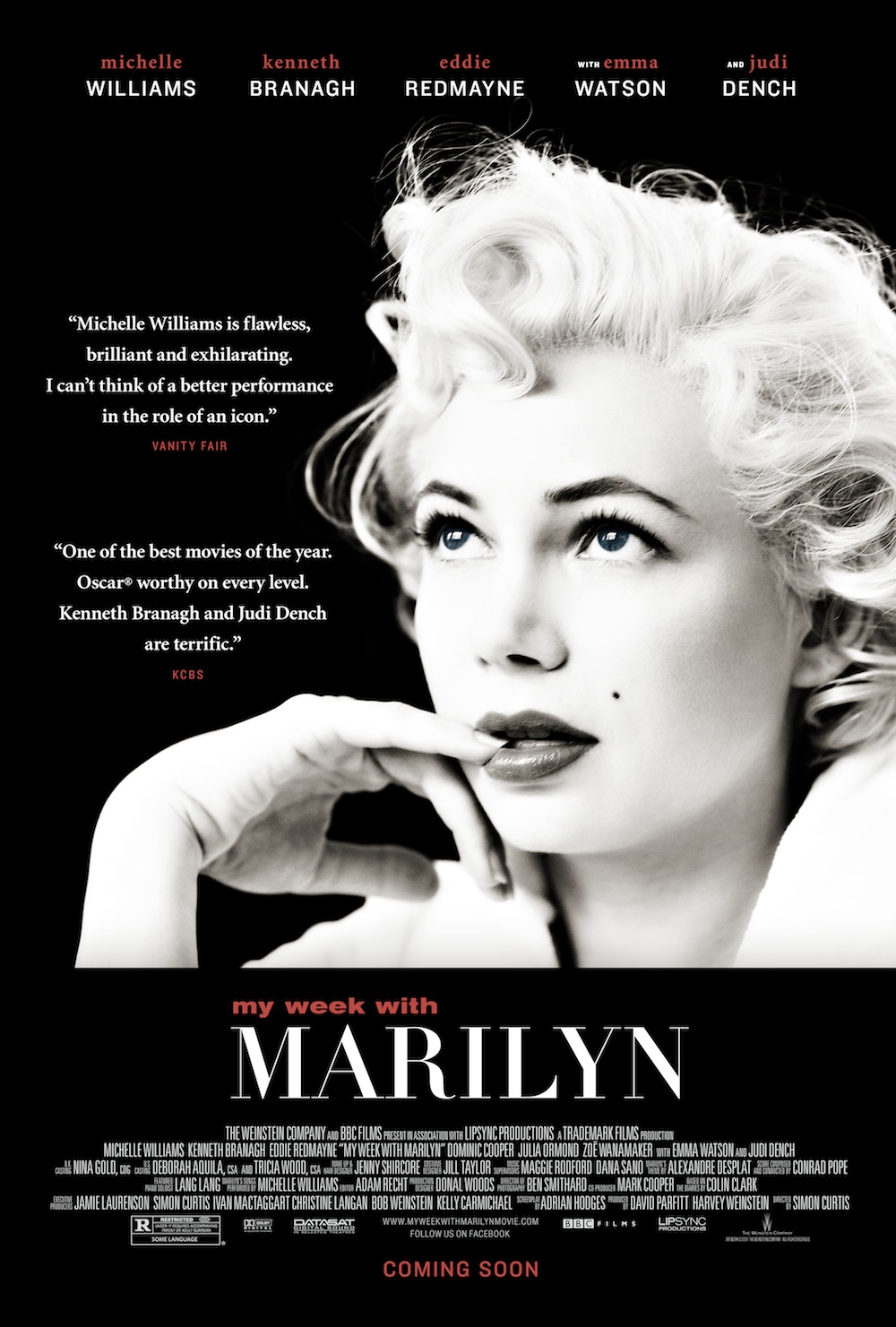
My Week With Marilyn

It has a certain surface charm to it, particularly if you're interested in old movies and movie stars. But like Marilyn Monroe herself, My Week With Marilyn isn't that deep or that interesting. Nor is Michelle Williams's performance something to write home about. She's not embarrassing or inept, just unaffecting. She merely rustles up images of the real thing, who, we're reminded, was actually dull. Her inner circle may have sucked up to her like she was a brilliantly innovative and intellectual devotee to the craft of acting, but the bottom line is that people were fascinated with Monroe because they wanted to have sex with her or because they wanted to be like her, and that was why she was famous and adored (and hated, too, I imagine). The film offers up the classic "I'm-beautiful-so-no-one-thinks-I-can-act" portrait of Marilyn but declines to comment on it. This movie tries to make an awards grab without any fingers.

The "my" in the title is Colin Clive (Eddie Redmayne), a British film buff of a privileged family background who lands himself a job as third assistant director on the set of The Prince and the Showgirl (1957), which was directed by and co-starring Laurence Olivier. Redmayne's performance failed to win me over to his character, who just seemed like a spectator throughout the movie. His clunky narration at the beginning tries to rush us through his efforts to ingratiate himself with the British movie studio operated by Olivier. But his character doesn't at all appear to be fleshed out properly. He's just a kid with a wide-eyed love of movies, and his love never really comes across on the screen. He can smile and look entranced, but his movie love isn't infectious the way it ought to be.

Playing Olivier, Kenneth Branagh nails the voice and even manages to convince you that he looks like Olivier, midway through the production. Julia Ormond doesn't fare as well portraying Vivien Leigh. I just couldn't buy it. Maybe I'm not familiar enough with what Leigh looked like and sounded like off the screen (since most of us know her from her performances as deluded Southern belles).

The problem with My Week With Marilyn is that it's too bowled over by its subject matter, and expects us to feel the same without trying to win us over. The closest it gets to achieving this is during the brief moments where Williams performs two songs. The movie is momentarily transformed into something with real movement and passion and fun. But it doesn't last, and for most of the time, we're just supposed to sit back and adore Michelle Williams as Marilyn Monroe. I don't think anybody took into account the possibility that some of us don't care about people's bizarre nostalgic obsession with a Hollywood bombshell. There are much more interesting actresses from that era. And Branagh's performance as Olivier, which is probably the most interesting aspect of the movie, will likely be ignored.

With Judi Dench as the actress Sybil Thorndyke, Emma Watson (who needs to stick to playing kids until she actually starts to resemble an adult) as a wardrobe assistant, Dougray Scott as Arthur Miller, Dominic Cooper as Milton Greene, Marilyn's assistant, and Zoe Wanamaker, as Paula Strasberg, daughter of Lee and acting coach of Marilyn. Directed by Simon Curtis.

June 16, 2011

Jane Eyre

A compact adaptation of Charlotte Bronte's semi-gothic romance, directed by Cary Fukunaga and written by Moira Buffini. It's hard to fathom the skill involved in telling Jane Eyre under two hours without missing the subtle, deliberately paced story elements which have made the book such an enduring tale. What the movie lacks as far as development it makes up for in visual energy and pace. It captures the grimness of the plight of women--particularly lower-class women--and yet there's an ethereal lightness that Adriano Goldman captures in his camera work. He brings a breathtaking sense of vitality to the new Jane Eyre.

The casting is spot on. As Jane, Mia Wasikowska knows how to convey the turbulent spirit of her character. Her passion refuses to be quelled by social conventions. And yet she refuses to disrespect herself or her sense of right and wrong. As Rochester, Michael Fassbender has the right mixture of rugged incisiveness and vulnerability. I think Charlotte Bronte would agree that Rochester is a dick, but Jane somehow sees past the irritating aspects of his personality to the good inside him, the tortured soul.

During the fateful wedding scene (I'll avoid spoilers for those of you who haven't read the novel or seen any of the other film adaptations), I laughed because it seems one of the fixations of Victorian literature has been the tortured hero, the man with a deep, dark secret. It's always such a shock to everyone else, or at least to the heroine, who's so innocent, so unspoiled, that she could never imagine some other kind of life for her darling husband-to-be. Men have the remarkable quality of being both earnestly guilty for our actions and ravenously hungry for more. Robert Louis Stevenson's Jekyll/Hyde character is perhaps one of the best embodiments of this in all of pop literature. Bronte's Rochester is another. He's pure appetite.

Jane makes it plain in the movie that she might be just like him if she could. The constraints put on women at the time forbid this, of course, and the movie is a testament to how wretched was the condition of most women. They were taught propaganda by cruel, hard Calvinists without a speck of compassion in their veins. Jane refuses to believe the propaganda, and Mia Wasikowska somehow manages to convey all the complex emotions of the character with very little dialogue to put her feelings into words. She's a woman who thinks and feels so much more than she can say, and the movie itself is the same way. There's so much tacit emotion within the frames, so much that cannot be contained by the frames. You feel that the makers could have done something even more spectacular with an original work. Adapting Victorian novels seems almost like an obstacle, except that it allows us to experience a kind of oppression (and repression) we might not otherwise understand.

I don't want to spend too much time comparing Jane Eyre the movie to Jane Eyre the book. I think that's an unfair way to look at the latest incarnation of the Bronte story, because I think we should evaluate the movie for what it is, rather than what it isn't. We can't fault the filmmakers for not making a direct translation. What would be the point of making the movie, then? What we can be glad for is a literate, passionate yet controlled movie that isn't bogged down in exposition, and somehow manages to capture a magnetic sense of lyricism. There's not really any romanticism about the past. There's the picture of two souls who feel lost without each other. They're spiritually connected. Near the end, St. John (pronounced Sin Jin) lightly mocks Jane for speaking to Rochester even though he's nowhere nearby. St. John asks incredulously, "why are you talking to the air?" Jane feels a connection to him, an urgent calling. St. John, a devout minister and missionary, whole-heartedly believes in spiritual connections, but not that kind. He's unable or unwilling to consider the possibility. Jane, on the other hand, is willing. She doesn't shut life out, as much as life has tried to shut her out.

Judi Dench plays the head housekeeper Mrs. Fairfax; Jamie Bell plays the devout preacher St. John; Imogen Poots is Rochester's vapid flirt, Blanche Ingram; Sally Hawkins plays Jane's unfeeling Aunt Reed; and Romy Settbon plays Adele, Rochester's ward.

Playing exclusively at 5 Pointes Theatre thru June 23!