I was surprised by how much I enjoyed Dead Man Down, which stars Colin Farrell and Noomi Rapace as two strangers, both looking for revenge. Farrell plays Victor, whose wife and daughter were killed by gangster Terrence Howard's underlings, who left Victor for dead. Aided by the fact that none of them recognize his face, Victor joins their criminal operation as part of his elaborate plan to carry out vengeance. Rapace plays Beatrice, Victor's neighbor whose apartment parallels his; they meet on their balconies, and eventually she explains that she saw him killing someone, and needs him to kill the man who injured her in a car crash that ruined her face.
The screenplay by J.H. Wyman deserves much credit for making Dead Man Down a deliberately paced, exciting, intelligent thriller. I was expecting nonstop violence and carnage. (There are a few brutal scenes that feel gratuitous, but they're not as bad as you might have been expecting from the theatrical trailers.) Instead, this is a movie that seeks to actually explore a character's deep-set motives to kill. It's not a morality tale about the pitfalls of revenge, though. Much to its credit, this film sticks to telling its lurid crime tale.
Watching Victor's labyrinthine scheme unfold is a pleasure, even if the movie tends to be deadly serious at all times. (A little more humor would have lightened the mood considerably, but we seem to be living in an age where humor mustn't interfere with the ferociousness of the modern thriller, which seems impenetrable to anything that doesn't add to its moroseness.) Part of Victor's plan involves sending creepy packages to Howard in the mail, which include cryptic messages and small pieces of a photograph cut up like a puzzle. He's calculated his mind game to play out right down to the wire, and it's this aspect of Dead Man Down that makes it stand out from the usual drek.
Colin Farrell isn't particularly magnetic in Dead Man Down, but his dark eyes give him that jaded puppy dog look. He doesn't have to do much to elicit our sympathy. Dominic Cooper really shines as his buddy, a fellow new recruit to Howard's operation, who is himself a family man. Cooper's character seems a bit naive about the world into which he's entered, but he's determined to make a good impression with his boss, by doing everything he can to track down the person who's sending Howard those creepy messages. Noomi Rapace continues to exude a sort of enigmatic wistfulness. She's got some fire in her blood, though, and she lets a little of that come through her performance as Beatrice.
With Isabelle Huppert (as Beatrice's mother), Luis Da Silva, Wade Barrett, Franky G, F. Murray Abraham, and Armand Assente. Directed by Niels Arden Oplev (who helmed the Swedish Girl With the Dragon Tattoo). 115 min. ★★★
Showing posts with label Dominic Cooper. Show all posts
March 09, 2013
July 03, 2012
Abraham Lincoln: Vampire Hunter
Dreadful. The cast is a fairly capable assortment of actors: Benjamin Walker as Abraham Lincoln, whose secret life as a vampire killer this movie (and the book it was based on) seeks to expose; Dominic Cooper, as the wise, good vampire who trains Abe to fight the teeming droves of bloodsuckers; Mary Elizabeth Winstead as Mary Todd; and Anthony Mackie as Abe's longtime friend. The film is heavy-handed, adapted by author Seth Grahame-Smith from his novel. Smith demonstrated his ineptitude as a screenwriter in the earlier Dark Shadows. Here he confirms his inability to do anything different, as vampires remain his subject matter, only Abraham Lincoln doesn't try to be funny, where Dark Shadows made every attempt (and failed). Walker is a pretty convincing Abe Lincoln, but he's also convincing as a sort of 19th century ass-kicking action hero, and that's a rare combination. He could have carried this movie if there'd been any movie to carry, and Dominic Cooper has a wonderfully seedy look. He really belongs to the age of 1940s gangster movies, where he would have spent most of his career playing a hood or a failed prizefighter..
But the movie itself is rife with missed opportunities. It takes itself deadly serious, which is a preposterous way to approach an already preposterous storyline. Vampires are responsible for the South's near-victory in the Civil War, and Lincoln himself changed the course of history by implementing ammunition made of silver (to kill an army of vampires encroaching upon Union turf). Not only does it lack humor, the scare scenes aren't handled with any finesse. Most of the time, things move too fast for you to get a sense of what's going on, who's doing what to whom. The editing is to blame, perhaps, as well as the blurry camera work, and the dark lighting. (It's really not atmospheric if you can't see.) The movie itself seems to have been made entirely via computer, so there isn't a hint of reality to it. You can never really fall for its tricks because you're so aware of the phoniness of it all. How can you convince an audience to believe such an asinine premise without a genuine-looking visual design?
It's offensive enough when movies are poorly made, but even more so when you get the feeling that the filmmakers don't care (or perhaps don't know) to make an effort. There's no plotting to build the story. Lincoln's training with his vampire-killing instructor Cooper is completed within fifteen minutes of the movie's beginning, and it feels disingenuous, too soon. It also recalls every bad montage of the hero preparing for battle in every bad action movie ever made. It's as though the creators decided you'd already seen that before. The filmmakers don't bother to develop these scenes, or the relationships between the characters. This isn't a point to avoid redundancy, but rather a lazy man's excuse for quick-and-dirty story-telling, and we're never really able to develop an affection for "Lincoln." What little interest we have in him is through Walker's performance. But the cast is rendered less effective by the bummer of a movie that ensnares them in blandly conceived action sequences and a below-average script that's full of grandiose emotions but no brains to sort them out coherently.
Directed by Timur Berkmambetov. With Rufus Sewell and Martin Csokas.
December 26, 2011
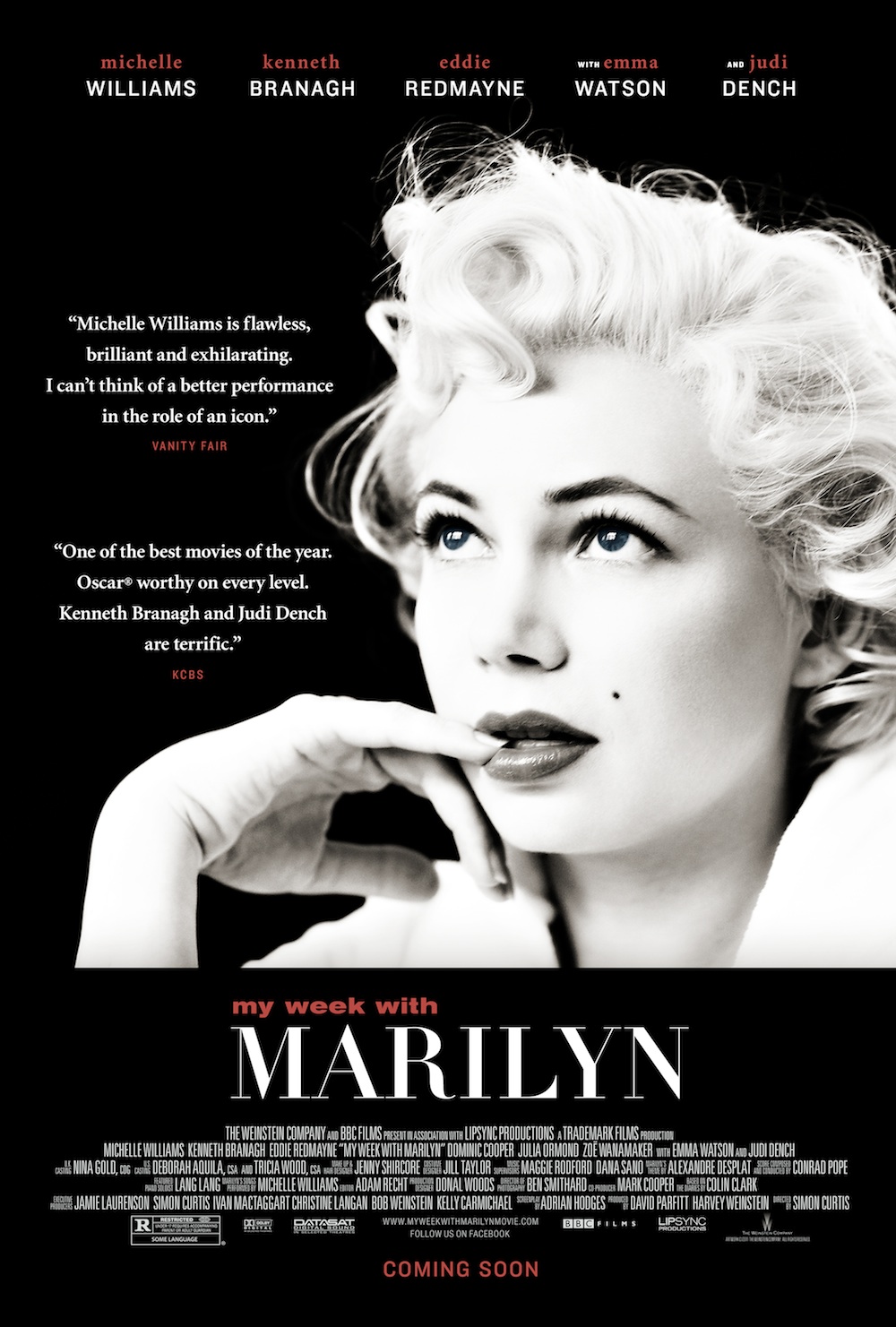
My Week With Marilyn
It has a certain surface charm to it, particularly if you're interested in old movies and movie stars. But like Marilyn Monroe herself, My Week With Marilyn isn't that deep or that interesting. Nor is Michelle Williams's performance something to write home about. She's not embarrassing or inept, just unaffecting. She merely rustles up images of the real thing, who, we're reminded, was actually dull. Her inner circle may have sucked up to her like she was a brilliantly innovative and intellectual devotee to the craft of acting, but the bottom line is that people were fascinated with Monroe because they wanted to have sex with her or because they wanted to be like her, and that was why she was famous and adored (and hated, too, I imagine). The film offers up the classic "I'm-beautiful-so-no-one-thinks-I-can-act" portrait of Marilyn but declines to comment on it. This movie tries to make an awards grab without any fingers.
The "my" in the title is Colin Clive (Eddie Redmayne), a British film buff of a privileged family background who lands himself a job as third assistant director on the set of The Prince and the Showgirl (1957), which was directed by and co-starring Laurence Olivier. Redmayne's performance failed to win me over to his character, who just seemed like a spectator throughout the movie. His clunky narration at the beginning tries to rush us through his efforts to ingratiate himself with the British movie studio operated by Olivier. But his character doesn't at all appear to be fleshed out properly. He's just a kid with a wide-eyed love of movies, and his love never really comes across on the screen. He can smile and look entranced, but his movie love isn't infectious the way it ought to be.
Playing Olivier, Kenneth Branagh nails the voice and even manages to convince you that he looks like Olivier, midway through the production. Julia Ormond doesn't fare as well portraying Vivien Leigh. I just couldn't buy it. Maybe I'm not familiar enough with what Leigh looked like and sounded like off the screen (since most of us know her from her performances as deluded Southern belles).
The problem with My Week With Marilyn is that it's too bowled over by its subject matter, and expects us to feel the same without trying to win us over. The closest it gets to achieving this is during the brief moments where Williams performs two songs. The movie is momentarily transformed into something with real movement and passion and fun. But it doesn't last, and for most of the time, we're just supposed to sit back and adore Michelle Williams as Marilyn Monroe. I don't think anybody took into account the possibility that some of us don't care about people's bizarre nostalgic obsession with a Hollywood bombshell. There are much more interesting actresses from that era. And Branagh's performance as Olivier, which is probably the most interesting aspect of the movie, will likely be ignored.
With Judi Dench as the actress Sybil Thorndyke, Emma Watson (who needs to stick to playing kids until she actually starts to resemble an adult) as a wardrobe assistant, Dougray Scott as Arthur Miller, Dominic Cooper as Milton Greene, Marilyn's assistant, and Zoe Wanamaker, as Paula Strasberg, daughter of Lee and acting coach of Marilyn. Directed by Simon Curtis.
June 19, 2010
An Education
Carey Mulligan plays a curious young woman growing up in Britain who falls in love with a man some ten years older than her (Peter Sarsgaard). She sees him as sophisticated and lavish and fun. But his carefree lifestyle comes at a high price. The title, An Education, serves as both a candid synopsis of this movie's plot as well as a nod to English novels of old that purported to teach women how to behave, what to think, and how to live. This movie asks the question: why do we teach our young people (particularly women) the things we teach them? What kinds of ideals do we hand down to them and with what expectations? Mulligan's character confronts these questions herself and lives through them in a poignant and intelligent movie with a heart like its heroine: equal parts soft, tough, naive, witty, stubborn, vulnerable, and resilient. With Olivia Williams, Alfred Molina, Cara Seymour, Dominic Cooper, Rosamund Pike, and Emma Thompson. Directed by Lone Scherfig. ★★★
Subscribe to:
Posts (Atom)