Showing posts with label Michelle Williams. Show all posts

December 09, 2016

"Manchester by the Sea" is the feel-sad movie of the year.


With Manchester by the Sea, writer-director Kenneth Lonergan returns as the master of the sad family drama, although after you watch a Kenneth Lonergan movie, you start to wonder if there’s any other kind. What sets Lonergan apart from so many other filmmakers is his deep commitment to the moral failings of his characters. We want them to wake up, to change their lives for the better, to say “I’m sorry” and “I love you”, but so many of them “just can’t beat it,” as Lee, the main character in Manchester, finally admits. 

Lonergan’s directing debut, You Can Count on Me, was the gem of 2000, a supposedly bad year for movies, that featured wonderful, heartfelt, and delightfully nutty performances from Laura Linney and Mark Ruffalo as a dysfunctional brother and sister coming to terms with the tragic deaths of their parents—when they were small children—and so many other things that have happened to them in the subsequent twenty years of their lives. Manchester By the Sea likewise hinges on several tragedies, one of them in the present (the death of Lee’s brother Joe, played by Kyle Chandler in flashback), and one from the past, rearing its head like a specter and consuming Lee apparently for good.

As Lee, Casey Affleck gives a heartbreaking performance. In an early scene, he’s drinking at a bar and erupts in anger at two strangers, because they're staring at him. The chip on Lee's shoulder weighs him down, and anger is the only emotion he can produce; it wells up uncontrollably and spills out into the lives of everyone around him. But we get the impression Lee’s always been sort of an asshole, even before all the funerals that have left him emotionally dead. He’s a gruff, tough, wise-talking blue-collar boy from Manchester, Massachusetts, and when he’s called back to his hometown (now he’s a handyman living in Quincy, just outside Boston) because of Joe’s unexpected death, everyone knows him, and quite a few people mutter under their breath, “that was him. Lee Chandler.” 

The film revolves around the relationship between Lee and his 16-year-old nephew, Patrick (Lucas Hedges, giving a funny, salty, and sharp performance). Lee reluctantly assumes guardianship over his nephew, and the two of them eke out some kind of existence, although Lee keeps threatening to move them back to Boston, despite the fact that Patrick’s life—his two girlfriends, his athletics, his rock band, and his dad’s boat, which has been left to him—are all there in Manchester.

But there’s too much life in Manchester for Lee, or too much death, rather. As the two of them drive to a neighboring town to arrange Joe’s memorial, they pass a graveyard, and Lee remarks to Patrick, “there’s no funeral home in Manchester, but the cemetery’s here.” Manchester itself becomes a monument to Lee’s grief, and to the life he once had with his children and his ex-wife Randi (played by Michelle Williams, whose performance is so good she even wrings a few tears out of Affleck’s hardened Lee). 

And even though Manchester by the Sea is sure to squeeze the moisture out of its audience by the gallon, the film isn’t just a somber tearjerker. Lonergan is too invested in the humanity of his characters to leave out humor, even at its darkest, like when, in a flashback, a doctor tells Joe he has congestive heart failure. “It’s a bad disease,” the doctor says, trying to be honest and sounding too glib; “What’s a good disease?” Joe asks, and Joe’s wife, Elise, storms out of the hospital room, unable to laugh at such a frightening moment. Patrick, though grieving his father's death, doesn't stop being a teenage boy: his multiple attempted conquests with one of his girlfriends comes to mind, or the moments when he scolds his uncle for being socially awkward, or when, during Joe’s funeral, we can hear the vibrations of Patrick’s cell phone from a text he’s receiving, layered under the classical piece that scores the entire sequence. 

Lonergan masterfully curates the music for certain dramatic sections of the film, including the afore-mentioned funeral, during which Lee and Patrick greet numerous guests, among them Randi, who's remarried and expecting another child. Just about any dialogue Lonergan might invent would probably be trite or at the very least repetitive; the music in these scenes (he uses Handel, Massenet, Albinoni, and Poulenc) speaks something truer than words, on an emotionally true level that deepens our own response, letting these composers' music fill in the emotional beats: such juxtapositions could easily veer toward the self-important or the histrionic, but Lonergan knows the line of tragedy and comedy and he and his actors walk it with an astonishing finesse. And in the process, the film becomes all the more personal to the viewer. These characters don't do what we expect them to in movies; they do what they do, because they've become as human as anyone we know in real life. That's what makes the hurt so good. 

Indeed, Manchester by the Sea will tear out your heart and put it back and stitch you up. It won’t tell you it loves you, but it will love you in its own way, perhaps with its remarkable mixture of brutal honesty and tenderness. There’s no better film to see during the Christmas season, when the pressure to be happy is unbearable, and you need a beautifully made, perfectly structured feel-sad movie to keep you company. I loved it. 

With Gretchen Mol, C. J. Wilson, Matthew Broderick, Kara Hayward, and Erica McDermott.

March 20, 2013

Oz the Great and Powerful

The first and last thirty minutes of Oz the Great and Powerful are funny and clever, and James Franco's deliberately corny performance works well for the movie. The middle section sags, as Franco, playing Oz, the con man from Kansas who is magically transported--via tornado--from Kansas to Oz, is sent out by two good witches to destroy a wicked one.

James Franco is just the man for this kind of movie. With his wide-eyed stoner look, Franco is amiable but also tongue-in-cheek. He turns Oz into an endearing snake oil salesman who has dreams of emulating Harry Houdini and Thomas Edison, but feels constrained by the cynical frontier-people of the Midwest. Once in Oz, he encounters people who have real magic powers, but are so trusting that they're easily conned into believing his yarns.

The problem is that the story feels too much like a rehash of The Wizard of Oz. Only it's not nearly efficient enough to retread such familiar turf. Worse, the film is full of cutesy characters, including Franco's flying monkey sidekick and a tug-at-your-heartstrings china girl. (I kept hoping someone would smash her, and groaned inwardly when I realized she was to be a major character.)

It's surprising to see a director like Sam Raimi churning out such commercial material, except that he's spent the last decade making the Spider-Man movies. Probably it would have been even less fun with a more conventional director. Raimi is trying to out-Tim Burton Tim Burton. But he also takes the material more seriously than Burton has done in some of his recent work (like the abysmal Dark Shadows). There's a mixture of reverence and deliberate artifice at work here, only the two fail to connect the movie. It's a bit disjointed. Is it a silly kid's movie? A wide-eyed adventure/homage to a classic American fable? A parody? It wants to be all of them, perhaps, but never really makes up its mind what it's going to do with such ambitions.

At the same time, there are bits of humor that manage to find their way into the script, and these help loosen up some of the dry spots in Oz, which has visual opulence to spare, but often finds itself lacking in true imagination. (Also, I really enjoyed the finale, in which Oz uses his tricks to fool the witches. It was a fun way to end the movie and breathe some life into it.)

[Spoilers in next paragraph]

The witches are interesting: Michele Williams looks a little like Kim Basinger. She plays Glinda: the exceedingly good and somewhat naive witch. Mila Kunis and Rachel Weisz play the bad witches. Kunis is hard to take in anything because she constantly reminds me of her character from Family Guy, and she's not very intimidating when she transforms into the green-skinned Wicked Witch of the West. I kept wishing for Margaret Hamilton (the original Wicked Witch), so terrifyingly good. But Weisz is an absolute delight. I felt that she relished her part, and she's so gorgeous that it makes her a very enjoyable villain.

With Zach Braff, in a small role as Franco's assistant back in Kansas (and the voice of the annoying monkey), Joey King, Tim Holmes, Bill Cobbs, Tony Cox, Abigail Spencer, and Bruce Campbell in a cameo as one of the guards in the Emerald City. Culled together from L. Frank Baum's various Oz books by screenwriters David Lindsay-Abaire and Mitchell Kapner. 127 min. ★★

December 26, 2011

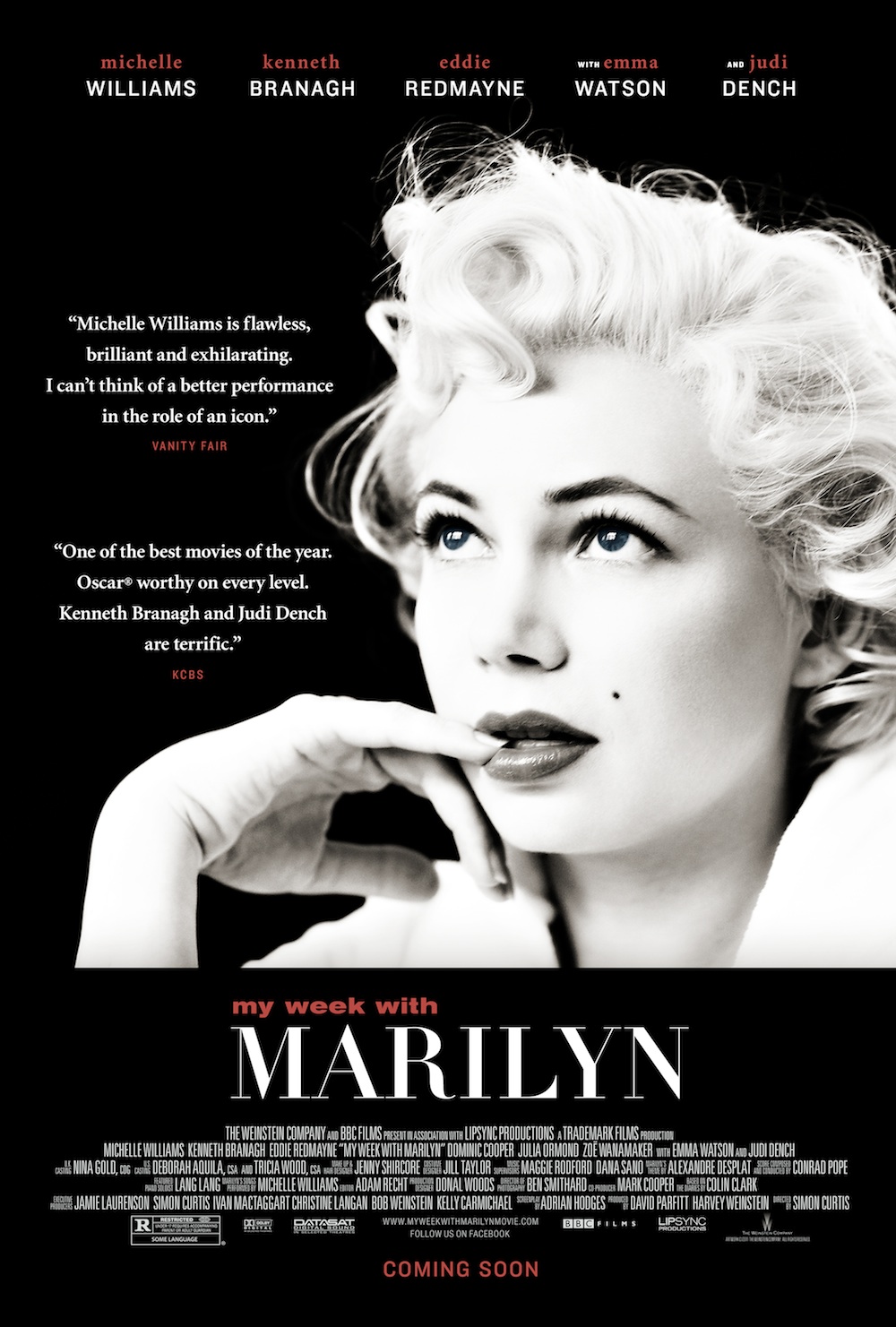
My Week With Marilyn

It has a certain surface charm to it, particularly if you're interested in old movies and movie stars. But like Marilyn Monroe herself, My Week With Marilyn isn't that deep or that interesting. Nor is Michelle Williams's performance something to write home about. She's not embarrassing or inept, just unaffecting. She merely rustles up images of the real thing, who, we're reminded, was actually dull. Her inner circle may have sucked up to her like she was a brilliantly innovative and intellectual devotee to the craft of acting, but the bottom line is that people were fascinated with Monroe because they wanted to have sex with her or because they wanted to be like her, and that was why she was famous and adored (and hated, too, I imagine). The film offers up the classic "I'm-beautiful-so-no-one-thinks-I-can-act" portrait of Marilyn but declines to comment on it. This movie tries to make an awards grab without any fingers.

The "my" in the title is Colin Clive (Eddie Redmayne), a British film buff of a privileged family background who lands himself a job as third assistant director on the set of The Prince and the Showgirl (1957), which was directed by and co-starring Laurence Olivier. Redmayne's performance failed to win me over to his character, who just seemed like a spectator throughout the movie. His clunky narration at the beginning tries to rush us through his efforts to ingratiate himself with the British movie studio operated by Olivier. But his character doesn't at all appear to be fleshed out properly. He's just a kid with a wide-eyed love of movies, and his love never really comes across on the screen. He can smile and look entranced, but his movie love isn't infectious the way it ought to be.

Playing Olivier, Kenneth Branagh nails the voice and even manages to convince you that he looks like Olivier, midway through the production. Julia Ormond doesn't fare as well portraying Vivien Leigh. I just couldn't buy it. Maybe I'm not familiar enough with what Leigh looked like and sounded like off the screen (since most of us know her from her performances as deluded Southern belles).

The problem with My Week With Marilyn is that it's too bowled over by its subject matter, and expects us to feel the same without trying to win us over. The closest it gets to achieving this is during the brief moments where Williams performs two songs. The movie is momentarily transformed into something with real movement and passion and fun. But it doesn't last, and for most of the time, we're just supposed to sit back and adore Michelle Williams as Marilyn Monroe. I don't think anybody took into account the possibility that some of us don't care about people's bizarre nostalgic obsession with a Hollywood bombshell. There are much more interesting actresses from that era. And Branagh's performance as Olivier, which is probably the most interesting aspect of the movie, will likely be ignored.

With Judi Dench as the actress Sybil Thorndyke, Emma Watson (who needs to stick to playing kids until she actually starts to resemble an adult) as a wardrobe assistant, Dougray Scott as Arthur Miller, Dominic Cooper as Milton Greene, Marilyn's assistant, and Zoe Wanamaker, as Paula Strasberg, daughter of Lee and acting coach of Marilyn. Directed by Simon Curtis.

December 21, 2011

Meek's Cutoff

Meek's Cutoff (2010) is about a harrowing journey along the Oregon Trail. The party of eight is lost, and their supposed guide, Stephen Meek (Bruce Greenwood), doesn't have a clue where they're going (although he tries to maintain the illusion that he's leading them to the promised land). It's a demystified Western. The cowboy isn't the hero, the Indian doesn't miraculously know English or save the day, and most of the characters are impotent.

As impressive and admirable a picture as this may be with its sparseness and economy and gritty realism, it's more a test of endurance than a piece of entertainment. It works out like a short story you read without feeling anything. Michelle Williams's performance comes through but only because her character is written to be the strong one. Everyone else is practically mute.

With Will Patton, Paul Dano, and Rod Rondeaux. Written by Jon Raymond. Directed by Kelly Reichardt.

June 30, 2011

Shutter Island

-->
Somehow I missed seeing Shutter Island in theaters, where it must have been all the more exciting to experience. Leonardo DiCaprio plays a marshal who journeys, by ferry, to a foreboding island off the New England coast, called Shutter Island. On it is an ominous facility that functions as a lunatic asylum, run by the calm, collected, and creepy Dr. Cawley (played with stiff, serene menace by Ben Kingsley). DiCaprio, along with his partner (Mark Ruffalo), has come to help locate an escaped patient. The people on Shutter Island are totally deranged, so it's a dangerous situation. Director Martin Scorsese is intent on keeping you on edge from start to finish. However, I found myself almost completely relaxed. I enjoyed the plot and how it unraveled, and there were suspenseful moments, but there wasn't the unbearable tension and anticipation you might expect from a movie like this. At least, I didn't feel it.

Perhaps it's because from the word go I was expecting some kind of bizarre, shocking plot twist. We've--audiences--been conditioned to expect such things. I think modern audiences can look back to The Sixth Sense as the moment we were so embarrassingly (or pleasurably?) fooled by a movie. Of course, it's been done dozens of times before, but in recent movie memory that is the movie that stands out for sheer tom-foolery. Hitchcock did it with Psycho. More recently than that, Jonathan Demme did it at the end of The Silence of the Lambs.

Audiences these days seem to fancy themselves uber-sophisticated when it comes to figuring thrillers out before they reveal themselves to us, yet desperately in need of the kind of movie that takes us along for the ride and completely dupes us. Thrillers, in that sense, deliver the most visceral and exciting experience that we get from movies. We love stories because we love watching them unfold, and the suspense makes the work of an audience member akin to the work of a detective, fetching clues and trying to make guesses about the outcomes, the motivations, and the mysteries, of movies. This must offer at least a partial explanation for how well horror movies--even dumb ones--do at the box office.

A thriller is almost a sure thing as far as making money is concerned, especially if you can get Leonardo DiCaprio to star and Martin Scorsese to direct. Scorsese piles on the atmosphere here, and yet the movie has stark, rich colors to it, colors you don't typically find in a dark and eerie suspense yarn. He goes against that film noir dark-alley quality. Even the scenes in usually dimly lit places are disturbingly well-lit. DiCaprio lights a match that might as well be a spotlight. It never seems to burn out, either.

The opening shot looks obviously computer-generated, though, and that's one of the things modern movies struggle to fight. Filmmakers may save a lot of money to construct the scene virtually, but there's often a phoniness to the scene that floats to the surface, and you wonder how the actors can really trick themselves into believing they're on a real boat and a real ocean. But, for all that, the opening shot also retains a noirish quality, thanks mainly to the costumes. DiCaprio and Ruffalo wearing their hats and their trenchcoats look like two separate Dana Andrews in Laura. They're bound and determined to figure out the mystery that confronts them, but then the movie takes on a sort of Key Largo turn: a magnificent storm disarms the asylum's security system and the inmates start wandering about. All of them are homicidal maniacs (or very close), we're told.

If Shutter Island doesn't blow anyone out of the water, at least it's refreshing to see Scorsese making a movie that's just out to entertain you. He's not trying to do something important and Oscar-worthy like that awful mess The Aviator, or even The Departed, which finally got him what many considered a long-overdue Academy Award. The movie is a hallucinatory mess of a good time, nowhere near as bloated as the misfired Christopher Nolan movie Inception. It's just a crackling, old-fashioned thriller. From the novel by Dennis Lehane. The supporting cast is appropriately nightmarish: Max Von Sydow, Michelle Williams, Emily Mortimer, Patricia Clarkson, Jackie Earle Haley, and John Carroll Lynch.