Showing posts with label Emma Watson. Show all posts

July 02, 2013

The Bling Ring

In The Bling Ring, which is about a group of bored, privileged adolescents who get their kicks sneaking into the homes of celebrities (such as Paris Hilton, Lindsay Lohan, and Orlando Bloom) and stealing their stuff, there's a kind of religious reverence for possessions and fame. The film, which is apparently based on real events, represents perhaps the most blatant product of the separate yet inseparable cults of youth and celebrity that permeate popular culture and capture the imaginations of those of us who aren't rich and famous. We're the schlubs on the outside looking in, and the impressionable teenagers are the easiest targets and the most willing participants, the most devout cult members, it would seem.

When they sneak into Paris Hilton's house, they revel in the excess of her closet, which has smaller closets and hidden compartments: walls and walls of shoes, drawers full of necklaces and bracelets, ridiculous outfits; she has a night club "room," and there are pillows with her face embroidered onto them placed on the seats of her chairs. This is all very impressive to the Bling Ring kids, who treat it like make-believe: they're the princesses trying out mother's big dresses and putting on a show. But the thrill of sneaking and stealing, the allure of never knowing exactly what they'll find, and the money they're able to make hocking some of their contraband (much of which funds a festering cocaine addiction), quickly turns their nightly outing into a kind of thrillseeking high in and of itself, one which spirals out of control in short order.

Director Sofia Coppola isn't interested in having us condemn the actions of the teenagers without condemning ourselves. She's more interested, I think, in letting the consequences play out, and capturing the reactions of the kids, most of which are pretty dismal. There's one, the one boy in the group (played by Israel Broussard), who was obviously looking for acceptance, who seems to regret his decisions. The other members don't though. In getting caught--and exposed by the media--they're finally able to achieve what they wanted all along: celebrity. The consequences are worth it for them.

The Bling Ring rather brilliantly implicates the audience in the crimes of its main characters. We who comment on the trashy magazines at the grocery store, who read all the gossip columns online, who treat our Facebook and Twitter accounts as venues for shameless bouts of narcissism, are expressing in a much more concentrated and acceptable way the kind of behavior these kids grow into. It was very easy for me to condemn them. I even rooted for the police when the inane, vapid kids were read their Miranda rights. (Let's remember--better yet, let's forget--that this ultimately pegged me as rooting for Paris Hilton.)

The Bling Ring, which is always sort of casual and mock-hip, manages to be a stinging indictment of American materialism without ever pointing a finger. (Although it's not very subtle when Leslie Mann, playing the completely bonkers mother of one of the girls, who touts the merits of The Secret and tries to pass it along to her daughters, who constantly deride her, is on screen. She becomes the hip modern mom with stunning ease.) With Katie Chang, Emma Watson, Claire Julien, and Taissa Farmiga. Written by the director; based on the article "The Suspects Wore Louboutins," by Nancy Jo Sales. 90 min. ★★★

November 12, 2012

The Perks of Being a Wallflower

In The Perks of Being a Wallflower, 15-year-old Charlie is recovering from a traumatic event in his life (the recent death of his best friend) and trying to adjust to high school. He soon finds a group of friends who haven't followed the herd mentality of adolescence, or so he thinks, and begins to find himself in them. Actually, when you read the plot of this movie in those terms, it sounds awfully cheap.

Some of the ideas in Wallflower seem so calculated to wrench out your heart that you feel writer-director Stephen Chbosky, who adapted the screenplay from his own 1999 novel, is performing the work of a surgeon, not a filmmaker. His movie resurrects a lot of the old devices and archetypes, including the hip, self-aware English teacher (Paul Rudd, more amiable than he's ever been because he doesn't appear to be trying so hard, nor does he seem as jaded as usual), and the parents who "just don't get it." Yes, Wallflower has most of the cliched ingredients of a teen drama. But yet it also has an effervescent sort of charm to it. You can't really feel any disdain for the world this film creates, because it's authentic, imaginative. Moreover, the relationships between adolescents and grown-ups and between adolescents and adolescents, is shown to be far more complex than "the parents just don't get it" or "the jocks don't talk to the geeks." It's refreshing.

Logan Lerman carries Wallflower with his wonderful performance, one of the strongest by an up-and-coming actor in recent memory. His Charlie feels the pain of everyone he knows, even of those who have caused him pain, and he can't let it go, or imagine it away. He reminded me of young Timothy Hutton in Ordinary People. Lerman makes it look so easy because he is, often, the most together of his friends (probably because he's hiding all his own problems so he won't fall apart.) The supporting cast includes Emma Watson, as Sam, the girl Charlie has a crush on, and Ezra Miller, as Patrick, Sam's step-brother, a remarkably self-aware young man who's also miserable because he's gay and has to keep his relationship with one of the football players a secret.

Wallflower is a wistful movie, one that makes you slightly depressed to have passed your teenage years, and slightly exuberant because you remember how bad they were, even if they weren't as cinematically bad as in this movie. (There are a lot of lovely moments in between the sad parts, though). I kept going back in my mind to John Hughes' movies, as they were, for me, the quintessential high school movies, even though they failed to reflect my own high school experience, which of course happened later than the 1980s. The high school experience that's reflected in Wallflower isn't in the same territory as a John Hughes movie though. It's more realistic, less sitcomish. You almost wish the John Hughes vision of high school life could be true, because it's such a fairy tale. Full of complications but all of them solved by the denouement. Wallflower won't solve the problems. It illuminates the people and leaves the problems where they are: some will go away with time, some won't. But the spirit that thrives in this joyful movie isn't nearly as temporal as those four years of prison, hell, and torment, or alternately freedom, euphoria, and excitement. And I liked that about it.

With Dylan McDermott and Kate Walsh as Charlie's parents, Johnny Simmons, Melanie Lynskey (as Charlie's Aunt Helen), Mae Whitman, Erin Wilhelmi, Joan Cusack, and Tom Savini. 102 min. ★★★½

December 26, 2011

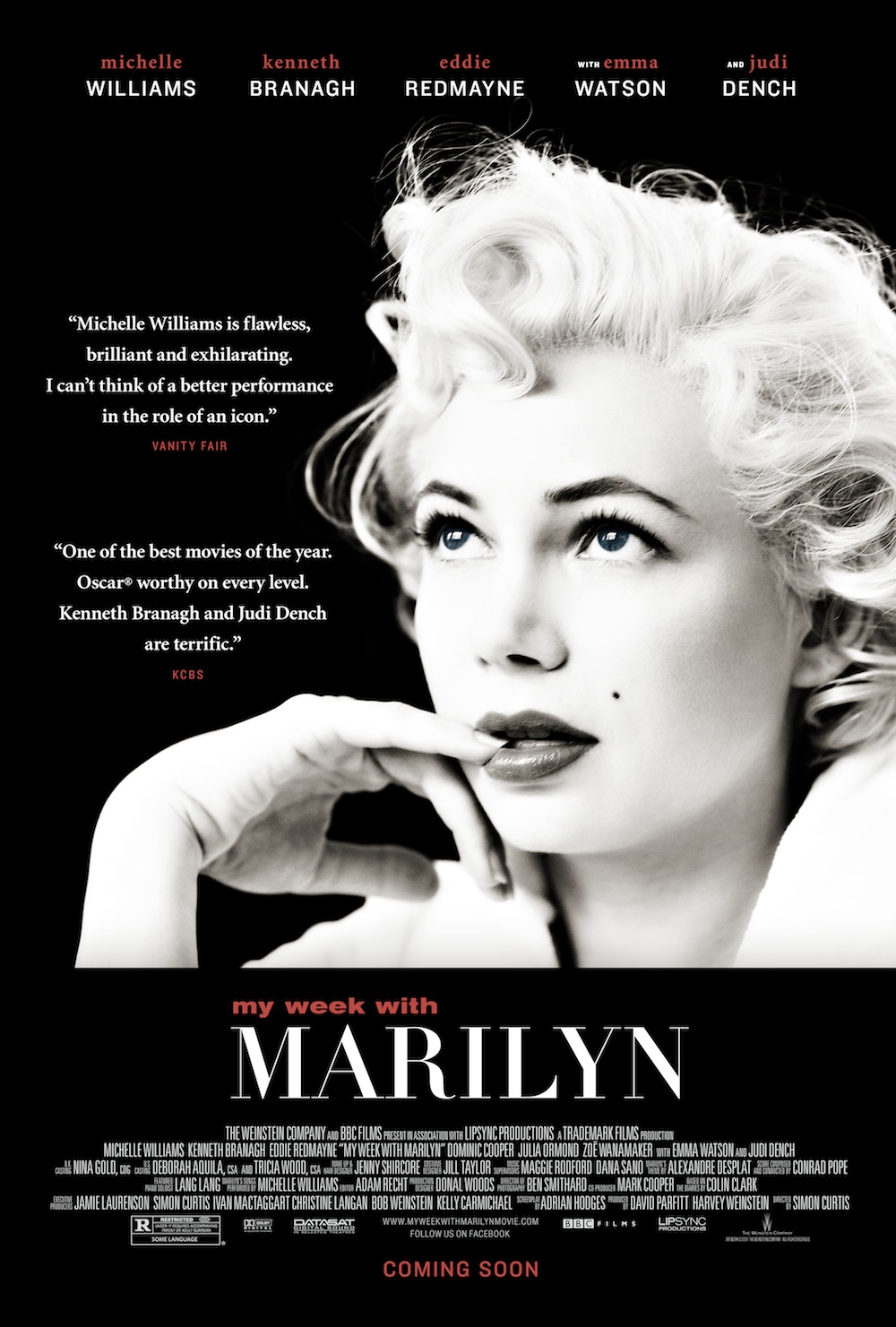
My Week With Marilyn

It has a certain surface charm to it, particularly if you're interested in old movies and movie stars. But like Marilyn Monroe herself, My Week With Marilyn isn't that deep or that interesting. Nor is Michelle Williams's performance something to write home about. She's not embarrassing or inept, just unaffecting. She merely rustles up images of the real thing, who, we're reminded, was actually dull. Her inner circle may have sucked up to her like she was a brilliantly innovative and intellectual devotee to the craft of acting, but the bottom line is that people were fascinated with Monroe because they wanted to have sex with her or because they wanted to be like her, and that was why she was famous and adored (and hated, too, I imagine). The film offers up the classic "I'm-beautiful-so-no-one-thinks-I-can-act" portrait of Marilyn but declines to comment on it. This movie tries to make an awards grab without any fingers.

The "my" in the title is Colin Clive (Eddie Redmayne), a British film buff of a privileged family background who lands himself a job as third assistant director on the set of The Prince and the Showgirl (1957), which was directed by and co-starring Laurence Olivier. Redmayne's performance failed to win me over to his character, who just seemed like a spectator throughout the movie. His clunky narration at the beginning tries to rush us through his efforts to ingratiate himself with the British movie studio operated by Olivier. But his character doesn't at all appear to be fleshed out properly. He's just a kid with a wide-eyed love of movies, and his love never really comes across on the screen. He can smile and look entranced, but his movie love isn't infectious the way it ought to be.

Playing Olivier, Kenneth Branagh nails the voice and even manages to convince you that he looks like Olivier, midway through the production. Julia Ormond doesn't fare as well portraying Vivien Leigh. I just couldn't buy it. Maybe I'm not familiar enough with what Leigh looked like and sounded like off the screen (since most of us know her from her performances as deluded Southern belles).

The problem with My Week With Marilyn is that it's too bowled over by its subject matter, and expects us to feel the same without trying to win us over. The closest it gets to achieving this is during the brief moments where Williams performs two songs. The movie is momentarily transformed into something with real movement and passion and fun. But it doesn't last, and for most of the time, we're just supposed to sit back and adore Michelle Williams as Marilyn Monroe. I don't think anybody took into account the possibility that some of us don't care about people's bizarre nostalgic obsession with a Hollywood bombshell. There are much more interesting actresses from that era. And Branagh's performance as Olivier, which is probably the most interesting aspect of the movie, will likely be ignored.

With Judi Dench as the actress Sybil Thorndyke, Emma Watson (who needs to stick to playing kids until she actually starts to resemble an adult) as a wardrobe assistant, Dougray Scott as Arthur Miller, Dominic Cooper as Milton Greene, Marilyn's assistant, and Zoe Wanamaker, as Paula Strasberg, daughter of Lee and acting coach of Marilyn. Directed by Simon Curtis.