Showing posts with label Edward Herrmann. Show all posts

February 22, 2013

The Lost Boys

An 80s cocktail, with vampires, The Lost Boys is something of a classic for those of us who grew up with it. Although, like The Goonies, it might be less enjoyable when viewed without nostalgic graciousness. It has a lot of fresh-faced young actors whose careers rose and fell in the coming years: Jason Patric and Corey Haim as two brothers who move to Santa Carla, California, with their recently divorced mom (Dianne Wiest); Corey Feldman and Jamison Newlander as two Santa Carla brothers who work in their parents' comic book store; and Kiefer Sutherland, as the head of a quartet of punk-vampires who live in the ruins of a hotel that sank into the earth during the great quake of 1906. The vampire buddies spend their nights at Santa Carla's main hangout: an amusement park located right on the beach.

The tagline of The Lost Boys is "sleep all day, party all night, never grow old, never die: it's fun to be a vampire." This is a vampire film for the MTV generation. (And these vampires do have a lot more "fun" than recent cinema's exploits into the genre. There's no policy about avoiding human prey. No kidding themselves about living in community with the not-undead. These vampires are evil, and happy about it.) Unfortunately, The Lost Boys isn't thoughtful enough to explore its own theme--the allure of eternal youth--with any finesse. This isn't a critique of youth culture or its excesses. Neither is it a celebration of youthful impressionism or recklessness. Instead, The Lost Boys, like so many other films, is an unashamed studio product, one that wants to cash in on young moviegoers. It's exploitative in that way. We're getting very mainstream vampirism here.

Lucky for us, this mainstreaming of the vampire legend works for the most part, because The Lost Boys, for all its cookie cutter edges, is still a fun, energetic movie at heart, full of witty, likable verve from its cast. It has a smartass sense of humor, punctuated by Haim's performance. His character is always ready with a well-delivered quip, usually directed at his older brother, Michael (Patric). Patric is the impressionable one, seeking approval and friendship in a new town, and willing to do anything to get it. He's sucked into the vampires' world, and it's hard not to see a comparison to the drug culture being made. In the ruins of the lost boys' lair is a large photo of Jim Morrison: iconic, surprisingly apropos. He's their idol, their inspiration.

The studio executives behind The Lost Boys were going for a hit, and nothing more, probably in response to the success of 1985's Fright Night, which was cheaply made and grossed 24,000,000 dollars. The Lost Boys made something over 30 million, and these two films ushered in another cycle of vampire-themed comic-horror films that also included Kathryn Bigelow's Near Dark (released a couple months after Lost Boys), and culminated in Buffy the Vampire Slayer and Bram Stoker's Dracula (both 1992). These movies--or more specifically, their financial success at the box office and the relative cheapness for which they can generally be made--do a lot to explain the popular culture's fascination with vampires in the last 30 years, though of course they don't explain all of it.

The allure of this sub-genre is also present in Kiefer Sutherland's performance: he's a magnetic actor, and a magnetic vampire; he's almost a cult leader, if you will, and he gets Michael to do just about anything--even literally jump off a bridge--in his quest to convert him into a bloodsucker. Then there's the Frogg brothers (Feldman and Newlander), whose dead-serious sincerity (they give Haim's character a vampire comic and assure him that it should be read like a survival manual rather than entertainment) makes The Lost Boys funny. And that's why I still enjoyed watching it tonight, after many viewings. It's the kind of horror movie you're allowed to laugh at. It never takes itself too seriously. (Although it has a few moments of excess, including some over-the-top special effects characteristic of 80s horror movies.)

Dianne Wiest is appropriately motherly (although not nearly as memorable as she would be in Bullets Over Broadway) in a mom role for which the spunky Dee Wallace (E.T., The Howling, Cujo) would have been perfect. With Barnard Hughes as the crusty old grandfather with a sharp sense of humor; Edward Herrmann as the mom's love interest, Max; Jami Gertz as Star, Michael's love interest, a half-vampire with a heart of gold; and Brooke McCarter, Alex Winter, and Billy Wirth as members of Sutherland's band of teenage nosferatus. Directed by Joel Schumacher. 97 min. 1987 ★★★
November 21, 2012

Overboard

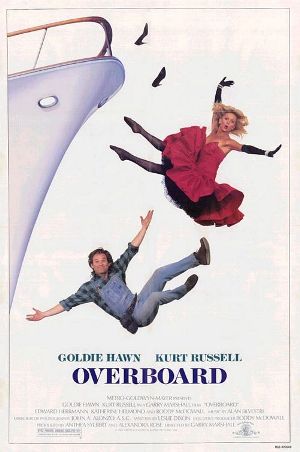
I grew up on Goldie Hawn. Overboard (1987) isn't one of her strongest vehicles, but her performance is enjoyable nonetheless. She plays a spoiled millionaire who hires a carpenter (Goldie's real-life significant other, Kurt Russell) to remodel the bedroom closet on her yacht while the boat is docked on the coast of Oregon, awaiting engine repairs. Unhappy with the local carpenter's final product, she pushes him off the boat and into the sea. Later that night, she falls into the ocean herself (unbeknownst to her husband or any of the crew), losing her memory in the process. She's eventually picked up by another boat and taken into town for medical treatment. But when her husband decides not to claim her (she's too much of a bitch even for him), the carpenter sees an opportunity for revenge. He pretends to be her husband, and takes her home to his ramshackle house and four unruly sons, turning her into the homemaker she never was.

You will enjoy Overboard more if you can ignore some of the gaping holes in the plot. (How did he convince the hospital staff he was her husband without a shred of documentary proof?) Goldie's transformation from a bored, boring, bossy snob to a person who actually knows a hard day's work, is fun to watch, especially because she does it with such charm, and she and Kurt Russell have such chemistry.

The movie is overly sentimental and lacks any kind of dependable smartness. It's funniest when the actors have little one-liners, delivered almost under their breath, showing you that the writer, Leslie Dixon, and the director, Garry Marshall, are capable of more than formula movies when given the right material, the right ideas, and the right stars. The stars are right, but the ideas aren't clever enough to make Overboard a complete success as a comedy, even though it is funny. (It's certainly not as embarrassing as it could have been; but it's also not as intelligent or as inventive either.) Most of those 80s comedies I grew up on work because of the performances, not because of the writing or the plot. It's when you remove your focus from the acting and pay attention to the silly, obvious plot that you start finding things to quibble with.

With Roddy McDowall, Edward Herrmann, Katherine Helmond, and Michael Hagerty. 112 mins.

June 16, 2012

Big Business

Big Business (1988) stars Bette Midler and Lily Tomlin as two sets of mismatched twins. One pair grows up in New York City, and now run the conglomerate started by their father; the other grows up in West Virginia, raised in a rural community that relies economically on a nearby factory and its jobs. So, when the factory, which is owned by the New Yorkers, is threatened in a liquidation deal with an Italian investor (Michele Placido) who's planning to shut it down, the West Virginia girls head up to the Big Apple for a showdown, not knowing that their enemies are their long lost sisters.

Without its cast, Big Business is a fairly limp comedy that fails to amount to anything surprising or novel. This plot has been done before at least a handful of times (going all the way back to Shakespeare and The Comedy of Errors), including with Gene Wilder and Donald Sutherland in the French Revolution comedy Start the Revolution Without Me (1970). Bette Midler and Lily Tomlin generate most of this movie's appeal: When she's playing a domineering capitalist, Midler is sensational. She looks like she's having fun, and Tomlin gets overshadowed as the spacy sister who's out of place in the big city. (She was born to a humble West Virginia farmer and his  wife, who, from the few minutes we see of her at the beginning, must have died from the sheer exhaustion of bearing too many children.) She's felt out of place her whole life, just like the Midler who's grown up in the country, not knowing she had city life in her blood.

One of the problems of Big Business is that it gets sidetracked trying to think of ways for its four main characters not to run into each other. The four of them end up getting booked at the Plaza in neighboring hotel rooms, so director Jim Abrahams milks the mistaken identity plot line for more than it's worth. Abrahams uses the crusade against a giant corporation which threatens to destroy the economic means of a small town as an afterthought, a way to give the movie some kind of moral impetus, not to mention a sappy finale that will unite the girls who are so different from each other. It's probably the most obvious part of the movie (but might also be the reason it was such a crowd-pleaser.)

The supporting cast is terrific: Fred Ward as the rural Tomlin's clueless but devoted boyfriend, Edward Herrmann and Daniel Gerroll as the urban Midler's flunkies, Barry Primus as her ex-husband, Seth Green as her adolescent, out-of-control son, Michael Gross as the urban Tomlin's exasperated doctor boyfriend, and Deborah Rush as the New York girls' complaining mother (seen at the very beginning).