Showing posts with label 1987. Show all posts

February 08, 2016

Full Metal Jacket

Full Metal Jacket (1987) is an astonishing, hard-t0-shake Vietnam movie, one that’s essentially two separate stories smashed together. Director Stanley Kubrick, working from Gustav Hasford’s autobiographical novel The Short-Timers, turns in one of his most effective films. Full Metal Jacket is mesmerizing, sick, terrifying, and funny. It lingers in the brain like a sickness, or a joke that you understand more fully with the passage of time.

I should point out that I’ve never expected to like the films of Stanley Kubrick. It’s probably my hero worship of Pauline Kael, who panned every Kubrick film after Lolita. But ever since watching Barry Lyndon last year, I’ve discovered a real love of Kubrick’s work that makes me feel slightly shameful, perhaps because he seems like a pretentious person’s filmmaker. Barry Lyndon was surprisingly hard to shake off, as was Eyes Wide Shut, and Full Metal Jacket joins them as one of my personal favorite Kubrick films.

The movie opens with a montage of boys—young and dumb, about to be sent to basic training—getting their hair buzzed off by clippers. Then the film cuts to a basic training facility where we’re pummeled by the craftily vulgar screams of relentless drill sergeant Lee Ermey, whose performance is the prototype for the kind of asshole-power-monsters we see in movies like Whiplash (the one where J.K. Simmons plays an asshole of a music teacher, who delights in the aggressive humiliation of his students). I felt more than a little sadistic laughing at the horrifying jeers of Ermey’s character: he berates his grunts with such unmitigated, tenacious fervor that it’s hard not to laugh, until you realize the chilling effect his torment as on one particular young man, the incompetent “Pyle” (Vincet D’Onofrio), who can’t seem to do anything right, and who becomes the pariah of the group when Ermey starts punishing the other guys for his blunders. Watching Pyle lose it is truly one of the most terrifying things I’ve ever seen in a movie.

When people talk about Vietnam movies, they often obsess over the authenticity of it. Every time I turn around, someone’s telling me about the 2002 film We Were Soldiers, and how that film is the most authentic of all the Vietnam movies, according to the men who actually put their boots to the ground. That may be the case. (I wouldn’t begin to know.) But Full Metal Jacket, whether it perfectly nails an authentic depiction of the war or not, is one of the most jarring, powerful movies about war that I’ve ever seen. Kubrick of course criticizes the politics of the war, as is to be expected, but his criticism transcends the political in showing us just how much the war dehumanizes people.

Of course, the most powerful example of dehumanization happens in basic training, not in combat. It’s D’Onofrio’s transition to madness which stays with us most. The second act, which offers a well-staged descent into a war-torn town where a handful of soldiers face off against a hidden sniper, is tense and extremely well-made, even though it lacks the emotional weight of the first half. It’s still powerful, and when you consider both halves of the film together, you can sense the layers of the war as they happened to the individual soldiers, for whom basic training was a world unto itself, a place where a new identity—the identity of a nationally-vindicated killer—was forged under the auspices of protecting the American way of life.

With Matthew Modine, Arliss Howard, Adam Baldwin, Dorian Harewood, and Kevyn Major Howard. Written by Kubrick, Michael Herr, and Gustav Hasford. 

November 23, 2014

Raising Arizona

In the overrated Raising Arizona (1987), two desperate hicks steal a baby from a wealthy couple who have just given birth to quintuplets and try to raise it as their own. The second film from the Coen Brothers (following 1984's Blood Simple) is very much alive, but despite all the verve in its images, and the earnest performances of Nicolas Cage and Holly Hunter as the career criminal and police officer (respectively) who unexpectedly fall in love, there isn't much of a movie here. Or maybe there's too much movie, not enough coherence. The film is technically very impressive, the kind of work that film students might do and fool everyone into thinking they had made something truly good because of the imaginative style of their visuals. But actually, the film isn't compelling and the action doesn't add up to much. In fact, it's more than a little sadistic in that there are multiple scenes of horrible tragedies narrowly being averted: A car slams on the brakes right before running over a baby, two cars barely escapes a head-on collision, etc. The violence in Raising Arizona is cartoonish, but somehow nowhere near as funny as it is in a Merry Melody. (And even Merry Melodies had a kind of structure to them, where Raising Arizona is a hot mess, very loosely conceived.) With John Goodman, Frances McDormand, and Randall "Tex" Cobb. 

August 05, 2014

Broadcast News

Broadcast News (1987) was written and directed by James L. Brooks, one of the creators of The Mary Tyler Moore Show, which may be the greatest sitcom ever made. Brooks returned to the newsroom comedy format with Broadcast News, but with far less success. The characters in this film--there are three main ones, played by Holly Hunter, William Hurt, and Albert Brooks--somehow seem more sitcomish than the characters on Mary Tyler Moore, who were richly developed even in the show's first season, and became even more layered as the show progressed. It's apparent that Brooks, who transitioned into movies after decades of working on the small screen, was unable to create characters who worked on a cinematic level. Instead, each of them is a kind of mishmash of various yuppie traits and psychological problems.

The film opens with short introductions to the main characters as children, showing us the traits necessary for their future careers manifesting themselves even in grade school. Hurt's character, the handsome but intellectually inferior anchorman, struggles even then to compete at an academic level, and complains that he'll never succeed in life because people only like him for his looks. Holly Hunter's character, a Southern girl who's already planted in front of a typewriter, shows her spitfire zeal for telling stories and seeing beneath the surface of communication, and Brooks's character is the typical egghead kid that nobody likes.

So the film establishes these rather obvious characters and then sets them at work in a newsroom together. But it's difficult to believe that William Hurt struggles to keep up intellectually, especially because he comes to Holly Hunter, who's the producer, and complains to her that he doesn't measure up. Somehow, his self-awareness and his ambition to improve make him a less interesting character. He's almost a Ken Doll of banality. If he were Ted Baxter from The Mary Tyler Moore Show, the lovable narcissistic buffoon, we'd at least have something to laugh at.

And Albert Brooks, who made a pretty good living in the 80s playing cynical, sarcastic, smart yuppies (see Lost in America), grates on the nerves. His cockiness is a turn-off. He's more obviously arrogant than William Hurt's character, who may hide his arrogance behind a mask of fake-humility. However, he's intellectually honest, and the movie and James L. Brooks want us to prize this above all other qualities. And that's why Holly Hunter's character is so torn between the two men: One of them is handsome and "needs" her to help him be a better thinker, and the other one is smart and goes out of his way to value her as his equal. But these are such cookie-cutter 80s characters, and in so many ways, Broadcast News is such a cookie-cutter 80s movie, that I found myself increasingly less interested in the whole affair.

With Joan Cusack, Jack Nicholson, Robert Prosky, and Lois Chiles.

March 07, 2014

Prince of Darkness

Watching John Carpenter's deliciously horrible horror opus Prince of Darkness (1987) got me thinking about Christopher Nolan. Nolan, the director of such mammoth and overrated pictures as the Batman movies and Inception, has been called a great filmmaker by a lot of people who enjoy the confused rumblings of ideas going on in his films. They think that Inception is brilliant because it seems to be deep, although they may be confusing "deep" with "convoluted." They attribute their confusion to Nolan's strength as a "thinking man's director," who is so brilliant that we cannot possibly understand him. They also think he's a great storyteller whose films deserve accolades galore and all of our undivided adoration and reverence. But really, Christopher Nolan is like bad John Carpenter ramped up on an obscenely large budget.

The main difference is--and this is key--that Carpenter unashamedly loves trash, while Nolan continually tries to elevate his trash to the status of art. Carpenter's early films had a kind of rich composition to them that made them look more expensive than they were, but viewers were always conscious that his movies are what they are: well-made but simply conceived and pleasing on a somewhat juvenile level. That doesn't make them any less special, either. I adore Assault on Precinct 13 and Halloween and The Fog and Escape From New York and Christine (a bigger production, but still good, and I think, underrated).

Prince of Darkness is utter hogwash: It's a silly movie that grabs at some ideas relating to quantum physics and some other ideas relating to Christianity and then jumbles them together into a sluggishly paced and witless thriller. The script is credited to a "Martin Quatermass," which is really just a pseudonym for Carpenter, who was presumably embarrassed enough to avoid crediting himself with thinking up this hacky movie, but not enough to relinquish his director credit. It's about a bunch of researchers who become trapped inside an abandoned L.A. church that houses an ancient canister of green ooze. That ooze, we discover eventually, is...Satan. Or the powers of darkness that Satan represents. Or something. Anyway, it's pure, liquified evil that the Catholic church has kept under lock and key for 2000 years. And Donald Pleasence, as a priest, uncovers it, this horrible "secret that can no longer be kept."

The film gathers a whole bunch of people together, but we spend so little time getting to know them--scientists, divinity students, tech people, and a prestigious professor of physics played by Victor Wong--that we don't really care when they're dispatched in gruesome ways. (Carpenter never got past the slasher genre in some ways: he almost always resorted to mindless killing after Halloween.) We're also not clear on why these people have been assembled. They repeatedly ask the priest and the professor, but are given cryptic answers basically meaning "you'll know when the time is right." You get the feeling that they don't know either, because John Carpenter didn't know when he was writing it. Perhaps he thought it was obvious. We are aware that these people are studying the green ooze, but beyond that, it's anybody's guess.

There are a lot of scenes at the beginning where characters talk but we can't hear what they're saying. The ominous rock score plays over their dialogue, and at first we might be tempted to call this good filmmaking technique. It was admittedly a relief not to have the story outlined in banal exposition, the way it probably would have if this movie were being made today. But then it occurred to me that I didn't know what the hell these characters had to say in the first place, and that it didn't matter anyway. They're mere plot devices, and Carpenter's only reason for having so many characters in one relatively confined setting is so that he can kill off a bunch of them and turn those victims into mindless killers themselves, preying on the rest of the group. (This same problem of overpopulating the movie plagued Aliens, by the way. And later Prometheus.)

Prince of Darkness always seems to be building up to something, but that something never crystallizes. The movie just lies there. It's probably the Carpenter movie with the most talking. Is it ironic then that it's also the one that has the least to say? Perhaps Carpenter was just getting tired of thinking things out, or, more likely, this was a misfired attempt at doing something deeper conceptually. While I can't dismiss the movie as being self-important (it's far too ridiculous to be so), I certainly think that Carpenter was excited about some new-fangled scientific conceits and then wanted to distill them for us. This thrilling prospect gets in the way of the movie and becomes a clunky mechanism that keeps Prince of Darkness from being a success. The pulpy Los Angeles horror of Halloween and Escape From New York worked, and the fact that those movies were conceptually very simple and straightforward worked too. John Carpenter proves that ideas can actually get in the way if you don't know how to make them work for you. Christopher Nolan should watch Prince of Darkness (which is still entertaining in its badness) and take the hint.

With Jameson Parker, Lisa Blount, Dennis Dun, and Alice Cooper.

June 05, 2013

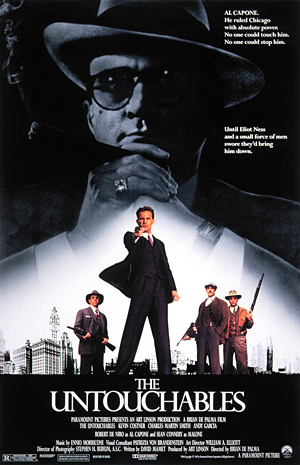
The Untouchables

After seeing The Untouchables (1987), I finally understand that joke in The Naked Gun 33 1/3, where Leslie Nielson imagines himself fending off gangsters on the stairs of the train station while a baby rolls down the steps in a carriage, its mother screaming in panic. It was lifted right from The Untouchables, and it was impossible for me to keep a straight face during that long, drawn-out scene, with the Nielson movie playing in my head. We actually see the mother mouthing the words, "My baby!" in slow motion. And let's not forget that it takes an excruciating three to four minutes of watching her struggle to get the damn carriage up the stairs before Elliott Ness begrudgingly offers her assistance, knowing that any minute the bad guys will come through the doors of the station and he'll be at a disadvantage helping this woman out.

That pretty much sums up The Untouchables: it's a drama queen of a movie, full of director Brian De Palma's tendencies toward hyperbole, and brought to a fever pitch by Ennio Morricone's score, which turns every scene into a touchdown set to an anthem. At times, the music takes on a very 80s-sounding beat via drum machine and you have to wonder how that made it to the final print.

Brian De Palma obviously tried to imbue every scene with the weight of the "I could have been a contender" speech from On the Waterfront. But then again, De Palma has never tried to hide his lack of subtlety, and sometimes, his gaudy directing works well, as it does in much of this movie, in spite of itself. It's a wonder that, as much as this movie desperately wants to be great, it manages to be quite watchable and emotionally affecting.

Yes, The Untouchables is a grandly entertaining movie, even when it's ridiculous. Seeing it reinforced for me both the greatness of The Godfather and the inferiority of the more recent Gangster Squad. I was grateful that Untouchables falls somewhere in between, leaning towards greatness but not quite getting there. It's helped along by the wonderful performance of Sean Connery as Malone, an aging beat cop who becomes the mentor of Elliott Ness. Connery won a much-deserved Oscar for his performance. Even Kevin Costner's performance works. He's a dull actor, but in this kind of role, as the determined Ness, a staunch upholder of the law fighting the bootlegging industry, his banality works better than you might think. The movie would have faltered with a more dynamic actor (say, a Michael Keaton, perhaps) in the role. And Costner's not even as banal as he usually is, perhaps because he's surrounded by a number of vibrant performers, including Connery and Robert De Niro as Capone.

With Andy Garcia and Charles Martin Smith as the other members of Ness's four-man team, Patricia Clarkson, Billy Drago (who's exceedingly creepy as Frank Nitti), Richard Bradford, Jack Kehoe, Brad Sullivan, Steven Goldstein, and Clifton James. Written by David Mamet. ★★★

March 27, 2013

Can't Buy Me Love

Can't Buy Me Love (1987) is about an unpopular teenage boy named Ronnie Miller (Patrick Dempsey), who pays a popular girl named Cindy Mancini (Amanda Peterson) one thousand dollars to pose as his girlfriend for a month. Of course, a genuine romance gradually forms, but Ronnie changes in the process of becoming accepted by the in-crowd. He gets high on being a somebody, and loses sight of what's really important. This movie shows that the geeks can be as shallow as the popular kids, and the popular kids, like Cindy, can occasionally be mature and selfless. It's a breezy, well-intentioned, but forgettable romantic comedy, and the message of togetherness at the end is a bit hard to take, since Ronnie spends most of the film being a total ass, ignoring his longtime friends and treating Cindy like a pawn in his attempt to climb the high school social ladder.

With Courtney Gains, Tina Caspary, Seth Green, Sharon Farrell, Darcy De Moss, Dennis Dugan, Cloyce Morrow, Eric Bruskotter, and Cort McCown. Written by Michael Swerdlick. Directed by Steve Rash. 94 min. ★★

February 22, 2013

The Lost Boys

An 80s cocktail, with vampires, The Lost Boys is something of a classic for those of us who grew up with it. Although, like The Goonies, it might be less enjoyable when viewed without nostalgic graciousness. It has a lot of fresh-faced young actors whose careers rose and fell in the coming years: Jason Patric and Corey Haim as two brothers who move to Santa Carla, California, with their recently divorced mom (Dianne Wiest); Corey Feldman and Jamison Newlander as two Santa Carla brothers who work in their parents' comic book store; and Kiefer Sutherland, as the head of a quartet of punk-vampires who live in the ruins of a hotel that sank into the earth during the great quake of 1906. The vampire buddies spend their nights at Santa Carla's main hangout: an amusement park located right on the beach.

The tagline of The Lost Boys is "sleep all day, party all night, never grow old, never die: it's fun to be a vampire." This is a vampire film for the MTV generation. (And these vampires do have a lot more "fun" than recent cinema's exploits into the genre. There's no policy about avoiding human prey. No kidding themselves about living in community with the not-undead. These vampires are evil, and happy about it.) Unfortunately, The Lost Boys isn't thoughtful enough to explore its own theme--the allure of eternal youth--with any finesse. This isn't a critique of youth culture or its excesses. Neither is it a celebration of youthful impressionism or recklessness. Instead, The Lost Boys, like so many other films, is an unashamed studio product, one that wants to cash in on young moviegoers. It's exploitative in that way. We're getting very mainstream vampirism here.

Lucky for us, this mainstreaming of the vampire legend works for the most part, because The Lost Boys, for all its cookie cutter edges, is still a fun, energetic movie at heart, full of witty, likable verve from its cast. It has a smartass sense of humor, punctuated by Haim's performance. His character is always ready with a well-delivered quip, usually directed at his older brother, Michael (Patric). Patric is the impressionable one, seeking approval and friendship in a new town, and willing to do anything to get it. He's sucked into the vampires' world, and it's hard not to see a comparison to the drug culture being made. In the ruins of the lost boys' lair is a large photo of Jim Morrison: iconic, surprisingly apropos. He's their idol, their inspiration.

The studio executives behind The Lost Boys were going for a hit, and nothing more, probably in response to the success of 1985's Fright Night, which was cheaply made and grossed 24,000,000 dollars. The Lost Boys made something over 30 million, and these two films ushered in another cycle of vampire-themed comic-horror films that also included Kathryn Bigelow's Near Dark (released a couple months after Lost Boys), and culminated in Buffy the Vampire Slayer and Bram Stoker's Dracula (both 1992). These movies--or more specifically, their financial success at the box office and the relative cheapness for which they can generally be made--do a lot to explain the popular culture's fascination with vampires in the last 30 years, though of course they don't explain all of it.

The allure of this sub-genre is also present in Kiefer Sutherland's performance: he's a magnetic actor, and a magnetic vampire; he's almost a cult leader, if you will, and he gets Michael to do just about anything--even literally jump off a bridge--in his quest to convert him into a bloodsucker. Then there's the Frogg brothers (Feldman and Newlander), whose dead-serious sincerity (they give Haim's character a vampire comic and assure him that it should be read like a survival manual rather than entertainment) makes The Lost Boys funny. And that's why I still enjoyed watching it tonight, after many viewings. It's the kind of horror movie you're allowed to laugh at. It never takes itself too seriously. (Although it has a few moments of excess, including some over-the-top special effects characteristic of 80s horror movies.)

Dianne Wiest is appropriately motherly (although not nearly as memorable as she would be in Bullets Over Broadway) in a mom role for which the spunky Dee Wallace (E.T., The Howling, Cujo) would have been perfect. With Barnard Hughes as the crusty old grandfather with a sharp sense of humor; Edward Herrmann as the mom's love interest, Max; Jami Gertz as Star, Michael's love interest, a half-vampire with a heart of gold; and Brooke McCarter, Alex Winter, and Billy Wirth as members of Sutherland's band of teenage nosferatus. Directed by Joel Schumacher. 97 min. 1987 ★★★

February 02, 2013

Summer School

Summer School (1987) is a breezy, aimless, totally dispensable 80s comedy starring Mark Harmon as a breezy, aimless, totally dispensable gym teacher who gets roped into teaching remedial English over the summer. He doesn't have the first clue as to how he will reach his cadre of disengaged, under-achieving students, all of whom have slipped through the public educational system. Cue lots of montages of students and teacher on field trips to an amusement park, a petting zoo, and the beach. Eventually, he decides he must actually teach them something, but they will only agree to pay attention and study if he will grant each of them one favor.

The thing about Summer School that stays with you is how incredulous much of it is. This teacher doesn't just bend over backwards for his students. He allows them to throw a party at his house, teaches one of them how to drive, arranges a screening of The Texas Chain Saw Massacre in class, lets a female student (who's obviously in love with him) stay at his house for several days, and attends Lamaze class with another one of the girls, who's about to break water any minute.

So you can't expect much in the way of credibility from Summer School, but it is amusing, despite the fact that much of it is exceedingly ridiculous. Mark Harmon is affably oblivious to the world around him, and Kirstie Alley lends a little charm as a fellow teacher/romantic entanglement. The "students" (many of whom appear to be ten years older than actual high-school age) are alternately obnoxious and appealing. With Robin Thomas, Patrick Labyorteaux, Courtney Thorne-Smith, Dean Cameron, Gary Riley, Richard Horvitz, Kelly Jo Minter, Shawnee Smith, Ken Olandt, and Fabiana Udenio. Directed by Carl Reiner. ★★

November 21, 2012

Overboard

I grew up on Goldie Hawn. Overboard (1987) isn't one of her strongest vehicles, but her performance is enjoyable nonetheless. She plays a spoiled millionaire who hires a carpenter (Goldie's real-life significant other, Kurt Russell) to remodel the bedroom closet on her yacht while the boat is docked on the coast of Oregon, awaiting engine repairs. Unhappy with the local carpenter's final product, she pushes him off the boat and into the sea. Later that night, she falls into the ocean herself (unbeknownst to her husband or any of the crew), losing her memory in the process. She's eventually picked up by another boat and taken into town for medical treatment. But when her husband decides not to claim her (she's too much of a bitch even for him), the carpenter sees an opportunity for revenge. He pretends to be her husband, and takes her home to his ramshackle house and four unruly sons, turning her into the homemaker she never was.

You will enjoy Overboard more if you can ignore some of the gaping holes in the plot. (How did he convince the hospital staff he was her husband without a shred of documentary proof?) Goldie's transformation from a bored, boring, bossy snob to a person who actually knows a hard day's work, is fun to watch, especially because she does it with such charm, and she and Kurt Russell have such chemistry.

The movie is overly sentimental and lacks any kind of dependable smartness. It's funniest when the actors have little one-liners, delivered almost under their breath, showing you that the writer, Leslie Dixon, and the director, Garry Marshall, are capable of more than formula movies when given the right material, the right ideas, and the right stars. The stars are right, but the ideas aren't clever enough to make Overboard a complete success as a comedy, even though it is funny. (It's certainly not as embarrassing as it could have been; but it's also not as intelligent or as inventive either.) Most of those 80s comedies I grew up on work because of the performances, not because of the writing or the plot. It's when you remove your focus from the acting and pay attention to the silly, obvious plot that you start finding things to quibble with.

With Roddy McDowall, Edward Herrmann, Katherine Helmond, and Michael Hagerty. 112 mins.