Showing posts with label Kurt Russell. Show all posts

December 31, 2015

Tarantino's Latest Film is Sick, Demented, Fun. (If you're up for it.)


The very mention of Quentin Tarantino’s name is loaded with associations and expectations. For some, Tarantino is a cinematic god. For others, he’s an irritant. Like J.J. Abrams, Tarantino is a nostalgia pirate, making movies that riff on specific films and genres he loves. But Tarantino is a better filmmaker, and even a “lesser” entry like The Hateful Eight is something to behold. There’s so much pressure to be a masterpiece, that it’s hardly fair to hold The Hateful Eight up to such an impossible standard. If you like the style of Quentin Tarantino, you’re likely to enjoy his latest joint; if you find his work maddening, steer clear.

The Hateful Eight may be the sickest Quentin Tarantino movie yet. Or, maybe I’ve just forgotten how sick all the previous films were. Eight is sort of a combination Western and Agatha Christie yarn, set on a blizzardy night in the Wyoming wilderness in a rickety old haberdashery, where a group of strangers is snowed in. Among them is John Ruth (Kurt Russell), a bounty hunter nicknamed “The Hangman,” who’s escorting a salty murderess named Daisy Domergue (Jennifer Jason Leigh) to the small town of Red Rock, where she’ll be hanged for her crimes. Russell is a pop culture legend, having created some of the best tough guys in action movies of the last thirty-ish years. As John Ruth, with his face hidden behind an unkempt wilderness of hair, he’s gruff and withered, but still tough as nails and still utterly likable, even when he elbows poor Daisy in the face (on multiple occasions).

Leigh’s performance as Daisy is probably the best in the film and the least show-offy. She’s like an older, weather-worn version of Ally Sheedy’s character in The Breakfast Club: she’s a quiet flake who can take just about anything that’s given her, and she’s constantly winking when her aggressors aren’t looking.

Daisy and John Ruth are on a private stagecoach when they’re stopped by Samuel L. Jackson’s character, Mark Warren, another bounty hunter. Warren fought for the Yankees in the Civil War, and he’s a controversial figure, having deliberately killed white soldiers on both sides of the fight. Unlike John Ruth, who always sees his captive criminals are given proper hanging justice, Warren has no scruples about collecting his bounty with a corpse. When we meet Warren, he’s sitting atop a pile of frozen dead swindlers, waiting for a ride into town.

Samuel L. Jackson exhibits such exuberant brio in his performances that he may be impossible to dislike. His acting in The Hateful Eight isn’t particularly different from his acting in Chi-Raq, or any number of other movies (including my personal favorite Tarantino film, Jackie Brown). But like many of the great stars, it’s Jackson’s personality that we love. The way he talks directly to us (even when he isn’t), the way his grandstanding and speechifying commands our attention and tickles us, is some kind of pure Hollywood pleasure. Jackson here does not disappoint, and even when he’s on the brink of physical agony, he's delightful.

Hateful Eight may be Tarantino’s nastiest effort. As the title suggests, nobody in this film is lovable. (It looks as grim as Robert Altman's wintry Western McCabe and Mrs. Miller, only the nastiness is canned, far less authentic.) Many of the characters have charming attributes, but those attributes are really the personalities of the actors coming through: Jackson’s smart-ass-cinematic-emcee quality, Russell’s charming-tough-guy, the way Jennifer Jason Leigh uses her eyes as obscene gestures directed at anyone and everyone. Tarantino newcomer Walton Goggins may have the most genuinely good character to play: his name is Chris Mannix, and he’s allegedy the new sheriff of Red Rock, stranded in the snow and awaiting rescue when John Ruth’s lucky stagecoach happens by and whisks him away. Mannix brims with foolhardy machismo, and it’s utterly charming: First you can’t help but feel sorry for him because you know he doesn’t know whom he’s dealing with; later you feel sorry for him because you actually like him; and by the end you may feel something like affection for him.

Tarantino doesn’t skimp on the gab in Hateful Eight, either. At times, the talking lulled me into almost-stupefaction. But the movie is just interesting enough in those moments to work. And it builds to a satisfying—if deeply troubling and disturbing and gory—finish that will not disappoint fans. Hateful Eight may be the least urgent of Tarantino’s later films, but it’s a terrific entertainment, and it’s beautifully shot (by Robert Richardson) and scored (by Ennio Morricone). And that cast is hard to beat.

With Tim Roth, Michael Madsen, Bruce Dern, James Parks, Demian Bichir, Bruce Dern, and Channing Tatum. Written by Tarantino.

January 02, 2014

Escape From L.A.

At some point during the film, one character says to another, "this is insane!" To which the former replies, "that's the point." That brief exchange is a pretty good summation of John Carpenter's Escape From L.A. (1996), which is far more of an exercise in ridiculosity than its predecessor, the slick, moody urban action thriller Escape From New York. Kurt Russell returns as Carpenter's most memorable anti-hero, the eye-patch wearing, John Wayne-esque Snake Plissken.

Escape From New York was set in 1997. L.A. is set in 2013, and the U.S. is now ruled by the religious right to the point that the president, a fundamentalist Christian, has been allowed to alter the Constitution so that he can be President for life. His daughter, in a quasi-Patty Hearst move, rebels against him by stealing a device that could shut down all power sources across the globe. Then she trots over to L.A., which, after a massive earthquake separates it from the contiguous United States, has become the new dumping ground for America's undesirables (atheists, Muslims, criminals, people who cuss, etc.). There she meets up with the gangster who runs L.A., a former Peruvian terrorist named Cuervo Jones (Georges Corraface).

Did I mention that the president's daughter is named Utopia? Did I mention that Snake Plissken rides a tsunami into the streets of L.A. along with an aging surfer who's played by Peter Fonda? (Perhaps being really laid-back is a moral crime bad enough to warrant exile in Los Angeles.) Did I mention that Escape From L.A. is just about the craziest movie in the history of cinema? Or at least of the 90s.

You really can't do anything but cheer for a movie that so proudly pursues insanity as the order of the day. You get the sense that this is not simply John Carpenter cutting loose. This may be the official moment when Carpenter just stopped giving a shit. (Although some of his previous work might suggest otherwise.) But despite that decidedly double-edged compliment, I'm actually trying to laud the man for showing us such a hacky, cheesy, singularly wacked-out good time. Carpenter, who wrote the script with Kurt Russell and Debra Hill (both of whom produced the film), has always had this kind of B-movie sensibility. But his B movies (aside from the 1974 Dark Star) had a sort of polish to them, mostly due to the fact that Dean Cundey was his DP from Halloween to The Thing. L.A. eschews that polished look, whether accidentally or on purpose, and we get something altogether different. (The special effects are laughable, but somehow mesmerizing.)

I did wish that the female characters were more interesting. Utopia is kind of strong, and there's a girl with some pluck who tries to help Snake early in the film, but she's dispatched rather quickly. You long for Adrienne Barbeau to show up and show 'em how it's done. Pam Grier does make a flashy appearance as a transvestite. (Her voice has been altered, but it comes off as a stupid machination. Grier's real voice is commanding, and it's a shame we don't get to hear it as it is.) There's also a pretty colorful role for Steve Buscemi as a weaselly "agent" who still tries to get work in the new, disheveled, post-Hollywood L.A.

With Stacy Keach, Cliff Robertson, Valeria Golimo, Bruce Campbell (in a funny turn as the Surgeon General of Hollywood, who removes attractive features from people and transplants them onto the freakish faces of patients who've already had too much plastic surgery), Michelle Forbes, A.J. Langer, Paul Bartel, and Robert Carradine. ★★½

June 12, 2013

Used Cars

It's a comedy about rival used car dealerships somewhere in the Southwest, run by constantly fighting twin brothers (both played by Jack Warden). Used Cars (1980) has some clever ideas in it, but as a comedy goes, it's lazy. The funny scenes are never particularly focused, and they don't develop the movie. It's episodic and haphazardly conceived, and then there's a race-against-time kind of finale tacked on at the end to try and maneuver the audience to root for the characters--and the movie--when both have just fumbled through the motions for nearly two hours. That's one of the biggest problems for this movie: it has a breezy style that seems contradictory to its ugly production values and its cynical sense of humor. (This is, after all, a comic exhibition of the worst of consumer culture: the junkyard.) I think it's an intelligent movie, but one that hardly deserves to be called a comedy. The comic scenes are never as funny as they are intended to be, and when the movie goes for cheap laughs (such as a car model's clothes being ripped off during a commercial that's preempting a football game), you feel like you're being played down to a little bit.

Kurt Russell is believable as one of the used car dealers, who's always trying to lure unsuspecting customers across the street and away from his competitor. In one scene, he fastens a ten-dollar bill to the end of a fishing line and casts his net across the street. The ending is somewhat enjoyable, but it comes too late, after the movie has gone on too long, and the characters never quite gel. It's almost as if the writers--director Robert Zemeckis and producer Bob Gale--were too familiar with them to bother to flesh them out for us. With Gerrit Graham and Frank McRae as Russell's assistants (who were my favorite characters in the movie), Deborah Harmon, Joe Flaherty, David Lander, Michael McKean, Michael Talbot, Al Lewis (who is very amusing as a judge), and Dub Taylor. Executive produced by Steven Spielberg. 113 mins. ★½

November 21, 2012

Overboard

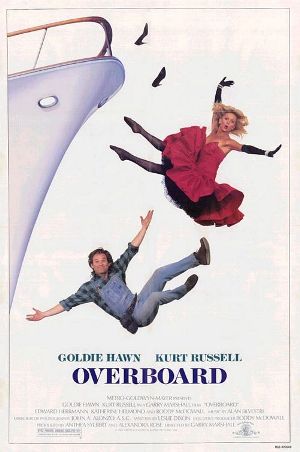
I grew up on Goldie Hawn. Overboard (1987) isn't one of her strongest vehicles, but her performance is enjoyable nonetheless. She plays a spoiled millionaire who hires a carpenter (Goldie's real-life significant other, Kurt Russell) to remodel the bedroom closet on her yacht while the boat is docked on the coast of Oregon, awaiting engine repairs. Unhappy with the local carpenter's final product, she pushes him off the boat and into the sea. Later that night, she falls into the ocean herself (unbeknownst to her husband or any of the crew), losing her memory in the process. She's eventually picked up by another boat and taken into town for medical treatment. But when her husband decides not to claim her (she's too much of a bitch even for him), the carpenter sees an opportunity for revenge. He pretends to be her husband, and takes her home to his ramshackle house and four unruly sons, turning her into the homemaker she never was.

You will enjoy Overboard more if you can ignore some of the gaping holes in the plot. (How did he convince the hospital staff he was her husband without a shred of documentary proof?) Goldie's transformation from a bored, boring, bossy snob to a person who actually knows a hard day's work, is fun to watch, especially because she does it with such charm, and she and Kurt Russell have such chemistry.

The movie is overly sentimental and lacks any kind of dependable smartness. It's funniest when the actors have little one-liners, delivered almost under their breath, showing you that the writer, Leslie Dixon, and the director, Garry Marshall, are capable of more than formula movies when given the right material, the right ideas, and the right stars. The stars are right, but the ideas aren't clever enough to make Overboard a complete success as a comedy, even though it is funny. (It's certainly not as embarrassing as it could have been; but it's also not as intelligent or as inventive either.) Most of those 80s comedies I grew up on work because of the performances, not because of the writing or the plot. It's when you remove your focus from the acting and pay attention to the silly, obvious plot that you start finding things to quibble with.

With Roddy McDowall, Edward Herrmann, Katherine Helmond, and Michael Hagerty. 112 mins.

February 12, 2012

Escape From New York

John Carpenter's trash-art action yarn Escape From New York (1981) has two things going for it: Kurt Russell's bad-ass performance as Snake Plissken, and a gritty, pulpy atmosphere that transcends its paper-thin storyline. The film is set in the near future, where Manhattan Island has been transformed into the country's lone maximum security prison. (Presumably there was low interest in preserving the Big Apple's iconic cultural monuments and history.) When the President's plane goes down inside the premises, the government makes a deal with a war criminal, Snake Plissken, to rescue the President in exchange for his freedom.

This was Carpenter's fifth feature film, coming off the phenomenal success of Halloween (1978) and the moderate success of The Fog (1980), but more closely related to his cult thriller Assault on Precinct 13 (1976). Both Escape and Assault have a certain neo-Western apathy for cinematic niceties, an attitude Carpenter seems to apply to all his movies. He's in love with those 1950s Westerns by Howard Hawks and he seems to have embedded into his movies a sort of synthetic sense of Los Angeles cool, even when the setting isn't L.A.

The problem with Escape From New York is that it never builds enough momentum to sustain its intriguing but problematic story. The idea feels like something contrived by a 12-year-old kid. It has wonderful cinematic possibilities, but Carpenter seems to have written this in a hurry, or perhaps when he decided to make this movie (he had written the screenplay years earlier) he didn't revise it. There are kinks in the plot, most embarrassingly the incredulous prospect of getting all the law-abiding Manhattanites to give up their jobs and their homes and their lives and leave the city to the underworld of criminals that inherit it in this movie.

The film itself looks like a comic book, and it's this dark, guttery, gloomy, nightmare-metropolis  production design that really makes Escape From New York a fun diversion, despite its shortcomings. You can tell the film's money pool wasn't too deep, and in a way, the shoestring budget works for it. It's a throwback to the  B movies that probably made Carpenter want to make movies when he was a kid.

The film was shot by Dean Cundey, who did the cinematography for several Carpenter films, and produced by long-time Carpenter collaborator Debra Hill. It moves along without much sense, but you find ways to enjoy yourself anyway.

The cast of stock characters, poorly fleshed out (such a shame, considering the collection of talent assembled), includes Adrienne Barbeau (whose wonderful comic abilities are barely used), Lee Van Cleef, Donald Pleasence, Harry Dean Stanton, Isaac Hayes, Ernest Borgnine, Tom Atkins, and Charles Cyphers. ★★★