Showing posts with label Goldie Hawn. Show all posts

November 20, 2015

Six Degrees of Richard Nixon


Three Days of the Condor, which was directed by Sidney Pollack, has at least one thing going for it: Robert Redford. Redford in his day was a terrific hippie-everyman. He was conservative enough in his demeanor to be mainstream, but progressive in his politics. But Redford loses some of his appeal when he starts to fancy himself a martyr for whatever cause his movies are about. In Three Days of the Condor, it's Robert Redford against the world, and it's a bit hard to take. I like him better when he's charming the world into compliance. 

Condor
 begins well: Pollack is a slick filmmaker, and the modern-jazz-funk score by Dave Grusin works for the opening shots, sounding more than a bit like the music by Weather Report from the same period. The film is set in New York, where a reader at the American Literary Historical Society named Joe Turner (Redford) is terrified to discover all of his colleagues have been gunned down while he was out to lunch. Turner pretty quickly realises that he missed death only by sheer coincidence, and that the party responsible (the CIA) isn't likely to make the same mistake twice. Soon he's hiding out in the Brooklyn Heights apartment of an icy photographer named Kathy, who's played by Faye Dunaway.

Pauline Kael criticized the casting of Dunaway as a mistake, but I'm not sure it's the casting so much as the character herself. There's a heady sort of macho intuition in the script that bungles the movie irretrievably: Turner, who's holding the terrified woman at gunpoint, looks around at her many pictures (all of them dreary black-and-white photos of autumnal trees and empty park benches: death and isolation and such) and basically pronounces her a frigid bitch. Where on earth does he get off? What's most distressing about this is that within twenty minutes of all this, they're in bed together. So I can't really fault Dunaway for what is decidedly silly writing.

Movies are supposed to be improbable, unlikely concoctions of fantasy, but this shacking up with your hostage business smacks of an improbability that only weakens the movie. Now that Kathy is on Joe's side (a new kind of putting the screws on your audience), she agrees to help him rough up a CIA desk jockey so he can find out what's really going on behind closed doors. It's depressing to realize that Dunaway had to settle for such a flat role, especially since she was one of the reigning queens of 70s cinema for a little while.

Meanwhile, Alan J. Pakula's The Parallax View (released a year earlier, in 1974), is equally muddled. Warren Beatty plays a reporter who witnesses the assassination of a politician in the Space Needle. Within a few years, six people who witnessed the murder have died mysteriously, and a frantic reporter (Paula Prentiss) turns to Beatty for help because she's convinced she'll be next.

Pakula doesn't have much facility for directing action sequences. In one case, Beatty's character deflects a gunshut with a fishing rod--by wrapping the wire around the would-be shooter's legs. It's a clumsily staged moment. Pakula's better thrillers--Klute and All the President's Men--didn't have scenes like this. He's better at transmuting static material than translating physical action to the screen.

Beatty's character, also named Joe, is a prototype for the smart-ass investigative reporter that Chevy Chase played so well in Fletch. Beatty doesn't exhibit contempt for his audience, but he does imbue Joe with a certain degree of hardness to the world. He doesn't seem particularly affected by any of the disturbing things he uncovers, particularly the strange mission of the ominous Parallax Corporation, which is apparently in the business of training assassins. If only it were as clever and interesting as The Manchurian Candidate. Instead, it's a rather obvious attempt to throw some doubt on the Warren Commission's investigation of JFK's assassination. 

Of course, all of these movies are inherently connected to the Nixon Whitehouse. Without Nixon (and Vietnam), we wouldn't have likely had such an interesting spate of paranoia thrillers. (The best of them, aside from All the President's Men, are less obvious, like Philip Kaufman's terrific remake of Invasion of the Body Snatchers.) But has any other President spawned a whole sub-genre? These films are carriers of a Nixonian spirit that is quite unsettling and altogether fascinating. The fact that the movies themselves don't really hold up doesn't negate their relevance in the culture, because they're ultimately more interesting as reactionary objects, put forth to question authority.

The most successful movie to directly address Nixon may be, surprisingly, a kooky little Hal Ashby comedy called Shampoo, which also stars Warren Beatty. I remember watching it on television many years ago. But seeing a movie divided into segments by commercial breaks (and edited for cable) is no way to live. Shampoo is about an anomaly: a straight hairdresser who services unhappy rich women in Hollywood. (And he services them in more ways than one.) His name is George, and it's been suggested that he was inspired by Jay Sebring, the man who revolutionized men's hairstyles before being butchered by the Manson family at Sharon Tate's house in August 1969.

Shampoo is glib but sweet, and director Hal Ashby manages to make a film about unhappiness and moral decay without turning moralistic. George is bedding both the wife and the mistress of a big money businessman (Jack Warden) from whom he's hoping to finance his own salon. The ladies are both unhappy, but unwilling to forgo the various pleasures afforded by George's services. (The wife, Felicia, is played by Lee Grant, and the mistress, Jackie, is played by Julie Christie.) Meanwhile, George's official girlfriend, Jill (played by the sunny, wide-eyed Goldie Hawn, who's a willowy flower with a spark of fire inside her), is equally muddled and dissatisfied with her boyfriend. 

Warren Beatty looks perpetually stoned in Shampoo. (He looks more lucid in The Parallax View.) This is the right look for his character, a man who concludes that he's basically happy--even despite his career failings--because he gets to sleep with a lot of women. We feel for George, genuinely, when he's left alone at the end, a consequence of prior indecision.

Shampoo is set during Election Day and Night 1968, and at the end, we see actual footage of Nixon making his victory speech. It's easy to see how he won in `68--a slick and skilled politician playing against someone his own age, Hubert Humphrey--despite a blistering loss in 1960 to the suave John Kennedy. Shampoo thus signals the death knell of the Peace and Love Moment. It was, after all, Nixon and Manson who signaled it. 

June 08, 2013

Housesitter

Steve Martin and Goldie Hawn work so well together that it's a wonder they didn't make a movie sooner than they did. Housesitter (1992) is yet another modern Hollywood attempt at channeling 1930s screwball comedies. The only trouble is that it's too carefully plotted to truly resemble the kind of fast, improvisational, fluid comedy to which it's paying tribute. However, Housesitter is a fun romp, bolstered by the performances and the chemistry of the two leads.

Steve Martin plays Davis, a struggling architect whose girlfriend dumps him after he proposes to her in front of the house he designed just for her. The house is in the quaint Massachusetts town Davis grew up in, but he works in Boston. Back in the city, he meets a colorful waitress named Gwen (Hawn) and in a weak moment--after telling her the whole story--has a one-night stand with her. Then she moves into the house and pretends to be his wife, winning over the whole town (including his parents) with her elaborate deception. In fact, Gwen turns out to be an expert storyteller: you never know when she's telling the truth.

This is Goldie's movie: she's always been such an engaging and appealing flake, and here she's balanced in her flakiness by Martin, who's grounded but reveals his own inner-flake at certain moments. The development of their relationship (which is admittedly predictable) is too much fun to dismiss the movie for its conventional plotting.

Dana Delaney co-stars as Becky, Martin's former girlfriend, whose love for her ex is re-awakened by Gwen and all her stories. With Julie Harris and Donald Moffat as Martin's parents, Peter MacNicol as Martin's colleague at the architectural firm, Richard B. Shull, and Lauren Cronin. Written by Mark Stein. Directed by Frank Oz. 101 min. ★★½

November 21, 2012

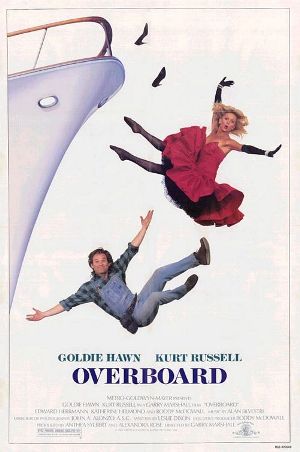
Overboard

I grew up on Goldie Hawn. Overboard (1987) isn't one of her strongest vehicles, but her performance is enjoyable nonetheless. She plays a spoiled millionaire who hires a carpenter (Goldie's real-life significant other, Kurt Russell) to remodel the bedroom closet on her yacht while the boat is docked on the coast of Oregon, awaiting engine repairs. Unhappy with the local carpenter's final product, she pushes him off the boat and into the sea. Later that night, she falls into the ocean herself (unbeknownst to her husband or any of the crew), losing her memory in the process. She's eventually picked up by another boat and taken into town for medical treatment. But when her husband decides not to claim her (she's too much of a bitch even for him), the carpenter sees an opportunity for revenge. He pretends to be her husband, and takes her home to his ramshackle house and four unruly sons, turning her into the homemaker she never was.

You will enjoy Overboard more if you can ignore some of the gaping holes in the plot. (How did he convince the hospital staff he was her husband without a shred of documentary proof?) Goldie's transformation from a bored, boring, bossy snob to a person who actually knows a hard day's work, is fun to watch, especially because she does it with such charm, and she and Kurt Russell have such chemistry.

The movie is overly sentimental and lacks any kind of dependable smartness. It's funniest when the actors have little one-liners, delivered almost under their breath, showing you that the writer, Leslie Dixon, and the director, Garry Marshall, are capable of more than formula movies when given the right material, the right ideas, and the right stars. The stars are right, but the ideas aren't clever enough to make Overboard a complete success as a comedy, even though it is funny. (It's certainly not as embarrassing as it could have been; but it's also not as intelligent or as inventive either.) Most of those 80s comedies I grew up on work because of the performances, not because of the writing or the plot. It's when you remove your focus from the acting and pay attention to the silly, obvious plot that you start finding things to quibble with.

With Roddy McDowall, Edward Herrmann, Katherine Helmond, and Michael Hagerty. 112 mins.

February 05, 2012

Foul Play

For most of my childhood, Foul Play (1978) was my favorite comedy (or at the very least, tied with Nine to Five--which, incidentally, was directed by the same man, Colin Higgins). It's about a shy but sexy librarian (Goldie Hawn) who becomes mixed up in a murder plot involving an odd assortment of criminals who are planning to assassinate the pope when he visits San Francisco. The movie is basically a remake of Charade, where Audrey Hepburn plays the chic widow pursued by a trio of cads in Paris and a mysterious stranger, played by Cary Grant. It evens mimics Charade in at least one scene where Goldie is running from one of her attackers. The camera zooms in on her legs and her black high heels as she runs for her life.

Goldie Hawn seems to have access to a neverending current of charm, and she's consistently engaging in almost every movie I've seen her in. While Foul Play may be one of the fluffier entries into her career, it's nonetheless a fun movie, provided you don't put too much thought into it. The comedy is best when Goldie is resourceful but wide-eyed, and her co-star, Chevy Chase, doesn't have to fake Cary Grant-ish charm. Chevy's strength is in his bumbling inability to be serious, and as long as he doesn't have to be a legitimate romantic lead, you can enjoy his being ostensibly paired off with Hawn. He plays a cop who Goldie meets at a party, and then becomes involved with her after responding to her frantic call to the police during an attack by a creepy thug (Don Calfa).

Several comic set pieces are utterly contrived. A scene with Billy Barty is a complete waste, manufactured by the confusion of the head criminal's nickname, "The Dwarf." There's a whole sequence involving Dudley Moore that doesn't fit into the movie at all. Moore is funny regardless, playing a kinky swinger who gets the wrong idea when Goldie asks him to take her home. She's running from a killer, but somehow convinces Moore that she's looking for a one-night-stand.

Hawn's character seems anachronistic to San Francisco. She's apparently the first modern American woman to be de-liberated by a divorce: it's turned her into a mousy loner who has shut herself off to the prospect of romance. It's hard to accept, because Goldie Hawn exudes an effulgent likableness that is anything but shy or unappealing.

And San Francisco isn't exactly portrayed in a good light: it's shown as a city of psychos and sex perverts. Another movie from 1978, Invasion of the Body Snatchers, turns the Bay city into a haven for an alien invasion where humans are being harvested. Granted, this was the city of the Zodiac killer, so perhaps there was good reason to paint it as a locus of dangerous activity. In the process, however, the filmmakers lose a lot of the capital they could have gotten out of their setting. The city's cultural opulence is dulled, with the exception of a sequence in a retrospective movie house and the denouement, which occurs during a performance of The Mikado (both sequences turn their settings into places of destruction). It's as if art itself is merely a breeding ground for violent criminal behavior. Or maybe it exacerbates the behavior.

The whole assassination plot is a bit half-cocked, but you don't go to this kind of movie for brilliant storytelling. The sequence where Goldie and Chevy race across San Francisco, wrecking several cars in the process, is a clunky way to liven things up. Burgess Meredith offers liveliness of a natural kind. He plays Hawn's landlord, a kindly retired anthropologist with a Black Belt in Karate that comes in handy during a scuffle with the radiantly evil-looking Rachel Roberts.

With Eugene Roche, Brian Dennehy, and Marilyn Sokol. 

May 16, 2011

The First Wives Club

This movie is one of my guilty pleasures. It's uneven and really, considering the sheer quantity of talent involved, it's a bit of a letdown. Based on a novel by Olivia Goldsmith, it's about three college friends (Goldie Hawn, Diane Keaton, Bette Midler) who reunite years later after they've been dumped by their husbands for younger women. Their plan for revenge soon evolves into one where they can channel their frustrations for good. The movie is some kind of rah rah feminist picture, and yet it has moments where it completely contradicts itself. The women spend a lot of time praising their own abilities to beat their lousy ex-husbands into submission, but at the end, when one of the grumpy husbands utters, "you can't do anything to us," they acquiesce that no, they cannot, but the people they have under their control (all men) have the ability to get results. It's a strange moment of inconsistency. The movie itself is a bit formulaic, complete with the montage toward the end where the three leads, frustrated with how things are going, spend the duration of a mushy 90's pop ballad walking with their heads down, consoling themselves with family, and having a good cry. The movie wants to be brassy and gushy in the middle, but I'm not convinced it can have it both ways.
Director Hugh Wilson doesn't always stage scenes the way he should. There's a scene where they sneak into Midler's ex's apartment, and it's built up like something out of a bad spy thriller, with the three comedians screaming and pushing and shoving and freaking out in histrionic fashion. The scene is big but it feels big in a contrived way--factory made comedy with a director's attempt to manage the audiences' reaction.
The talent rescues the movie from its shortcomings. The three leads are too much fun to watch to completely dismiss The First Wives Club, and the supporting cast is to die for: Maggie Smith, Eileen Heckart, Sarah Jessica Parker, Stockard Channing, Dan Hedaya, Victor Garber, Stephen Collins, Marcia Gay Harden, Bronson Pinchot, Elizabeth Berkley. 1996