Showing posts with label Robert De Niro. Show all posts

October 04, 2015

The Intern

The Intern opens and closes with Robert De Niro doing Yoga, as if writer-director Nancy Myers dreamed up this image first, and then wrote a whole script around it. The Intern is destined to be a hit with the over-50 crowd, and while the film doesn’t pander to them quite as much as I thought it would, it is at times astonishingly dull. But it hits all the right beats of its ready-made formula, and after the movie’s two meandering hours have finally passed, viewers may feel that the quantity has given them their money’s worth, even if the quality is bland and overly expository.

Here’s the set-up: Robert De Niro plays Ben, a retired ad exec who applies for a senior internship (meaning an internship for senior citizens) at an up-and-coming online apparel outlet, founded and operated by a frantic, driven, smart young woman named Jules Ostin (Anne Hathaway). Jules is a modern woman: She started this company only a year-and-a-half ago, and it’s grown to 200 employees and booming business. Her husband (played by Anders Holm) is a stay-at-home dad. (With his patchy manscaping, Holm looks like a boy who’s donned a thick prop beard to play dress-up in.) Jules is so under-developed that we have no idea she’s married (or has a child) for the first half-hour of the film. (This could be a poorly conceived attempt to show us that Jules is working too hard and therefore her family is invisible to her.) Ben becomes Jules’s assistant, and we watch as he gradually wins her over with his wise gentlemanly ways. There are the expected jokes about the clash between young and old, but even though this movie doesn’t hit them too too hard, it smacks of staleness. There’s even a scene in which Hathaway helps De Niro set up his Facebook account. Will this even matter in ten years, assuming Facebook goes the way of Myspace by then?

Nancy Myers, a veteran writer-director, has not shaped The Intern into anything sharp or alive. The movie lumbers along, and we’re all waiting to get to the part where De Niro and Hathaway become friends. We want to see them interact. Nancy Myers wants this too, but she makes us wait nearly an hour as Jules goes through the motions of resisting Ben. We all know what’s going to happen, so this device does nothing for the film but pad the running time. 

De Niro rarely rises above his abysmal fate playing a friendly, wise, oddly progressive Grandpa-Santa Claus-type, doling out obvious life advice—like telling his youthful co-workers they should tuck their shirts in. De Niro is likable, but he smiles his way through the film, like some big dumb grinning cartoon character, with no sense of direction. The movie desperately wants him not to be the crotchety hard-ass he played in Meet the Parents, but it swings so far in the other direction that he becomes passive. Anne Hathaway gets to be funnier and more defined, but by the time we arrived at those moments in the second half of the film, my patience had worn thin.

For all its attempts at clever commentary on the cultural divide between young and old people, The Intern isn’t very funny. Nancy Myers gets so caught up in grinding us through the formula of her story that she forgets to make it amusing. She relies entirely on her actors’ individual charisma and charm, like when Adam Devine (one of the goofy young employees, who’s like Speedy Gonzalez with his delightful maniacal ridiculousness) is rapping in the getaway car while De Niro and two others break into Jules’s mother’s house to delete a nasty email Jules accidentally sent to her mom. De Niro has been coaching Devine’s character about how to interact with women, and gives him more obvious advice: A text message is not a suitable venue for an apology. Adam Devine could make me laugh in almost anything, though, so his presence here comes as a relief.

Perhaps the biggest crime The Intern commits is its wasting of Rene Russo, who plays the company’s in-house massage therapist. She and De Niro’s character strike up a romance pretty quickly, but the film barely pursues it. We get one brief scene of them talking about their former spouses and their lives, and that’s it. The rest of the time, Russo’s character is either coming or going, saying things like “I’m just on my way to work.” (A far cry from the delicious part she had in last year’s Nightcrawler.)
You’d think Myers would have been drawn into this relationship, that she’d have wanted to develop it more fully. Perhaps her characters are so dull, so pat, and so predictable, that the only direction it can go is banal perfection.

That’s the real problem with The Intern: It essentially argues that old people have figured everything out, and along the way, it robs them of any interesting qualities. The young people in The Intern have all the problems, and the old people are there to solve them—or else get in the way with their cartoonish ineptness, like one of the other senior interns does when she attempts to serve as Hathaway’s chauffeur. This movie is the cinematic equivalent to all those shame-inducing think pieces dumping on the “millennial” generation by espousing the inherent superiority of the baby boomers. Myers hasn’t developed her thinking very much in the last thirty years. In fact, she was more honest in 1987’s Baby Boom.

Anne Hathaway is the reason to see this picture, if at all. Her performance as Jules Ostin is terrific. It’s a pretty standard Hathaway part: driven, smart, plucky, tough, and just a tad prickly. Obviously, De Niro’s character exists only to smooth over her rough edges. But the film finds itself in a quandary when [spoiler alert] Jules discovers her husband [spoiler] is cheating on her. There’s a lot of talk that Jules is somehow guilty for her husband’s cheating ways, because she’s too focused on work. But De Niro discourages this self-doubt, and reminds her that it’s okay to be a woman with ambitions. Somehow, this felt like a characterological flaw. De Niro’s Ben isn’t so much a human being as a Frankenstein-concoction: the ideal man,  created by a politically progressive but cinematically conventional filmmaker. And as much as The Intern tries to be progressively feminist, it settles for a treacly happy ending, one that cheats its convictions.


February 26, 2015

Great Expectations

When Anne Bancroft, as the kooky old spinster Miss Dinsmoor, orders the young Finn (Jeremy James Kissner) to “Dance! Dance! Dance!,” I couldn’t help laughing. It reminded me of an early episode in 30 Rock when Jenna (Jane Krakowski) is at a ball trying to land an Austrian prince (played with so much grotesque brilliance by Paul Reubens), himself a long-suffering victim of the royal family’s generations of in-breeding. (He dies in the scene after drinking champaigne because his body cannot metabolize grapes.) The prince orders Jenna to “Dance!” and then keeps requesting different styles: “Jazz! Tap! Jitterbug! Charleston! Interpretive! Twirl! Do it again! Keep Twirling!”

Alfonso Cuarón’s 1998 adaptation of Great Expectations may be the most beautiful film of the 90s. And it’s no wonder, because the director of photography is Emmanuel Lubezki. (He just won his second Academy Award for his work on Birdman; his first win was for 2013’s Gravity, also directed by Caurón.) The movie is like a dance: every image connects thematically and has a rhythm; the scenes are elegant, beautiful, and complex; they are full of associations of other movies—Sunset Boulevard, A Streetcar Named Desire, maybe even a little of Bertolucci’s The Conformist—and yet they do not feel like rip-offs of other works. They may be camera-work riffs, or maybe they’re just the result of two cinematic show-offs. But who cares? The visual beauty of Great Expectations is so dazzling that it threatens to undermine my own stubborn love of plot.

Cuarón isn’t interested in telling the Dickens story faithfully in terms of plot: he changes many of the names, the setting, and the time period. But thematically, Cuarón beautifully captures the essence of Dickens’s great work and the classism at the heart of Pip’s (or Finn’s) rise from poverty to success and his deep desire to be great, to be a gentleman, to attain a girl (Estella, played as an adult by Gwyneth Paltrow) who is ranks above him. So, while Great Expectations `98 lacks some of the weight of the novel (in the same way that the stunning, naturalistically filmed 2011 Jane Eyre was gorgeous to look at it but strangely less effective than the novel itself or even some of the stagier filmings of the material).

But, while I didn’t feel as much of an emotional wallop in Cuarón’s Great Expectations, I was struck by the way he gets movies and how to turn novels into movies, more than most filmmakers. When we’re watching two masters like Cuarón and Lubezki at work, we see all that is possible in movies that cannot be achieved on a page: the splendiferous greens which permeate every image, finding themselves on clothes, furniture, drapes, and in the lighting itself; the deliciously Gothic Miss Dinsmoor (Miss Havisham in the novel), played like an even older version of Norma Desmond from Sunset Boulevard, with a little Blanche DuBois thrown in for good measure. (The film is set in Florida, on the Gulf.)

Ethan Hawke plays Finn, who grows up with his simple handyman brother-in-law Joe (Chris Cooper) and becomes a sensation in the New York art world thanks to an unknown benefactor. Robert De Niro plays the escaped conflict Finn assists early in the movie. The film is at its most bizarre (and delightful) when dwelling with the eccentric Miss Dinsmoor, who makes him come visit her dilapidated Spanish mansion, which looks like a resort hotel that was abandoned thirty years ago with all the furniture and the glasses still perfectly arranged (though they're now covered with a thick layer of dust). With Hank Azaria, Kim Dickens, and Josh Mostel. Cuarón co-wrote the screenplay with David Mamet and Mitch Glazer.

February 08, 2015

Raging Bull

Raging Bull (1980) is probably the most overrated movie of the last 50 years, from probably the most overrated director, Martin Scorsese. Admittedly, I’m a biased reviewer. (Who isn’t?) I don’t usually respond to movies about boxing, and in the last few years I’ve developed a real antipathy for films that are about men and men only, with only marginal roles for women in them. (When half of the population is women, and when there are so many good women who act, why are movies so man-centric?) That’s probably why the only thing I liked about Raging Bull was Cathy Moriarty’s performance. She plays the wife of the film’s subject, boxing legend Jake LaMotta, who’s played by Robert De Niro.

Movie-lovers often bemoan the fact that Robert Redford’s suburban-family-coming-apart-at-the-seams drama Ordinary People won the Oscar for Best Picture of 1980, beating the obviously artistically superior Raging Bull. I’ve bit my tongue until now because I hadn’t bothered to watch Raging Bull. Now that I have—an endurance test if ever there was one—I remain securely tethered to team Ordinary People, even if Raging Bull is cinematically superior. It’s incredibly well-made, technically speaking. The stark, naturalistic black-and-white camera-work and the editing are truly masterful.

But the film’s technical achievements do not change the fact that its subject matter and its execution are monumentally unsatisfying and truly disturbing. This is a film about the emptiness of a New York prizefighter who’s consumed with jealousy and reduced entirely to his physical powers in the boxing ring. He’s a piece of meat. There’s no depth to De Niro’s characterization. Pauline Kael (I’ve never been so happy to be in agreement with her on a movie) put it best when she argued in her review that Raging Bull is looking back to the films of Brando and Coppola, trying to top them. Movies that scratch and claw their way to greatness can sometimes be fascinating—especially if they fail—but Raging Bull’s quest for greatness works against it.

Beneath all the showy cinematography and the showy acting of Robert De Niro, there’s very little humanity. Critics have repeatedly used this argument against De Niro (most recently for The Wolf of Wall Street), but not necessarily for Raging Bull, perhaps because they’re convinced by its technical style and De Niro’s macho machinations that the film is a brilliant piece of art. What Martin Scorsese achieves is a really well-made film about terrible people, but the film’s seriousness and its grandiosity make it seem like we should find these people interesting, or redeeming, or worth our time in some way. But that’s not true about any of them except for Jake LaMotta’s wife, whom he beats up on, accuses of infidelity, and then woos back with sweet nothings in a constant vicious cycle. Watching self-destructive men beat up on their women just isn’t that gratifying, especially when the women don’t get to fight back much. (There is one scene where Moriarty stands up to him, but he socks her in the face, and not long after, she’s back with him and all is apparently forgiven. She does eventually leave him, but years later, and the dramatic effect of the act is underwhelming.)


Joe Pesci, as Jake’s brother and manager, is admittedly very good in his role. But like De Niro’s performance, the acting he does turns into a tired, repetitive schtick. He, just like LaMotta’s long-suffering wife, seems always to be coming back to his brother even when Jake abuses him physically and accuses Pesci of sleeping with his wife. (Jake LaMotta’s mood ring is a constant volcanic red, and his absurd jealousy becomes tiresome, maddening and eventually infuriating.) I don’t want to make definitive statements about movies, but in this case, I really do not have any desire to see a movie about these kinds of characters. (And again, boxing.)

December 19, 2013

American Hustle

Watching American Hustle is like watching three different train wrecks happen at once, and yet there is an element of control involved that would distinguish it from an actual train wreck. First and foremost, it's a comic film that yearns to have been made in the late 70s, which is when it's set. The period detail is as conspicuous as the hair of the women in the movie, from the carefully chosen music to the glossy retro Columbia Pictures logo that plays at the beginning of the movie. That's part of the trouble: American Hustle feels too manufactured, and as such the story falters a lot. The script by Eric Warren Singer and David O. Russell (he also directed) is self-consciously a crime-comedy. Movies of this kind from the actual 70s weren't self-conscious. They just were. You begin to miss this element in American Hustle, because it always feels like a put-on.

But there are redeeming qualities, such as the magnificent cast: Christian Bale as a con artist with a deluxe comb-over and a striking little gut that compliments his even more striking fashion sense; Amy Adams as his mistress/cohort, a gal who affects an English accent in order to dupe clients; Bradley Cooper as a cop who's looking to get a promotion; Jennifer Lawrence as Bale's hard-drinking, hilariously out-of-control wife, who has a big nest of hair atop her head; and Jeremy Renner, a naive, well-intentioned mayor from New Jersey, who unwittingly becomes part of the cop's plan to entrap a bunch of politicians and mobsters.

David O. Russell's brand of comedy is hard to take sometimes. He's big on letting his characters ramble their way to a point, and you really miss clever, quick, flashy dialogue when that happens. On the other hand, there are some pretty funny lines in American Hustle, and many of them fall out of Lawrence's mouth like little flecks of verbal dynamite. Half the time you aren't aware of how funny they are, and just how loopy her character is. She really colors the film.

Bale is appropriately pathetic-looking as a lifelong scammer, he of the hyper-real performance. (I'm quite prepared to believe that he put on weight so he could have a real belly.) The movie doesn't take him too seriously, but it also doesn't completely dismiss him, which feels like loyalty on its own terms. Bradley Cooper, on the other hand, is always some degree of Bradley Cooper. (His character wears curlers at night, which is a good example of how the film can be uproariously funny when it wants to be.) They do play off each other well.

The overall results for me, were mixed. There were moments I laughed loud and long, and moments where I felt bored by what seemed like deliberate chaos. It's a whirlwind of a movie, and admittedly a well-made one. Linus Sandgren was the director of photography. His work is solid: American Hustle has panache and charm and sexy camera angles to spare. But there is something hollow inside of it, like director David Russell was grasping at becoming the next Coppola or Scorcese, and not quite hard enough. With Elisabeth Röhm, Robert De Niro, Jack Huston, Louis C.K., Alessandro Nivola, and Colleen Camp. ★★½

June 13, 2013

True Confessions

True Confessions (1981) is a story about rot and how it taints institutions like the Church. It's also loosely based on the grisly Black Dahlia murder case. The film is set in Los Angeles in 1948, and the focus is on two brothers: one a priest (Robert De Niro) who schmoozes with wealthy laymen in order to get funding for church buildings, and the other a hardboiled detective (Robert Duvall), who's a cynic. He's seen the corruption of religious institutions first hand, and it's no different from the corruption of law enforcement or any other supposedly pure organization.

When Duvall's character confronts a big-time construction magnate (Charles Durning) who's been helping out the Church, he unflinchingly mocks the man's moral character, and he gets something of a kick out of doing it. He's overly pleased with calling people out, but then he has a right to be infuriated when the Church celebrates a man who frequents prostitutes. But he's a hypocrite, too. Near the beginning of the film, he does the Church a favor by removing the corpse of a priest who suffered a fatal heart attack while visiting a house of ill fame. It would be a nasty scandal for the Catholic Church and in particular his brother, so he takes care of things for them.

True Confessions, which was based on John Gregory Dunne's 1977 novel and adapted by Dunne and Joan Didion, seems to be reaching for profundity when it exposes the rot with which it is so consumed. But when the police are investigating the brutal murder of a young woman found in a vacant lot (she was cut in half and eviscerated), they treat the murder as though it were a routine, unremarkable event. There's no feeling for her or for the particularly horrifying circumstances of her death.

It's only later that Duvall's character develops a kind of sympathy for the murdered girl, as well as a compulsive desire for justice, which he finds is just as elusive as the mysterious girl herself. It's hard to buy his sudden transition from callousness to compassion, because Duvall's character is a grim, pasty, unfeeling cardboard cutout out of a detective character from the 1940s. He's Humphrey Bogart without the charm and fast-talking wit. He has a sense of humor, to be sure, but he doesn't talk in all the lovely double entendres Bogart did in The Maltese Falcon or The Big Sleep.

De Niro too seems embalmed in True Confessions, and he appears as though he had no idea of how to play the priest any other way. It's probably a fault of the writing, which vacillates clumsily from murder mystery to morality tale to family drama, never successfully getting across any concrete ideas about any of them. Instead it just pounds us over the head with its one crystallized theme: Rot. By the end of the movie, you certainly feel it spreading, and it makes you wish the whole experience were over sooner. (And, there's a wedding scene near the beginning that has echoes of The Godfather, as though they were trying to make a film about the Catholic Church on that level; it's merely a reminder of how pale a comparison True Confessions is.)

Directed by Ulu Grosbard. With Ed Flanders, Burgess Meredith, Kenneth McMillan, Cyril Cusack, Dan Hedaya, Jeanette Nolan, and Rose Gregario. 108 mins. ★★

June 05, 2013

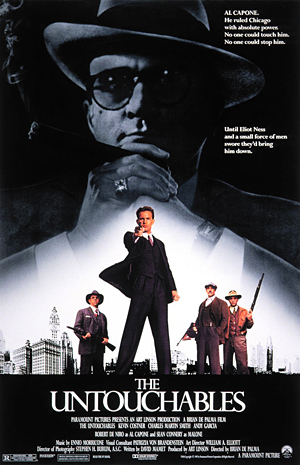
The Untouchables

After seeing The Untouchables (1987), I finally understand that joke in The Naked Gun 33 1/3, where Leslie Nielson imagines himself fending off gangsters on the stairs of the train station while a baby rolls down the steps in a carriage, its mother screaming in panic. It was lifted right from The Untouchables, and it was impossible for me to keep a straight face during that long, drawn-out scene, with the Nielson movie playing in my head. We actually see the mother mouthing the words, "My baby!" in slow motion. And let's not forget that it takes an excruciating three to four minutes of watching her struggle to get the damn carriage up the stairs before Elliott Ness begrudgingly offers her assistance, knowing that any minute the bad guys will come through the doors of the station and he'll be at a disadvantage helping this woman out.

That pretty much sums up The Untouchables: it's a drama queen of a movie, full of director Brian De Palma's tendencies toward hyperbole, and brought to a fever pitch by Ennio Morricone's score, which turns every scene into a touchdown set to an anthem. At times, the music takes on a very 80s-sounding beat via drum machine and you have to wonder how that made it to the final print.

Brian De Palma obviously tried to imbue every scene with the weight of the "I could have been a contender" speech from On the Waterfront. But then again, De Palma has never tried to hide his lack of subtlety, and sometimes, his gaudy directing works well, as it does in much of this movie, in spite of itself. It's a wonder that, as much as this movie desperately wants to be great, it manages to be quite watchable and emotionally affecting.

Yes, The Untouchables is a grandly entertaining movie, even when it's ridiculous. Seeing it reinforced for me both the greatness of The Godfather and the inferiority of the more recent Gangster Squad. I was grateful that Untouchables falls somewhere in between, leaning towards greatness but not quite getting there. It's helped along by the wonderful performance of Sean Connery as Malone, an aging beat cop who becomes the mentor of Elliott Ness. Connery won a much-deserved Oscar for his performance. Even Kevin Costner's performance works. He's a dull actor, but in this kind of role, as the determined Ness, a staunch upholder of the law fighting the bootlegging industry, his banality works better than you might think. The movie would have faltered with a more dynamic actor (say, a Michael Keaton, perhaps) in the role. And Costner's not even as banal as he usually is, perhaps because he's surrounded by a number of vibrant performers, including Connery and Robert De Niro as Capone.

With Andy Garcia and Charles Martin Smith as the other members of Ness's four-man team, Patricia Clarkson, Billy Drago (who's exceedingly creepy as Frank Nitti), Richard Bradford, Jack Kehoe, Brad Sullivan, Steven Goldstein, and Clifton James. Written by David Mamet. ★★★

December 29, 2012

Silver Linings Playbook

Does anyone remember that whole sub-genre of movies about the normal guy meeting the kooky girl who changed his life by encouraging him to live life to the fullest? Goldie Hawn did a couple of those kooky girl movies, and Geena Davis won an Oscar for play one of them in The Accidental Tourist. Well, writer-director David O. Russell's Silver Linings Playbook is sort of like those movies, if both the guy and the girl were playing kooky characters.

(Take note of some very mild spoilers in this paragraph.) Bradley Cooper plays the lead, a former teacher named Patrick, who at the beginning of the movie is getting released from a mental institute after spending eight months in court-ordered therapy. Patrick was sent there because of a violent outburst involving his wife and another man. Now he's been diagnosed with Bipolar disorder, but refuses to take his medicine because it makes him foggy, and bloated. He finds a fellow misfit in Tiffany (played by Jennifer Lawrence), a very young widow whose husband died during an act of Good Samaritan-ship.

Patrick is living with his parents (Robert De Niro and Jacki Weaver) in his Philadelphia hometown, trying to improve himself so his wife Nikki will take him back. He's deluded himself into believing she will take him back, and experiences moments of paranoia and rage. (For example, he freaks out any time he happens to hear the song that was played at their wedding.) Tiffany turns out to be the best thing for Patrick: she goads him into pairing up with her for a dance competition (in exchange for which she will pass along a letter from Patrick to Nikki, as Nikki currently has a restraining order against him). Their off-kilter relationship works, for them, and for the movie. Yes, Silver Linings Playbook stops short of being original. It resurrects too many staples of the formulaic romantic comedy, such as the character's carefully-contrived weaknesses coming back at the end to throw a little doubt on the outcome of the dance competition, or the dance competition itself, which seems like a pretty standard conflict for a movie like this.

But what makes Silver Linings Playbook stand out is the performances of its cast. Cooper, who I must admit tends to get on my nerves, is believable and sympathetic in this movie. Jennifer Lawrence, who everyone knows is extremely talented, does a fine job in this movie. It's one of the few strong female roles I've seen this year, in fact. De Niro and Weaver work well together as the parents, well-meaning but a but clueless as to how they can help their son's mental health issues.

There's one major flaw. In several scenes, the characters start screaming at each other at the top of their lungs. Russell should have put a stop to this. It doesn't work. It turns up the viciousness and quickly, transgressively, enters into the real of histrionics. Fortunately, there's a sharp sense of humor that generally saves the day. It's another good, not great movie.

With Chris Tucker (who has some amusing bits as Pat's friend from the mental institute), Julia Stiles, Anupam Kher (who's very funny as Pat's therapist), Shea Whigham, John Ortiz, and Paul Herman. 120 min. ★★½

July 16, 2012

The Godfather Part II

In the first Godfather, Michael Corleone (Al Pacino) never believed he could be sucked into his father's way of doing things. And in The Godfather Part II (1974), he can't accept that he has. His corruption happens quickly but subtly. Under the guise of vengeance, of protecting family honor, Michael becomes a tragic fallen hero. Director Francis Ford Coppola and author Mario Puzo have created a sequel that fills in a lot of detail for us, simultaneously depicting Michael's rise as the new Don Corleone and the life of young Vito (played in flashback by Robert De Niro) as he leaves Sicily for America and gradually begins a life of crime.

There are moments of greatness in The Godfather Part II, and moments of great drama. Some of the images stay with you, and considering how much it attempts, much of this movie is a smashing success. The actors are exceedingly good: Pacino shines darkly. You can see the transformation he's undergone in his face, which was once innocent. Now it has a yellow patina of greed and an addiction to power. Diane Keaton gets some stronger material in this sequel as well. She's the good wife who's stuck by Michael for longer than she should have, who's looked the other way too many times now. De Niro is a solid Vito (it's no small feat filling the shoes of Marlon Brando), Talia Shire adds a new level of depth to Connie, Michael's sister, who was always getting roughed up by her sleazy husband Carlo in the first one. In Part II she's given herself over to money and things, at the expense of her family. But then she experiences something of a reversal of character, and she rises up to be the family's new matriarch. It's fascinating to watch all these performances and the depths to which the actors take them.

But it's lacking something. Many critics have proclaimed this an even better film than its predecessor. They praise it for deepening the material, for elevating it to a mythological status. It's just that in the process of demonstrating how far Michael has fallen, the movie too seems to lose its soul. Despite the fact that he had already been corrupted by the end of the first Godfather, that film left you with a sense of ambiguity. That perhaps things were going to be different. After all, Michael's involvement in murder had been about "vengeance" and "justice." But in the sequel, we start to see the consequences of that. It's beautiful and compelling yet bleak and depressing. And the powerful scenes are linked by many scenes that lumber along. (It's three hours and twenty minutes long, where the first was under three, a significant difference.) The tacked-on ending, a flashback of the days before WW2, when all the children were alive, but grown, feels too TV-movie-ish, like Coppola was already showing signs of the bad judgment that would taint his directing ever after. (It is nice to see James Caan reprising his role as Sonny, if ever so briefly. His absence is really felt--Sonny was such a presence, such an iconic character, and Caan turned him into a hot-headed bad boy who you liked because of his brashness and his macho love for his family.)

Part II deserves credit for what it does and what it is: a very good movie, and a compelling study of the soul-destroying power of an America that has built-in methods of abiding criminal activity. It also gets at the things which knit this family together, and the myriad forces which tear it apart. With Robert Duvall, John Cazale, Lee Strasberg, Michael Gazzo, G.D. Spradlin, Richard Bright, Bruno Kirby, Morgana King, and Gianni Russo.

July 03, 2012

Brazil

Terry Gilliam of Monty Python directed Brazil (1985), a bizarre thriller that turns bureaucracy into a vehicle for a horrific comic satire, in which a government flunky named Sam Lowry (Jonathan Pryce) becomes involved in anti-government terrorism and generally frowned-upon behavior. The film is set "somewhere in the 20th century." Everyone wears suits, coats, and fedoras (it's like watching a movie where all the men are played by Humphrey Bogart), and the general atmosphere feels very 1940sish, as if Stanley Kubrick and George Orwell suddenly converged into the space of a single body and made a movie in 1948. Gilliam co-wrote the script with Tom Stoppard and Charles McKeown. Surely they have concocted one of the strangest movies ever made, but it's also a pretty accurate comment on the enslaving capabilities of red tape and forms and going through the proper channels, all trademarks of government.

The scene where Sam's AC breaks and a rogue repairman (played by Robert De Niro) opens up the walls to reveal a jumbled labyrinth of wires and tubes, is a spot-on analogy for the ugly tangled web that is bureaucracy. And there are a number of quirky scenes where this theme is embellished upon, including a scene with a government stenographer who records phone conversations for accurate records, and one particularly horrific exchange (a woman being attacked--viciously, judging by the screams) is taking place while she records every line with a banal, unfazed devotion to her job.

The problem with Brazil is that it's a lumbering movie, clocking in at nearly two hours and thirty minutes, and by the end of it you feel you've been hit over the head repeatedly with the same metaphors about the sluggishness of government, and how the encroaching tentacles of bureaucracy turn people into dulled out slaves, whose only means of feeling any hint of pleasure come in the pursuit of superficial things. (Sam's mother, played beautifully by Katherine Helmond, is a cosmetic surgery addict. She and her batty friend see opposing plastic surgeons, with alternately freaky and horrifying results.)

Jonathan Pryce feels like a combination of Jimmy Stewart and Mr. Bean, or maybe he's just a younger version of John Cleese. He's an okay Everyman, but certainly not the most compelling performer in the movie. De Niro's brief scenes do brighten things up a bit, and one can't help but marvel at the film's grandly imaginative set designs and the frequently astonishing camerawork of Roger Pratt. But overall it's a mixed bag, one that has apparently developed a cult following. Many have seen it as a sort of re-imagining of George Orwell's futuristic novel 1984.

With Kim Griest as a girl Sam keeps dreaming about, who shows up in his real life as a potential terrorist, Ian Holm, Michael Palin, Bob Hoskins, Derrick O'Connor, Jim Broadbent, Ian Richardson, and Peter Vaughan.

December 15, 2011

Jackie Brown

Pam Grier's belated tour de force. The tall, ravishingly beautiful Grier was the Queen of Blaxploitation in the 70s, appearing in such films as Coffy (1973) and Foxy Brown (1975), the latter of which I recently reviewed. Grier's acting has only gotten better over the years. She seemed wasted in Foxy Brown. Her acting wasn't forceful enough to grab the movie and take charge, but by 1997, and perhaps with the help of a director who respected her as an actress (Quentin Tarantino), she was ready to make her career performance.

As the title character in Jackie Brown, Grier is confident, strong, vulnerable, and always in control. Her character, Jackie, is an airline stewardess who works on the side for an illegal arms dealer named Ordell Robbie (played with relish by Samuel L. Jackson). Once she's pressed by the police to rat on Ordell, he decides it's time to silence her for good. But Jackie manages to take control of the police and Ordell with a "sting" operation she masterminds, somehow convincing both sides that she's working for them.

Jackie Brown is usually not the first movie people mention when citing their favorite Quentin Tarantino film. It's not as flashy as Pulp Fiction or as offbeat as Kill Bill. But in its controlled, sustained mission to tell a good story, Jackie Brown is a success. The characters who populate this movie's world are delightfully good at being bad. Jackie may be the least guilty, but her calculated mastery of circumstances seemingly designed to squash her, indicates a strong will and a genius for working situations to her advantage--it's something she's bottled up inside all her life, waiting to be let loose. The director sets all this into motion--these unstable characters and their greedy motivations--and we get to watch it unravel.

The reason people enjoy Tarantino's movies is that he enjoys ripping off the gritty, low-budget crime and action flicks that he grew up on. But because Tarantino seemingly started off as a filmmaking rock star, he's been able to get big money productions made (or at least, modestly big productions compared to the slapped-together-with-spit B-movies of the 1970s), with popular actors. Hollywood likes to think of him as their part of the effort to acknowledge low culture. But Tarantino improves on much of the material he seems to have canonized in his own mind. If you go back and watch Foxy Brown, you'll see a movie that's not very exciting for all its action: the fight scenes are staged ineptly, the acting is unimaginative (even Grier seemed like she couldn't find her footing), and it all boils down to a strangely unappealing revenge fantasy. Jackie Brown isn't really out to get even. She's just sick of being kicked around by a system that has nothing for her but condescension. (One of the cops implies that she ought to be grateful for her measly 16,000 dollar-a-year job).

Somehow, Tarantino takes the material he fell in love with and transcends it. His movies are a glossy imitation of something cheap and poorly done and generally available only in bootlegged form. There were movies like Ilsa, She-Wolf of the S.S. and the blaxploitation movies like Foxy Brown and Cleopatra Jones and Shaft, and car-chase movies like the energetic Dirty Mary Crazy Larry (which we see on a television in Jackie). All of this has been internalized by filmmakers like Quentin Tarantino, and the tropes of those genres have resurfaced in his movies and the movies of directors like him (such as Robert Rodriguez), and audiences are either re-experiencing something to which they attach a great deal of nostalgic value, or are simply getting a kick out of these "low" movies. (Jackie Brown cost 12 million dollars but made 72 million at the box office).

Jackie Brown emerges as Quentin Tarantino's best movie, I think, because of Pam Grier and what she brings to the film. Her performance is controlled but not robotic, and she knows how to be funny, and how to lubricate her sentences with profanity (and Tarantino the writer knows how to write juicy dialogue). Grier and Jackson make for a wonderful anti-duo. Jackson slips into his role with such ease. He's dangerous but appealing at the same time.

The supporting cast of Jackie Brown includes Robert De Niro, as a junkie who becomes Ordell's right-hand-man; Michael Keaton and Michael Bowen as two cops who are trying to nail Ordell; Robert Forster as a bail bondsman who becomes Jackie's partner and possible love interest, and Bridget Fonda, as Ordell's blonde live-in junky girlfriend, who revels in challenging his self-proclaimed authority.

July 10, 2011

Taxi Driver

Robert De Niro as a cabbie who's so disgusted with New York City he develops an inflated sense of his own moral superiority to the grimy, sleazy underbelly of the Big Apple. Taxi Driver (1976) is director Martin Scorcese's paean to violence, or something like that. If you trace the radical change in movies that began around the time of Bonnie and Clyde (1967), you can pretty much tell that Taxi Driver is the ne plus ultra of that evolution, sort of a domestic Apocalypse Now (1979), but less inflated.

However, Taxi Driver never tries to be anything it isn't. It's about a man with a deluded one-track mind. He wants to find his niche in the world, but can't. He's got a charming arrogance that only temporarily hides his social ineptitude. When he introduces himself to a political campaign organizer (Cybill Shepard), he's remarkably sure of himself. But then he blows it by taking her to a porno movie, and acts completely shocked, dumbfounded even, when she's appalled and wants to break the date. And you believe that he generally didn't think it through that a dirty movie isn't her idea of a good time. Somehow De Niro makes you believe that.

As garishly unappealing as Taxi Driver can be, it also has a luridly intoxicating flow to it. You feel as if you're floating through the movie right alongside De Niro. His cab is a "vehicle" by which we experience his disgust with a capital D. He can't seem to get his life in order, and the sleaze he sees, which he deliberately ensconces himself in, helps him distance himself from his own problems. Like most serial killers, he would rather blame the world for his shit than get his shit together.

The 1970s ushered in a lot of violent movies, and thus a lot of talk from filmmakers, studio executives, critics, the media, and audience members, about the impact of violence on viewers. The violent scenes in Taxi Driver, as unpleasant as they are, transform the main character into a local hero who rescues the kid prostitute from her swarthy pimp. Is heroic violence that glorifies violence still bad? Is violence bad? It's certainly a reality in the world in which we live.

The script is by Paul Schrader, who showed an even deeper proclivity for sleaze in the George C. Scott drama Hardcore (1979). Jodie Foster co-stars as a very young hooker. Harvey Kietel plays her vile pimp, who shows a true virtuosity at being a complete sleazebag. Albert Brooks plays the nerdy political aide who's hot for Cybill Shepard but unwilling to break the professional veil of xerox machines and political rallies and business meetings.