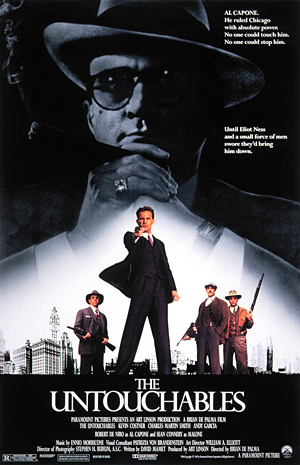
After seeing The Untouchables (1987), I finally understand that joke in The Naked Gun 33 1/3, where Leslie Nielson imagines himself fending off gangsters on the stairs of the train station while a baby rolls down the steps in a carriage, its mother screaming in panic. It was lifted right from The Untouchables, and it was impossible for me to keep a straight face during that long, drawn-out scene, with the Nielson movie playing in my head. We actually see the mother mouthing the words, "My baby!" in slow motion. And let's not forget that it takes an excruciating three to four minutes of watching her struggle to get the damn carriage up the stairs before Elliott Ness begrudgingly offers her assistance, knowing that any minute the bad guys will come through the doors of the station and he'll be at a disadvantage helping this woman out.
That pretty much sums up The Untouchables: it's a drama queen of a movie, full of director Brian De Palma's tendencies toward hyperbole, and brought to a fever pitch by Ennio Morricone's score, which turns every scene into a touchdown set to an anthem. At times, the music takes on a very 80s-sounding beat via drum machine and you have to wonder how that made it to the final print.
Brian De Palma obviously tried to imbue every scene with the weight of the "I could have been a contender" speech from On the Waterfront.
But then again, De Palma has never tried to hide his lack of subtlety,
and sometimes, his gaudy directing works well, as it does in much of
this movie, in spite of itself. It's a wonder that, as much as this
movie desperately wants to be
great, it manages to be quite watchable and emotionally affecting.
Yes, The Untouchables is a grandly entertaining movie, even when it's ridiculous. Seeing it reinforced for me both the greatness of The Godfather and the inferiority of the more recent Gangster Squad. I was grateful that Untouchables falls somewhere in between, leaning towards greatness but not quite getting there. It's helped along by the wonderful performance of Sean Connery as Malone, an aging beat cop who becomes the mentor of Elliott Ness. Connery won a much-deserved Oscar for his performance. Even Kevin Costner's performance works. He's a dull actor, but in this kind of role, as the determined Ness, a staunch upholder of the law fighting the bootlegging industry, his banality works better than you might think. The movie would have faltered with a more dynamic actor (say, a Michael Keaton, perhaps) in the role. And Costner's not even as banal as he usually is, perhaps because he's surrounded by a number of vibrant performers, including Connery and Robert De Niro as Capone.
With Andy Garcia and Charles Martin Smith as the other members of Ness's four-man team, Patricia Clarkson, Billy Drago (who's exceedingly creepy as Frank Nitti), Richard Bradford, Jack Kehoe, Brad Sullivan, Steven Goldstein, and Clifton James. Written by David Mamet. ★★★
Showing posts with label Sean Connery. Show all posts
June 05, 2013
March 19, 2013
Cuba
If Sean Connery's James Bond was about English political dominance, Sean Connery's Robert Dapes is about its political irrelevance. In Cuba (1979), which is set in Havana in the year 1959, Connery plays a British mercenary who's hired by the Batista regime to help them stop Castro from taking over. (Viewers shouldn't be shocked by how that ends up.) Dapes is never particularly invested in the job, but that seems to be true of his attitude in general. He's a jaded ex-soldier who has accepted the ways of the modern world and has learned how to capitalize on them. While in Havana, he runs into an old flame, Alex (Brooke Adams), now married into a prominent Cuban family. Alex runs her husband's factory while he runs around with women. (He's also fond of booze and gambling.) Their marriage is unhappy, but she likes the control she has over him, doling out money to him when he needs it, and managing their capital.
Cuba isn't bad. Director Richard Lester has a clever sense of humor, which keeps this from being self-serious. It's sort of a modern-day Casablanca, except that nobody saw it in 1979 and nobody remembers it now. And while it is about 20 minutes too long, Cuba is generally a fascinating (perhaps unreliable) piece of quasi-historical filmmaking. What's perhaps most historically accurate isn't its take on the Castro revolution, but its depiction of American culture's pervasiveness in Cuba. Everywhere Lester's camera turns we see Cubans inundated with Western capitalist ideals: from the grandson of one of the generals playing Monopoly with his grandfather, to the "Mr. Clean" commercial playing on the television set while a seemingly unresponsive elderly woman stares at it, to the General watching a private screening of Horror of Dracula (a British film, but it qualifies as a Western influence nonetheless).
Brooke Adams, ever the photogenic actress, radiates in Cuba. She's a stunning beauty, and her dark hair makes the New York-born actress believably Latina (maybe not Cuban, necessarily) even when her accent falters periodically. The chemistry between Connery and Adams seems off, but there's something oddly fitting about it at the same time: it's a jaded, unworkable romance for the jaded soldier. Alex is spoiled and selfish but also sympathetic. And Dapes is stubborn but not unfeeling.
And a cast of amusing supporting characters populates Lester's Havana: Chris Sarandon as Alex's arrogant beauty of a husband, Hector Elizondo as one of Batista's men, hired to accompany Dapes (he begins something of an amiable sidekick), Jack Weston as a sleazy American investor, Martin Balsam as General Bello, Lonette McKee as Sarandon's girl on the side, Danny De La Paz as her Castro-infatuated younger brother, who's a pawn of the revolutionaries, and Walter Gotell. Written by Charles Wood. Filmed--convincingly--in Spain. 122 min. ★★½
Subscribe to:
Posts (Atom)

