Showing posts with label Brian De Palma. Show all posts

December 19, 2016

De Palma gabs, an Irish high school band apes Duran Duran, and a 1960s witch casts a Technicolor spell on the 21st century (and other reviews).

Below are short reviews of movies I never got around to writing about. 

De Palma. Legendary filmmaker Brian De Palma (Carrie, Scarface, The Untouchables) sits down and gabs for 100 minutes about his career: the early days of the 1960s, making anti-establishment films and working with De Niro, the 70s, when he was at his peak as a filmmaker and working alongside Spielberg, Scorsese, Coppola, and others during the most exciting period in American films, the shift his career took in the 80s, including some of his biggest successes (e.g. The Untouchables) and most humiliating disappointments (The Bonfire of the Vanities). De Palma also talks about other directors, including Hitchcock, a major influence on his work, and gives us a sense of how a director can truly be an artist, or how the corporate nature of Hollywood can destroy a director’s vision. Of course, it’s all coming from De Palma himself, a man who’s honest but not a little arrogant (a character trait we expect from great Hollywood directors). I’d love to see a sequel with actors, producers, writers, and crew members discussing De Palma. This movie’s a delight for any film lover, and you can rent it on iTunes.

Florence Foster Jenkins. Meryl Streep, playing the insane, syphilitic Florence (a woman who thought she could sing, and since she was rich and crazy, was allowed to), warbles and croons her way to Carnegie Hall. We could almost suspect that Darling Streep was making fun of herself, if it weren’t for the fact that she treats even this role like a dissertation. She’s done her homework, studied the most accurate and realistic way to be a terrible singer and a happy loon. Somehow, a studied performance of this kind rings false, and Florence Foster Jenkins isn’t good, but isn’t bad enough to be really amusing as a failure. It’s just Streep being artfully ridiculous, and suddenly, Ricki and the Flash doesn’t seem all that bad. 

The Handmaiden. Park Chan-Wook’s mesmerizingly produced but cold adaptation of Fingersmith, the trendy neo-Victorian thriller by Sarah Waters. The cinema police have declared it a masterpiece, because it is beautifully made, with many exciting shots and an elaborate and impressive production design by Seong-hie Ryu. But as beautifully hip as The Handmaiden is, the film never grabbed me. The story involves an impoverished girl named Sook-hee who becomes embroiled in a scheming young cad’s plot to marry a naive rich girl for her money. But there are plot twists upon plot twists, as there are in Waters’ novel. (The film is mostly faithful, except of course that it updates the setting from 19th-century London to early 20th century Japan). But Waters’ writing has always turned me off: she’s aping the Victorian style in a calculated way, and imposing her modern-day literary sensibility (one I find mostly unreadable) on the sensation fiction that was popular at the time, much of which was delightfully disposable. But with Waters, every word is steeped in meaning, like tea that’s become impossible to drink. The Handmaiden makes the same mistake: every object has been deified, and we’re suddenly not lost in a movie but trapped in a museum, with a numbing feeling that we’re supposed to be having a good time. 

The Love Witch. Anna Biller’s throwback to 1960s B movies and Technicolor (it was filmed on 35mm), laced with a little psychedelic occultism and some kind of anti-feminist feminism, in which Samantha Robinson plays Elaine, a self-described witch who’s got a yen for men, but can’t seem to keep them alive. It’s those love potions she keeps making in her witchy bachelorette pad in a big, gabled Victorian house that looks like the one Mary Richards lived in, if Mary Richards had been a spell-casting nymphomaniac. (And who knows what Mary did on her off-days.) When the film opens, we see Samantha driving in her convertible along the Pacific Coast highway, and it feels like an old movie just blew us a kiss from Cinema Heaven. The Love Witch goes on for two full hours, which is too long (the movies it imitates were all like an hour and some change), but it’s a canny, fun, strange, at times hilarious movie about women consumed with their need to be loved. When Elaine and her boyfriend—a strapping detective named Griff—are walking in the woods and stumble across some kind of traveling Medieval circus run by Elaine’s occultist friends, I’m reminded that we should never lose hope in the movies if somewhere, Anna Biller can make a movie as deliriously nutty as this one. 

Sing Street. John Carney, director of the 2007 musical Once, offers another music-obsessed film, in which a group of high school boys form a band called ‘Sing Street’ (named after their oppressive Catholic secondary school). It’s set in the 1980s in the wake of MTV, and Conor (Ferdia Walsh-Peelo), who’s never really been interested in making music (unlike his older brother Brendan, a has-been college-dropout, played with heart by Jack Reynor), takes a liking for a beautiful young model named Raphina (Lucy Boynton). (This movie, incidentally, is the first time I've seen a defense of MTV as the purveyor of a new art form, the music video, rather than the death knell of rock 'n' roll.) The band is his attempt to impress her. But when he teams up with Eamon (Mark McKenna), a musical prodigy who wears big glasses like John Lennon, the band becomes more than just an after-thought. Sing Street has its flaws (when the boys seek out the only black kid in their school because they assume he’s musical, they’re right, and they welcome him into the band, but the movie never fleshes out his character, which makes their tokenism John Carney’s tokenism). But what I love about Sing Street is its exuberant love of its characters and its reminder of why people first fall in love with the creative process: it’s a way to express our rage at the world. And who could resist a movie that channels its rage into something as charming and fun as this?

Too Late. A disappointing L.A. noir starring John Hawkes as a private eye looking for a missing girl. The film plays around with time and narrative, acting like a Modernist novel, and reveals its big plot points early and then shows us how those things happened. Writer-director Dennis Huack shows some promise as a filmmaker: he clearly has a vision and a desire to subvert genres, but he’s maybe too influenced by the likes of Quentin Tarantino and other “hip” filmmakers, and less attuned to what makes a film noir really work. The fragments of meaning and truth Huack gives us in Too Late seem less important when the movie’s soap-opera-like plot comes fully into the light, and suddenly, “playing around with narrative” feels less like a literary device and more like an amateurish gimmick.

January 02, 2015

The Fury

Of all the thrillers Brian De Palma made in the 70s and early 80s, The Fury holds the record for being the wackiest. Its loosey-goosey story involves youths with telepathy who are targeted by a secret government agency. The Fury has a terrific music score by John Williams. Williams’s music elevates the supreme goofiness of De Palma’s movie. (It was right around the time he was composing scores for Star Wars and Superman, and the influence is obvious, although the music is still distinct. It’s beautiful, emotionally big and evocative, and compelling.)

Kirk Douglas plays Peter Sandza, an ex-CIA agent whose son Robin (Andrew Stevens) has psychic abilities that the government wants to harness. So, they kidnap Robin after attempting to kill his dad while the two of them are vacationing somewhere in the Middle East. Then the film jumps a year ahead, to Chicago, where Amy Irving is strolling along Lake Michigan with her girlfriend, studying for an upcoming test. Irving’s character, Gillian, has the same kind of psychic powers as Robin, and a man—also possessive of these abilities—has procured her for the desperate Peter, who’s hoping Gillian can help him track down his son. 

Robin, it turns out, is being held by the afore-mentioned ominous government agency, pacified by a sexy psychiatrist (Fiona Lewis) while the government tries to exploit him. Gillian makes several psychic connections with Robin when she goes to stay at the Chicago-based Paragon Institute, a facility that reaches out to people with these kinds of gifts. It’s run by two apparently sincere scientists played by Charles Durning and Carol Rossen, who know Robin because he stayed there once too (briefly).

The government learns of Gillian’s powers just as Peter does, so that it becomes a race to see who can get to her first, and whether or not Peter can track down his son and rescue him from the manipulative clutches of the powers-that-be.

I took the time of explaining the oddball plot of The Fury to point out that Brian De Palma, perhaps more than any director working in his genre in the 1970s, was a filmmaker committed to a kind of madcap expressionism. The movie glides along to that wonderful John Williams score, soaking in the sights of Chicago, humming along with all its bizarre plot points, and as illogical, incredulous and half-baked as much of it is, the thing is a hell of an experience. It’s not as iconic as Carrie, nor as freaky as Dressed to Kill, but it’s alive with energy, and De Palma pulls sincere performances out of everyone in the cast. The movie falls apart in the end, but fans of such genre-tripping nuttiness should definitely give this freak-out of a horror film a try. It's wonderfully cynical and made with an exuberant love of the genre. There are also some bonkers special effects—especially at the end—featuring bodily explosions. (These youths have a lot of pent-up energy.)


With Carrie Snodgress, John Cassavetes, Joyce Easton, Rutanya Alda, and, in bit parts, Darryl Hannah and Dennis Franz. Screenplay by John Farris (adapted from his novel).  

January 05, 2014

Passion

It's a shame that nobody has seen Brian De Palma's latest exercise in mania, Passion (2012), because it's a pretty entertaining piece of trash, in line with all those ultra-stylish thrillers De Palma made in the 70s and 80s. He got sidetracked doing more "important" work in the late 80s and into the 21st century. Passion suggests that maybe we're getting our old De Palma back.

Now don't misunderstand me. Passion isn't a great film, not even a great De Palma film. But I think it's been unfairly panned by critics. Its score on Rotten Tomatoes is a dismal 16% among the top critics. Richard Brody in the New Yorker called it "a collection of mechanisms that decorate mechanisms." And Rene Rodriguez in the Miami Herald asserts that De Palma has "run out of ideas." And I would have to agree with these and other critics up to a point. There's nothing particularly new about Passion. (And in fact, the film often feels calculating and subdued: it lacks the frenzy of Sisters and the delightful, lascivious twistedness of Dressed to Kill.) But as an exercise in mindless semi-stylish cheap thrills, Passion works pretty well, and De Palma still knows how to create a lush thriller replete with sexy, dangerous weirdness.

The plot involves the catty chicanery of two women working at an ad agency in Berlin. Rachel McAdams plays Christine, the bitchy, controlling go-getter who takes credit for a video that Isabelle (Noomi Rapace) shoots. The one-ups-woman-ship then escalates, and until somebody gets murdered. But first we're asked to believe that perhaps every attractive woman on the planet is willing and able to be a lesbian on command. (Brian De Palma was never able to shy away from his fantasies.) But to De Palma's credit, he doesn't exploit this fantasy as much as he may have wanted to. (The film is nowhere near as steamy as Dressed to Kill, for example.)

Again, I don't mean to suggest that Passion is a work of genius. It's a work of amusement by a director who has in his prime made some pretty ingenious movies. And it's fun to see Rachel McAdams playing a bad girl again. Noomi Rapace is a mildly convincing tragic figure in this, but she already looks so forlorn and nymph-like, that I wish De Palma had cast someone against type.

With Paul Anderson, Karoline Herfurth, and Rainer Bock. Written by De Palma and Natalie Carter, from the 2010 French film Love Crime. ★★½

June 05, 2013

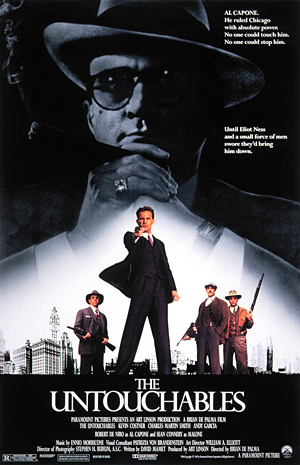
The Untouchables

After seeing The Untouchables (1987), I finally understand that joke in The Naked Gun 33 1/3, where Leslie Nielson imagines himself fending off gangsters on the stairs of the train station while a baby rolls down the steps in a carriage, its mother screaming in panic. It was lifted right from The Untouchables, and it was impossible for me to keep a straight face during that long, drawn-out scene, with the Nielson movie playing in my head. We actually see the mother mouthing the words, "My baby!" in slow motion. And let's not forget that it takes an excruciating three to four minutes of watching her struggle to get the damn carriage up the stairs before Elliott Ness begrudgingly offers her assistance, knowing that any minute the bad guys will come through the doors of the station and he'll be at a disadvantage helping this woman out.

That pretty much sums up The Untouchables: it's a drama queen of a movie, full of director Brian De Palma's tendencies toward hyperbole, and brought to a fever pitch by Ennio Morricone's score, which turns every scene into a touchdown set to an anthem. At times, the music takes on a very 80s-sounding beat via drum machine and you have to wonder how that made it to the final print.

Brian De Palma obviously tried to imbue every scene with the weight of the "I could have been a contender" speech from On the Waterfront. But then again, De Palma has never tried to hide his lack of subtlety, and sometimes, his gaudy directing works well, as it does in much of this movie, in spite of itself. It's a wonder that, as much as this movie desperately wants to be great, it manages to be quite watchable and emotionally affecting.

Yes, The Untouchables is a grandly entertaining movie, even when it's ridiculous. Seeing it reinforced for me both the greatness of The Godfather and the inferiority of the more recent Gangster Squad. I was grateful that Untouchables falls somewhere in between, leaning towards greatness but not quite getting there. It's helped along by the wonderful performance of Sean Connery as Malone, an aging beat cop who becomes the mentor of Elliott Ness. Connery won a much-deserved Oscar for his performance. Even Kevin Costner's performance works. He's a dull actor, but in this kind of role, as the determined Ness, a staunch upholder of the law fighting the bootlegging industry, his banality works better than you might think. The movie would have faltered with a more dynamic actor (say, a Michael Keaton, perhaps) in the role. And Costner's not even as banal as he usually is, perhaps because he's surrounded by a number of vibrant performers, including Connery and Robert De Niro as Capone.

With Andy Garcia and Charles Martin Smith as the other members of Ness's four-man team, Patricia Clarkson, Billy Drago (who's exceedingly creepy as Frank Nitti), Richard Bradford, Jack Kehoe, Brad Sullivan, Steven Goldstein, and Clifton James. Written by David Mamet. ★★★

February 02, 2012

Dressed to Kill

Brian De Palma's most lascivious thriller (with the possible exception of Body Double), Dressed to Kill (1980) shamelessly explores the transgressive nature of human sexuality and the propaganda side of horror movies that depict sex as a death wish. One woman's spontaneous tryst gets her slashed to death in an elevator by a platinum blonde murderess, and a high-class prostitute witnesses the slaying, positioning herself as both prime suspect and prospective victim.

De Palma structures the film like a bad dream, pulling the viewer into a voyeuristic session of gender-bending cheap thrills. But the whole thing's an intentional tease: the murderess with her cheap wig and black trenchcoat and shiny razor is a comical fright figure impersonating a truly terrifying menace, and the victim is punished twofold for having an unexpected affair with a stranger she meets in a museum: she finds out he has a venereal disease (too late), and then meets her death minutes later.

De Palma turns the slasher film into an erotic comic melodrama. He borrows from Alfred Hitchcock's Psycho (particularly the idea of killing off the star early in the movie). De Palma had already ventured into the Hitchcock canon with Sisters (1973) and Obsession (1976). Dressed to Kill is his most sustained shocker. It's like the Id of Psycho's Ego, because Psycho, for all its chilling power, holds back in a lot of ways that Dressed to Kill doesn't.

It would be too easy to dismiss De Palma's work entirely as ripping off Hitchcock, because De Palma always explores a different side. He uses similar conventions of plot and theme as Hitchcock but there's always a sort of cinematic irony underneath what he's doing, as though the joke is that he's turning Hitchcock inside out.

The Pino Donaggio score is appropriately grandiose--it's the symphony of a grand love scene, full of highs and lows and subtle ironies and dramatic swellings that punctuate the set pieces, turning them into sudsy, sensationalistic camp. You'll either revel in its majestic hyperbole or feel indifferent to it all.

With Michael Caine, Angie Dickinson, Nancy Allen, Keith Gordon, and Dennis Franz.

August 26, 2011

Carrie

Poor Carrie White (Sissy Spacek) is the scapegoat at school because she's awkward and quiet and plain. She lives with her raving lunatic of a mother (Piper Laurie), who's such an avid fundamentalist she makes up her own damning scripture verses and then utters them with gospel fervor. On top of all Carrie's problems, she's noticing some strange behavior: she can move objects with her mind if she concentrates hard enough. It's telekinesis, and director Brian De Palma has never had so much fun with it than here. (He takes the theme and runs--in too many directions--again in The Fury).

It's interesting to note that Carrie was Stephen King's first novel, but that we really don't think of Stephen King as much as we think of Brian De Palma when we think of Carrie. De Palma had begun making Hitchcock-influenced thrillers with 1973's Sisters, and some consider Carrie to be his ultimate thriller (that or 1980's Dressed to Kill). More than any of his other thrillers, Carrie has become part of pop culture. There's something sleazy and irresistible about it.  

Carrie is the outcast who simply snaps after she's been pushed too far. She's hated because she's stuck in a shell of social ignorance and otherness. But no one can really blame her for her ignorance, given her home life. In the opening scene, she panics when she experiences--rather late, biologically--the first signs of menstruation, and then pays for it when the other girls in the locker room begin hurling tampons at her. When Carrie gets home, her mother treats her like she's a harlot. Femininity is the enemy in Carrie's house, a sign of weakness and uncontrollable appetites that must be hemmed in by a rigidly dogmatic denial of pleasure.

Despite whatever it's saying about repression and fundamentalism, the movie is really just a big buildup to its grand finale, where the pig's blood prank turns Cinderella into the Medusa, and the Love Under the Stars dance into the prom from hell. De Palma uses a lot of European techniques to endow Carrie with a certain artful trashiness. It's visually very entertaining. Even in its most disturbing moments you find yourself laughing--it's all too histrionic to take seriously, unless you want to view it as a morality tale about the dangers of sexual repression.

Pino Dinaggio's score, which frequently rips off Bernard Herrmann's staccato violin from the Psycho shower scene, is very elegant but also over-the-top. It echoes De Palma's sensibility as a director all the way: violent, chaotic, and sensual, driving yet richly beautiful. Except for the Hermann imitations it's good.

The revenge element--the reason I'm including Carrie in my series on revenge in high school--points, partially, to the movie's endurance in popular culture. Sissy Spacek is so pathetic in the lead that it's hard to really see Carrie as the monster. She's been spit on by everyone, and stifled by her mother, who comes off as the movie's true villain. This might explain why Sissy Spacek did not become typecast as a horror movie star the way Anthony Perkins did for playing Norman Bates in Psycho. People seem to view Carrie as a validation of their wretched high school experiences, and they take comfort that they weren't alone. Carrie's always having a worse day than you, and her telekinetic meltdown elevates high school into the Shakespearean tragedy that everyone falsely makes it out to be in real life. She validates the stupid drama by sending the school up in flames. At least they had the guts to in Carrie what they ultimately couldn't do in Heathers.

With Amy Irving, William Katt, Nancy Allen, Betty Buckley, John Travolta, and P.J. Soles.

July 17, 2011

The Black Dahlia

The murder of Elizabeth Short in Los Angeles in January of 1947 still fascinates people today, including James Ellroy, whose novel this was based on. However, this 2006 crime-thriller, which promises to be akin to the knockout noir L.A. Confidential (1997), is a freaking mess. Brian De Palma directed, without the kinky excitement he brought to his early thrillers (Dressed to Kill and Carrie come to mind). The cinematography by Vilmos Zsigmond is first-rate. He captures beautifully the fact that there's nothing going on in this movie that you should care about. As luridly tingling as the Black Dahlia case is, this movie should have been an easy success. Instead, The Black Dahlia looks the other way, on purpose, as a matter of "style." Rather than focusing on the Elizabeth Short murder, it veers into other, fabricated directions.

Why, I'll never know.

Everything is contrived. If you come to this movie expecting an absorbing retelling of a scintillating true crime tale (even with the knowledge that Hollywood typically tinkers with historical fact), you've come to the wrong movie. If you've come looking for even a whisper of narrative logic, you'll also be left wanting. It's nonsensical. Big dramatic scenes are inflated and unexpected even. When they unfold, we laugh because they're so poorly conceived. (In one scene, Josh Hartnett, as one of the detectives investigating the Dahlia murders, pulls a table cloth off a table in a fit of passion with Scarlet Johansson. It seems a pity to make such a mess with a movie that's so carefully dull.)

De Palma has always been a manipulative little cheat of a director, playing with the audience in obvious ways, but in The Black Dahlia he doesn't even do that. We're supposed to sit back in awe of the "master" at work, but he isn't working, and neither is the movie. The blame should probably go also to the screenwriter, Scott Friedman, as well as James Ellroy (assuming his book is akin to Friedman's adaptation).

The main characters, two LAPD detectives (Hartnett and Aaron Eckhart) are involved in a love triangle with the boring, flirtatious Scarlet Johansson. Johansson was best in Woody Allen's Scoop. He brought out the passion in her, and the curious little pixie that she can turn into, the one who wooed Hugh Jackman, the handsome killer. But she tends to be uninteresting without a good director, and in The Black Dahlia, De Palma doesn't know what to do with her. Perhaps to him, her beauty is enough to maintain the audience's interest in her acting. But for anyone looking beyond the surface, there's little satisfaction.

De Palma is at a loss with the other actors, too. Eckhart's character becomes obsessed with the Dahlia case (he's the only aspect of this movie that stays focused on the Elizabeth Short murder, when the entire film should be reveling in Black Dahlia mania). And so quickly does he go bananas that we as an audience don't feel invested in his transformation. We can only jeer and laugh at a performance that falls flat and looks out of place. He's in the wrong movie. He's in the movie about the Black Dahlia murder, not the movie that pretends to be about the Black Dahlia murder.

As for Hartnett, he's never been that compelling of an actor, and using him in the lead is a miscalculation. He narrates clumsily the clumsy narration (not to mention the clumsy dialogue), and he's so scrawny and young that you don't really buy him as a detective--or as a contender in a boxing match that occurs early in the film (and feels just as out of place as everything else in this misfired movie).

There are some scenes where the police view screen tests of Elizabeth Short. They're meant to humanize the disfigured corpse left in grisly exhibition in an overgrown lot, but instead they just turn her into a bimbo who told fairy tells to get what she wanted. And maybe that's true of the real Elizabeth Short, but for a movie that gives little attention to the subject of its title, this adds yet another nail in the coffin. And Hilary Swank, who's desperately in need of a meal, shows up as another bimbo, someone for Josh Hartnett's character to sleep with in lieu of Johnasson, from whom he feels an obligation to abstain (since she's living with his partner).

Fiona Shaw gives the most overwrought performance as Swank's hopped up mother, a society woman who knows more than a bit about the Short murder. In fact, her performance is so hysterically bad, that I recommend watching this movie now. It was earth-shattering. The always exciting Rose McGowan has a cameo as one of Elizabeth Short's roommates. It's a pity that she had such a small part. She's far more interesting an actress than either Scarlet or Swank.

If only The Black Dahlia were as exciting as L.A. Confidential, or any of the old 1940's film noirs that it was modeled after. Instead, we're left with a labyrinthine mess of a movie that's shooting blanks after promising a bang.