Showing posts with label Woody Allen. Show all posts

August 08, 2015

Irrational Man

Greetings and welcome to the annual Woody Allen movie experience. We’ve carefully selected a script, possibly written 15 years ago (selected from one of our many filing cabinets), which we think will ensure your maximum enjoyment. Mind you, even if you are ultimately unhappy with our selection, you’ll be glad to know that the ordeal shouldn’t last longer than 90 minutes. As per usual, the opening credits will be that same white font across a black background, this time sans music. (We do appreciate the value of change.)

This year’s film is titled Irrational Man. We’ve decided to include as much voice-over effect as possible, since we, honestly, weren’t that into this project and didn’t have the energy to flesh out the characters or their scenes together. Handy voice-overs make everything so much easier when you’re trying to meet those pesky deadlines. Also, our regular viewers will be happy to note that our condescension towards women remains strong, as does our aversion to 21st-century technology. We’ll just leave all that high-tech stuff to the kids.

But here are some kids for you to look at, since this movie takes place at a fancy-pants-liberal-arts-college-in-New-England, and one of them kids is played by Emma Stone. She’s so adorable. And she’s going to be hot-to-trot for this glum philosophy professor named Abe, who is played by Joaquin Phoenix with a potbelly. And we know you’ll appreciate how brilliant Abe is, because Emma Stone’s character will remind you over and over again just how brilliant he is in her voice-overs. She will proclaim his brilliance and all the things that make him so brilliant. She will ruminate on how complicated he is and how sad. He feels that all of life is meaningless and there’s no point in carrying on. How Emma Stone’s character wants to save him.

And see Parker Posey? She’s so talented. (She really is.) She will play a science professor (we’re not sure of the specifics, so the generic term will suffice) at the same college at which Abe works and Emma Stone’s character studies. And Parker Posey’s character will want to bone Abe just as much as Emma Stone’s character does, because Abe is so complicated and brilliant and fascinating and broken and needing to be fixed!

And then—a plot twist.

We are not going to reveal any spoilers about the plot twist, because it does actually make the film more interesting, even though Joaquin Phoenix’s character is so fascinating we could just sit and listen to him summarize the great philosophers all day long and that would be movie enough for us. Somebody bring me a spoon so I can dig into this yummy intellectual stuff, because Woody Allen’s Survey of Western Philosophy is truly a revelation.

Also, we’d like to note that our poet of the year is Edna St. Vincent Millay, as she’s the poet Joaquin Phoenix’s character encourages Emma Stone’s character to read more of. (We hope you remember the time Michael Caine told someone—Mia Farrow? We can’t remember—to read more e.e. cummings in Hannah and Her Sisters. Actually I don’t think it was Mia Farrow.)

All right, now that I’ve got that out of my system.

I was disappointed with Irrational Man, but even as I write this sentence, the inner-critic who lives in my head is shaking his or her head and saying derisively, “Ahhh, what did you expect from Woody Allen these days?” I did hope that this one would be better, since the trailer looked so promising, and since I really do love all three of the leads. Joaquin Phoenix is pretty good as the mopey philosophy professor, but Emma Stone’s infatuation with him is a hard sell, unless you buy that she’s one of those fixer-upper girls. But she’s so smart. And she has a really good boyfriend her own age (cruelly named Ron) whom she cruelly mistreats. Her attraction to Abe feels totally forced, and not necessarily because the idea of it is incredulous. It's because Allen doesn’t write enough scenes of the two of them just hanging out and talking, letting their natural onscreen chemistry and individual charms woo us, the viewers, into their romance. Instead, we get repetitive assurances from the narration of Emma Stone that she just loves him and wants him. 

And again, Allen’s insistence that men are here to teach women about culture and keep them in their place is truly depressing. When Emma Stone’s character says to him, “I love that you order for me,” I felt like hurling. There is one tiny bit of growth in the Woody Allen character (because I think we can all agree that any lead in a Woody Allen movie that’s a man—and that’s all of them—is Woody Allen, whether it’s played by Woody Allen or not): he tells his college-student-girlfriend: “I like that you disagree with my ideas.” So that’s growth, I guess. Annie Hall probably deserved that much from Alvy Singer. And it only took 40 years. 

June 01, 2015

Interiors

Interiors (1978) feels like Woody Allen wanting us to take him seriously, as though making groundbreaking comedies wasn’t good enough. It’s an incredibly conscientious film, shot with skill by Gordon Willis and laden with somber qualities, but it’s also incredibly underwhelming. And not even that original. The problems of the characters have been explored in Allen’s films for his entire career: artistic frustration, fear of commitment, fear of death, etc. Allen has always managed to steal from himself. Some critics would argue that he’s developing several themes over the course of his long career; and if you watch an older Allen film out of context with the rest of his body of work--as I have done, seeing them in a fairly haphazard fashion, starting with, I think, 1993’s Manhattan Murder Mystery and basically working backwards--you do get an unfair advantage. I was, for instance, comparing the three sisters of Interiors (played by Diane Keaton, Mary Beth Hurt, and Kristin Griffith) to the three sisters of Hannah and Her Sisters (1986), and I kept thinking that Allen had done better with his material in that considerably lighter movie.

My mind also drifted to the comparably recent Cassandra’s Dream (2007), another of Woody Allen’s serious pieces, which I detest. Some people adore his dramas, and that’s fine. Allen obviously wants to remind us that he’s scene Bergman’s films, that he’s a well-rounded cinephile, but it’s this need to prove himself that makes Interiors so disengaging. The icy Wasp-mother, played to a kind of heartless, horrifying perfection by Geraldine Page, is so awful that it’s a relief when she drowns herself at the end, except that we know she died a martyr in her own mind. If her neglected daughter Joey (Hurt) can experience some kind of relief in the death of her unfeeling, self-involved mother, it seems somehow trite that Allen turns the event into a device, allowing Joey, the middle sibling who could never express herself like her older sister Renata, the writer (Keaton) or her gorgeous younger sister Flyn, the actress (Griffith), to finally create something fulfilling: a diary. (I must confess I’m guessing on the birth order here; I don’t know that the film makes it very clear, except that Flyn is obviously the youngest.)

With E.G. Marshall as the doctor-father who leaves his wife after 30-plus years of marriage, Maureen Stapleton as the new woman in his life (who has some good moments, the only real air in the whole movie), Sam Waterston, and Richard Jordan.

October 12, 2014

Hannah and Her Sisters

Woody Allen’s Hannah and Her Sisters (1986) has a lot going for it: winning performances by Mia Farrow, Michael Caine, Barbara Hershey, Dianne Wiest, Maureen O’Sullivan, and Max von Sydow; a wonderful soundtrack of jazz music that almost deflates the problems of the people in the movie; and a surprisingly grimy portrayal of New York City. To my recollection, it didn’t have any wide shots of the Big Apple, and most of the times the city is shown under a gloomy grey sky or at night, making many of the larger, dirty old buildings seem forlorn and almost Victorian in their gloom, as if they were exported from a Dickens novel about poor people. It feels like a more honest depiction of living in a big city, especially New York in the 80s.

But there is one lovely scene of New York in which Michael Caine—who’s fallen in love with his sister-in-law, Lee (played by Barbara Hershey)—goes with her to a bookstore. Caine retrieves a volume of poems by e.e. cummings and buys it for Lee, insisting that she read the poem on page 112. (Later, we hear a voice-over of Lee reading it, and it’s one of the loveliest moments in the film.) That bookstore was truly heavenly with all those books stacked up, up, up and everywhere. And the romantic complications of Caine and Hershey’s unanticipated love for each other are dealt with relatively lightly, which is a good instinct on the part of Woody Allen.

Woody Allen in many of ways was my biggest problem with Hannah and Her Sisters, and yet, he’s also responsible for much of the good in this very charming, very amusing, film. Allen plays Mickey, the ex-husband of the title character Hannah (Mia Farrow). Micky is the usual Allen type: neurotic, obsessive, whiny, hypochondriacal. And he grates on the nerves in the usual Allen way. But there are some funny bits that he very generously gives himself. For instance, after various medical tests Mickey believes that he’s dying, but when CAT-scan results prove the opposite, he’s left with the reality that eventually, he will die, and that life is rendered meaningless in the light of this fact, especially if there is no God. Mickey, born and raised a Jew, then begins a spiritual quest that leads him to the Catholic Church for a time, and then to the Hare Krishnas for an even shorter time.

But Mickey’s story, which is interwoven with the stories of Hannah, her sister Lee (Hershey), and her other sister, a struggling actress named Holly (Dianne Wiest), is self-indulgent. Although it is funny some of the time, it’s also a constant reminder of the director’s arrogance. Why does it have to be about Woody Allen all the time? Hannah and Her Sisters really shines in some moments, but Mickey’s constant whining about the meaning of life sometimes feels like a buzz kill.

Still, there are so many lovely moments in Hannah and Her Sisters that it’s difficult to dislike the movie just because of the Mickey scenes and their tendency to grate on one’s nerves. Maureen O’Sullivan (mother of Mia Farrow in real life) is another highlight, playing the three sisters’ mom, who still likes to flirt with young men and drinks too much at parties (a tricky combination). She and her husband (played by Lloyd Nolan) have an argument somewhere in the second half of the movie, but it all melts away when he sits down and plays the piano. There’s a scene shortly after at a Thanksgiving gathering they’re hosting, where he sort of introduces his wife by telling a story about her from when they were dating: the men used to be so distracted by her beauty, they would drive their cars into the sidewalk. She smiles and then he plays the piano some more. How lovely that a man can recall such flattering memories of his wife and make her the star of the show with just his words.

Hannah and Her Sisters ends on a problematic note: Mickey begins dating Holly, the failed-actress-turned-struggling-writer, and after they’re married she announces that she’s pregnant. It’s as if Woody Allen was the secret to happiness, because after she writes a play and reads it to him, they begin dating. It seems quite clear that her attraction to him is based on his lavish praise of her writing. (Earlier, the movie shows us a date between them years before where they did not hit it off and vowed to themselves never to see each other again.) It feels phony and hampers the film, which up to that point, at least tries to deal honestly with relationships.

With Carrie Fisher, Julie Kavner, Daniel Stern, Sam Waterston, and Julia Louis Dreyfus. 

June 06, 2013

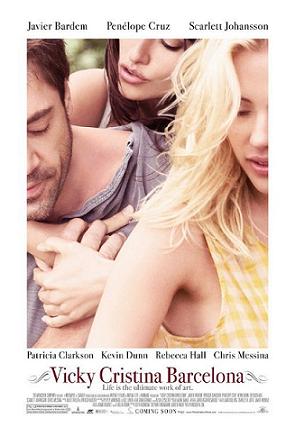
Vicky Christina Barcelona

Vicky Christina Barcelona (2008) is flirtatious and enchanting fun about two best friends whose extended stay in Barcelona one summer has unexpected effects on both of them, and all because they meet a charming, suave painter, a sort of modern-day Casanova, played by Javier Bardem, who invites them to spend the weekend with him. Fun-loving and curious Christina (Scarlet Johansson) is intrigued and immediately receptive, while cautious, level-headed (and engaged) Vicky (Rebecca Hall) balks at Bardem's outright proposition.

Of all Woody Allen's recent movies, this one--along with Scoop--is the most entertaining. Allen is currently on a quest to capture all the romantic European cities. With Barcelona, there isn't so much of an expectation--as there was with Paris in Midnight in Paris. This is breezy, undemanding entertainment that is clever and unpredictable enough to feel fresh and playful.

Penelope Cruz plays Bardem's ex-wife, a dramatic, neurotic painter who allegedly tried to kill him during one of their famously intense fights. When she enters the picture, things get even more complicated. Allen presents Barcelona as a kind of drink, and its effects on the two unsuspecting American girls are like the effects of alcohol, intoxicating the senses, making them falter in their once sure-footed plans for the future, and filling them with a new-found appreciation for the unpredictable. With Patricia Clarkson, Chris Messina, and Kevin Dunn. Narrated by Christopher Evan Welch. 97 min. ★★★

April 11, 2012

Cassandra's Dream

In Cassandra's Dream (2007) writer-director Woody Allen aims for something along the lines of Greek tragedy in the modern world: Two brothers (Ewan McGregor and Colin Farrell) are hired by their rich uncle (Tom Wilkinson) to rub out one of his business associates who's going to testify in court against some apparently damning illegal activity. But the consequences are far graver than they imagined.


A feeling of dread comes over you about midway, when the brothers' choices start to develop into their repercussions. McGregor's character, Ian, becomes corrupted (almost entirely but not quite) by his own ambitions, and Farrell's, Terry, begins to fall apart because he can't live with the guilt, and moreover, the sense that he has upset some kind of moral balance for which he must atone.

Cassandra's Dream makes a point of giving us an insightful look into human drama, the irony of life. Ian's girlfriend (Hayley Atwell) is an actress, and once while she's performing on stage, her character says this, that life is ironic. Of course the play is not accidentally talking about the theme which runs throughout this movie, and of course the reference to the Greek character Cassandra is important as well. But I'm wondering at what cost.

This movie was just depressing. The performances are all delivered by competent, effective actors. Sally Hawkins is remarkable as Farrell's girlfriend Kate. Farrel; may resort to the same tricks to convey his angst (twisting his face, raising his voice up an octive, all the things that made him really stand out in In Bruges), but he's good. Surely no actor was better when looking panicked and guilty.
 You feel for Terry much more than Ian, McGregor's character.

McGregor maintains his usual level of poise and self-assurance. I'm not sure exactly, but I believe one of the reasons I enjoy Ewan McGregor is for his banality. There's something consistently measured, controlled, calculated, in his performances. He's always a calming agent, and this makes for a contrast and a foil to Terry's weak, unstable constitution.

But the movie doesn't give you much enjoyment for all its important-ness and its references to stock literary conceits and characters. It's too much like life to be an entertainment. How long can you admire good acting when you're depressed, and part of you regrets starting the movie in the first place because you were in the mood for something else? Woody Allen is certainly not expected to confine himself to romantic comedies (his comedies have always been so much darker anyway, dwelling on the ironies of life as they do), but in the case of Cassandra's Dream, I felt ready for it to be over well before it was.


June 15, 2011

Midnight in Paris

Woody Allen has always approached the fantastic without feeling a need to explain it or unravel its mystery. He's dealt with the collision course of the real and the unreal in such films as The Purple Rose of Cairo (1985), where a movie character leaves the screen and enters the life of a Depression-era waitress played by Mia Farrow; and, more recently, in Sleuth (2006), which was a wonderfully witty mystery yarn where we witnessed the murdered victim's journey down the river Styx, where she expresses her frustration over the events that lead to her death.

In Midnight in Paris, Allen takes us to the City of Light and layers it with the mysterious undercurrents of time travel. Owen Wilson plays Gil, a would-be novelist who's bored and dissatisfied with the success he's had as a self-proclaimed hack screenwriter. He's lost his sense of enchantment with movies, turning instead toward literary pursuits. He dreams of living in Paris in the 20s, when all the expatriates were there on seemingly never-ending holidays, drinking and dancing and having deep, sophisticated conversations into the night; and falling in and out love; and realizing the vision of their art.

Instead, Gil is visiting Paris with his fiance, Inez (Rachel McAdams), who's not very enchanted by Paris, at least, not at first. Gil's hoping for stormy weather so he can stroll through the city in the rain. She's perplexed by this, views it as eccentric. Her parents are with them (they're played by Kurt Fuller and Mimi Kennedy), and they don't connect with their future son-in-law at all. It's as if the city exposes all the differences between Gil's and Inez's personalities for the first time, or perhaps it just illuminates them on a grander scale, and suddenly her lack of romanticism is driving him up the wall. Plus, they unexpectedly meet an old friend of Inez (Michael Sheen) and his wife (Nina Arianda). He's a professor of art, and his knowledge impresses Inez, who admits that she had a crush on him in college.

The stage is set for reality to take an unexpected backseat in Gil's life. He is transported back to 1920's Paris. He meets F. Scott Fitzgerald (Tom Hiddleston) and his loopy wife Zelda (Alison Pill), and Cole Porter Yves Heck), Ernest Hemingway (Corey Stoll), Gertrude Stein (Kathy Bates), Pablo Picasso (Marcial De Fonzo Bo), and Salvador Dali (Adrien Brody), to name a handful. It's the most delightful moment if you go into this movie with absolutely no knowledge of what's going to take place. And especially if you have any interest in the artists and writers of the 1920s, it's like a wonderful dream. Gil finds himself being drawn into this other-worldly encounter every night at midnight, and he begins to develop a romantic interest with Adriana (Marion Cotillard), a muse/lover of Hemingway and Picasso.

Allen's movies of the last few years have had a strangely ineffectual slightness to them when you get beneath their witty, refreshing premises. Midnight in Paris isn't any different in that sense. Beyond the surprisingly fun idea, is a movie that sort of meanders along without anything much to say. Gil learns that you have to live in the moment, rather than dreaming about the past, idolizing it to the point where an era becomes a fantasyland that never really existed. There are moments, however, that make Midnight in Paris a joy. It's the movie's wonderfully intoxicating love of the past that plays with your head even when the "message" is trying to tell you not to worship the past too much. It can be dangerous, after all.  Plus, you'll find that in every era there were people who felt they were missing out for being born in the wrong moment of history.

Allen, who has done quite a few nostalgia pieces, might very well be writing a cautionary tale to himself. Indeed, Gil's character seemed perfect for Allen if this were 1975. Diane Keaton could have been Inez. In 2011, Wilson and McAdams make an acceptable pairing, but I've always found Owen Wilson to be slightly uninteresting. He seems to be totally lacking in intrigue. McAdams has a wonderfully likeable quality, but that is squelched here by a character who's a complete drag. And she's off having a wonderful time with the snooty college professor while her husband is having bizarre experiences that might have been the result of a bad LSD trip.

May 15, 2011

Manhattan Murder Mystery

Manhattan Murder Mystery (1993). Diane Keaton and Woody Allen traipsing through Manhattan trying to figure out if their elderly neighbor (Jerry Adler) murdered his wife. An enjoyable movie (Allen's 2006 comic-mystery Scoop is kind of a companion to it) that coasts on the charisma of its stars. Keaton's character drives the investigation--she's bored with her life and the prospect of a genuine murder mystery is just too tantalizing to ignore, dragging her neurotic, whiny, reticent husband (Allen) along. The banter between them is wonderfully witty, a lovely little tribute to the films they made in the 1970s like Annie Hall. I think this one is totally underrated. It's not as "important" as some of Allen's earlier films, but it's got a wonderfully vervy charm to it that keeps the viewer engaged in the comic suspense. With Alan Alda, Anjelica Huston, Joy Behar.