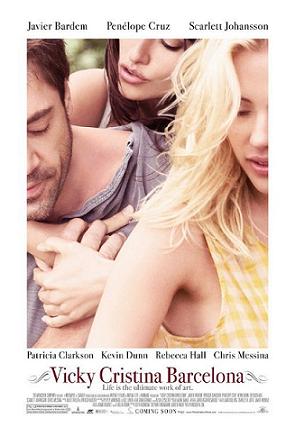
Vicky Christina Barcelona (2008) is flirtatious and enchanting fun about two best friends whose extended stay in Barcelona one summer has unexpected effects on both of them, and all because they meet a charming, suave painter, a sort of modern-day Casanova, played by Javier Bardem, who invites them to spend the weekend with him. Fun-loving and curious Christina (Scarlet Johansson) is intrigued and immediately receptive, while cautious, level-headed (and engaged) Vicky (Rebecca Hall) balks at Bardem's outright proposition.
Of all Woody Allen's recent movies, this one--along with Scoop--is the most entertaining. Allen is currently on a quest to capture all the romantic European cities. With Barcelona, there isn't so much of an expectation--as there was with Paris in Midnight in Paris. This is breezy, undemanding entertainment that is clever and unpredictable enough to feel fresh and playful.
Penelope Cruz plays Bardem's ex-wife, a dramatic, neurotic painter who allegedly tried to kill him during one of their famously intense fights. When she enters the picture, things get even more complicated. Allen presents Barcelona as a kind of drink, and its effects on the two unsuspecting American girls are like the effects of alcohol, intoxicating the senses, making them falter in their once sure-footed plans for the future, and filling them with a new-found appreciation for the unpredictable. With Patricia Clarkson, Chris Messina, and Kevin Dunn. Narrated by Christopher Evan Welch. 97 min. ★★★
Showing posts with label 2008. Show all posts
June 06, 2013
June 03, 2012
Role Models
Role Models (2008) is another one of those man-child-becomes-mature comedies, bolstered slightly by Paul Rudd's performance. He plays Danny, who pedals energy drinks to America's youth, with the help of his partner, Wheeler (Seann William Scott), who wears a giant minotaur suit. After Danny has a meltdown (following a rejection by his would-be fiance, he and Wheeler are ordered to participate in a mentoring program called Sturdy Wings. Their "littles" are a nerdy fantasy freak named Augie (Christopher Mintz-Plasse) and a foul-mouthed devil-child named Ronnie (Bobb'e J. Thompson). If watching a 9-year-old boy curse like a sailor is your idea of a good time, then Role Models is the movie for you.
It's an elongated sitcom, written by Rudd, director David Wain, Ken Marino, and Timothy Dowling, and between the four of them they couldn't come up with any original ideas or gags. The characters are all familiar archetypes: Danny is a sardonic curmudgeon, Wheeler is a horny man-whore, Elizabeth Banks, as Danny's girlfriend, is the beautiful, successful lawyer who's somehow put up with Danny's shiftless negativity for seven years, and Jane Lynch is the oddball director of the Big Brother-like organization. Lynch gives the film a few moments of relief, but her character is weird for no reason. There isn't anything credible about her, or anyone else. Forget motivation or story impetus. There are moments where Rudd and Scott mesh well together. They get into a comic rhythm that is funny and engaging, but the movie isn't well-thought-out enough to sustain their performances, and their performances don't do much for the movie overall. They may get you through it, but that's about it.
May 06, 2012
Quantum of Solace
Quantum of Solace (2008) is an absorbing, fairly compact sequel to Casino Royale, and its story feels stronger, or perhaps just more focused and driven, because 007 is looking for vengeance for a lover who he's not sure even loved him. It may be that people are hailing Daniel Craig as the best of the Bonds because he's playing a Bond who is genuinely affected by the things that happen to him. He's not a sitcom character whose slate is wiped clean at the end of each episode. And Craig looks the part. His face looks hardened and dazed, like a junkie whose addiction is used to ameliorate other pains. But he's also a striking actor, who doesn't botch the character by over-thinking it. After all, the allure of the Bond films has always been an artificial one, and to turn him into a completely "realistic" character would probably destroy that sense of artificiality that makes Bond superhuman. He's a superhero who doesn't need capes or magic or any kind of supernatural powers, and he has enough moral ambiguity to not be a cop-out.
Director Marc Foster seems tuned into what will make this movie work. He doesn't drag things out as much as Martin Campbell did in Casino. Quantum has a more engrossing sense of mystery about it than Casino Royale, even though Casino may be more memorable as an action thriller. It did have some stunning set pieces. Quantum does too, and it also taps into the growing anxiety about the environment as an impetus for international criminal activity, as Bond targets a multinational corporation run by Dominic Greene (Mathieu Amalric) that's trying to control the world's oil and water supplies. There's also a subplot about a scummy dictator named Medrano (Joaquin Cosio) who murdered the family of Bond's latest conquest, Camille (Olga Kurylenko). She wants revenge, and this unites her with Bond on a considerably personal level.
Judi Dench returns as M. Her imposing personality is always worth watching on the screen, and she continues to have a fascinating relationship with Bond that is a partly maternal, partly manipulative, and partly malicious.
Written by Paul Haggis, Neal Purvis, and Robert Wade. With Giancarlo Giannini, Jeffrey Wright, Gemma Arterton, David Harbour, Jesper Christensen, and Rory Kinnear. Stunning visuals, designed by the company MK12 accompany the films opening titles.
April 07, 2012
In Bruges
Two hit men await orders from their boss about their next job, in Bruges, Belgium. Writer-director Martin McDonagh maintains a droll sense of humor that sustains the movie through its dark subject matter, and turns it into something remarkably like Shakespeare. Colin Farrell and Brendan Gleeson play the hit men. Gleeson is cultured, wise, measured, and careful, and Farrell is cocky, questioning, and bored with the sights of Bruges. In fact, it becomes a running joke that he will be stuck in Bruges forever.
The supporting cast is eclectic and gives the movie a trippy other-worldliness: there's the live-wire of a boss, played by Ralph Fiennes, who turns swearing into art. There's an American dwarf actor (Jordan Prentice) who's filming a movie there, as well as a duo of crooks (Clemence Poesy and Jeremie Renier) who specialize in stealing money from tourists after luring them into their apartment.
Farrell has perhaps never been more appealing than in this role, because his cocky facade is easily shattered to reveal a weak, scared man who isn't really up to the line of work he's chosen. And Gleeson becomes oddly philosophical as events turn toward the fatalistic. But it's the humor that really works for In Bruges. It would have been a maudlin piece of camp otherwise. Instead, we get something really quite stunning; a smashingly twisted crime serio-comedy that refuses to stay within the boundaries of clearly defined genres. ★★★★
August 07, 2011
Body of Lies
This twaddle about terrorism and the CIA is mixed-up and convoluted. It's the kind of massive, dull, film that makes you think the occasional explosion or torture scene is climactic, when really it's just a minor interruption to the plodding rhythm of a movie that's too high-minded and pseudo-intellectual for its own good. It's proof that two respected actors and a well-known director (Ridley Scott). can pick a bummer.
I've never been completely sold on DiCaprio anyway. He's certainly got talent (and he shines in the right part, such as in Catch Me If You Can), but he often fails to be convincing in the roles in which he's cast. Did anyone really forget it was Leonardo DiCaprio they were watching rather than Howard Hawks in The Aviator? Blame it on the youngish face that has kept him looking 25 even at 35 (and older). You're always aware that he's acting.
On the other hand, Russell Crowe looks and sounds better than he acts in this movie. He becomes immersed in the character at the surface level, but he never gets the delicious breakout scene we're expecting. There's no meltdown. Even when DiCaprio's character pushes him out of his chair (a funny scene that gets underplayed, even dismissed, because this movie is too serious to really care about humor), Crowe's character reacts with phony finesse, and lifts higher our anticipation that he'll blow a gasket sooner or later. It doesn't pay off. Crowe puffed himself up to play DiCaprio's sleazy and slick good-ole-boy boss, a doughy Southern scoundrel who's too much of a coward to do anything but pull the strings and push the buttons. He's placed with the obvious intention of conjuring up the image of any number of politicians in recent history. but his character has nothing likeable.
This is a movie that's bungled by its own high-falutin aspirations, not to mention its relentlessly sluggish pacing. It's trying to be hip and complex, and as a result, its true intentions are too cloudy to be clear. The movie fails to resonate with the viewer. Actress Golshifteh Farahani breathes some life into the muddle for a while, as DiCaprio's Jordanian love interest, and Oscar Isaac registers well as one of DiCaprio's partners. (He played the scummy Prince John in another, better, Ridley Scott-Russell Crowe movie, Robin Hood).
Based on a 2007 novel by David Ignatius.
July 09, 2011
What Doesn't Kill You
A movie that overcomes its murky Boston-in-winter setting, carried by Mark Ruffalo's performance as a career criminal who's trying to justify his profession to his wife (Amanda Peet) and two young sons. It's similar to 2010's The Town, except it's a richer character study, and it doesn't sensationalize the violence the way The Town did. Ruffalo is an exceedingly good actor, but he has this calm, monotone voice that I think hides his abilities at first. What he's doing is never immediately apparent. He brings certain flair to his characters but there's a sense in which none of the people he plays are that far removed from each other.
In What Doesn't Kill You (2008), he's Brian Kelly, a guy who's been stealing money all his life (along with partner-in-crime Ethan Hawke). In 2000's You Can Count On Me, he was Laura Linney's ne'er-do-well brother, likewise a character made up of compulsions. Both Brian and Terry feel unable to change the course of their lives. However, there's a greater sense of determination in Brian. He has more at stake than Terry.
What Doesn't Kill You avoids some of the crime genre cliches, partly by some clever editing. Robert Hoffman is credited as the film editor, and he and director Brian Goodman do something quite interesting with this movie's transitions. You will go from one scene to the next without a clear explanation of why you're there, and Goodman leaves it up to the actors to clue us in on what has happened since the last scene. There are often not just spacial movements from scene to scene, but very liminal movements in time.
This movie takes place over 20 years, and yet manages to tell a long story in 100 minutes. You can't be anything less than grateful when the filmmakers are capable enough to get their story out compactly. This story is too grim and murky to be drawn out into an epic form, and Brian Goodman is keenly aware of that in his direction. More than focusing the film at an epic scale, he zooms in on Ruffalo's character, because this is ultimately not a movie about armed car robberies or mindless shootouts, but about the compulsion within a man to keep doing the same dumb things out of pure habit. The movie keeps us cynically convinced that Brian isn't going to be able to resist the pull of the crime world (not to mention the booze and the cocaine that have enslaved him for so long).
Amanda Peet is a terrific actress. She hasn't really gotten her due, but I think she's done good work in everything I've seen her in. She played Rebecca Hall's self-centered sister in Please Give, and she does a good job in a thankless role as Brian's devoted wife, Stacy, in What Doesn't Kill You. Ethan Hawke is also good. He's so sleazy, like a pale, skinny, slightly taller Joe Pesci. The more he ages the more you feel he was made for these kinds of roles. He's come far from the fresh-faced teen in Mystery Date and Reality Bites. With Will Lyman, the director, Brian Goodman, Angela Featherstone, Edward Lynch. Donnie Wahlberg also shows up as a cop.
In What Doesn't Kill You (2008), he's Brian Kelly, a guy who's been stealing money all his life (along with partner-in-crime Ethan Hawke). In 2000's You Can Count On Me, he was Laura Linney's ne'er-do-well brother, likewise a character made up of compulsions. Both Brian and Terry feel unable to change the course of their lives. However, there's a greater sense of determination in Brian. He has more at stake than Terry.
What Doesn't Kill You avoids some of the crime genre cliches, partly by some clever editing. Robert Hoffman is credited as the film editor, and he and director Brian Goodman do something quite interesting with this movie's transitions. You will go from one scene to the next without a clear explanation of why you're there, and Goodman leaves it up to the actors to clue us in on what has happened since the last scene. There are often not just spacial movements from scene to scene, but very liminal movements in time.
This movie takes place over 20 years, and yet manages to tell a long story in 100 minutes. You can't be anything less than grateful when the filmmakers are capable enough to get their story out compactly. This story is too grim and murky to be drawn out into an epic form, and Brian Goodman is keenly aware of that in his direction. More than focusing the film at an epic scale, he zooms in on Ruffalo's character, because this is ultimately not a movie about armed car robberies or mindless shootouts, but about the compulsion within a man to keep doing the same dumb things out of pure habit. The movie keeps us cynically convinced that Brian isn't going to be able to resist the pull of the crime world (not to mention the booze and the cocaine that have enslaved him for so long).
Amanda Peet is a terrific actress. She hasn't really gotten her due, but I think she's done good work in everything I've seen her in. She played Rebecca Hall's self-centered sister in Please Give, and she does a good job in a thankless role as Brian's devoted wife, Stacy, in What Doesn't Kill You. Ethan Hawke is also good. He's so sleazy, like a pale, skinny, slightly taller Joe Pesci. The more he ages the more you feel he was made for these kinds of roles. He's come far from the fresh-faced teen in Mystery Date and Reality Bites. With Will Lyman, the director, Brian Goodman, Angela Featherstone, Edward Lynch. Donnie Wahlberg also shows up as a cop.
April 07, 2010
Food, Inc.
Some things to remember when viewing a documentary: 1) Images can often be manipulated out of their original context; 2) Use of music and editing techniques can heighten the emotional wallop of a scene in the documentary to manipulate the viewer 3) since a documentary is not a research paper, the filmmakers aren't really required to "cite their sources" or even explain beyond any doubt the facts they present and the arguments they make.
That being said, I highly encourage everyone to see Food, Inc. It's a powerful examination of the food industry in America. I listed the above criteria for viewing documentaries because I think it's absolutely important to remember that everyone has an agenda--even the seemingly well-meaning documentarian, and so it's not enough to simply swallow everything you're fed (pun intended, obviously). However, the claims made in this movie are provocative, and the evidence presented in the movie very convincing. When I examined their points at face value, everything they argued (mainly, that the food industry is for the most part controlled by a handful of gigantic corporations more concerned with making money than making healthy food that respects animals, the environment, and the consumers) seemed very straight-forward and common-sensical.
I'm not a very adept economist or businessman, so I can't really examine the logistics of the food industry with much expertise. But I get (I understand, but do not necessarily support) why companies are trying to produce more food at less cost. However, it seems like the cost is not really that cheap...it may indeed be deadly.
Immediately, however, I am reminded that our current life expectancy in America continues to rise. On the other side of that argument, it seems that cancer is becoming more and more pervasive. Every time we turn around it seems, someone else we know is diagnosed with a type of cancer. I have to wonder if what we eat is a huge part of this problem.
Food, Inc. reaffirms some of the things a lot of us have already been thinking for a while: it's worth it to pay extra for milk retrieved from cows not being abused or fed weird chemicals; it's worth it to pay extra for vegetables at a farmers' market that were grown locally and support farmers who are trying do things right. It is quite ridiculous to gripe about the cost of vegetables if we're buying soda and fast food left and right.
Is Food, Inc. just promoting yet another anti-capitalist movement? I'm not sure. Someone being interviewed made a comment that "we're not going to get rid of capitalism fast enough for that to be the solution" (I'm paraphrasing). However, the narrator made the comment that the control our government has over the food industry is just a really insidious form of socialism. It would be better for everyone if this issue veered away from becoming another left vs. right debate. I think the pitfalls of capitalism AND socialism are problems we will always be dealing with. As the Wal-Mart execs say in the movie, the market will decide what they choose to sell. If we buy healthier products, companies like Wal-Mart and Publix will be only too happy to oblige us.
Before I give away everything, check out this movie, nominated for the Best Documentary Oscar this year. ★★★
December 17, 2009
The House Bunny

In my quest to watch the noteworthy films of 2009, I inadvertently drifted back to 2008 and landed upon The House Bunny: the feel-good sophisticated comedy of the year! Or, perhaps the opposite. Let's be honest, no one goes to a movie starring Anna Faris (star of all the Scary Movie flicks) for her keen wit or comic bravado. She is, however, a funny actress (although she may be stuck in a rut playing the dumb girl for longer than she should). The House Bunny starts, proceeds, and ends, predictably enough: narcissistic and shallow but likable Playboy bunny Farris is ejected (rather suspiciously) from the Playboy Mansion (it may help to liken this to Nixon's self-imposed abdication of the White House) and forced to make something of herself.
She inadvertently winds up in a college town and discovers that being a "Housemother" to a sorority might be a pretty good gig for a girl whose only real talents are dressing in skimpy outfits and acting stupid to attract attention from guys (and envy from girls). Happening upon the fledgling Zetas, Faris offers to help them gin up their image and increase their non-existent recruitment (a problem which threatens the loss of their house). What is the answer to their sorority woes, you ask? Shredding their geeky appearances, social awkwardness, and smarts for sexy attire and superficial giggly-ness. Nothing that an out-of-work Playgal can't handle! Indeed, they transform from the caterpillars no one would talk to, to the butterflies everyone's talking about. The seemingly contradictory lesson? Beauty is on the inside (wow, HOW original). Of course, a rockin' hot bod helps too, giving you the audience to demonstrate your erudition and individuality.
It's always fun when shallow and sexist movies attempt to redeem their entire plots by offering a predictable but palatable message. Problems: Why would girls like this even WANT to be in a sorority if the other sorority sisters are so vapid and vain? Also, why would they want to change into something they aren't? The film (I often throw this high-brown term around like Paula Dean throws sour cream on butter) tries to present to us the idea that women can be both hotties and brains, like, at the same time, for real! ★★
August 22, 2009
Last Chance Harvey
Dustin Hoffman and Emma Thompson are two of the best actors around today. Their pairing in Last Chance Harvey (2008)--if unexpected--is perfect. Their unlikely romance is kindled in London where he's visiting for his daughter's wedding. Kate Walker (Thompson) works at Heathrow Airport (don't blink and miss a brief exchange between the pair in the beginning of the film, before they know each other), and is lonely and introverted. She lets her mother badger her with constant phone calls because she has no other close relationships, except a couple co-workers who are always trying to fix her up with guys.
Harvey Shine (Hoffman) is equally lonely. His dream of being a jazz pianist deferred, he's a self-described composer of jingles (for television commercials) being forced into retirement by the changing industry. The London trip is low on the priority scale. He and his daughter Susan (Liane Balaban) maintain a stilted relationship, and he feels slighted by his ex-wife (Kathy Baker) and her new husband (James Brolin), who has stepped up in many ways as Susan's more involved father figure (to the point that he's been asked to give her away, much to Harvey's chagrin).
It's in the midst of all these circumstances--be they self-imposed or the product of outside forces--that Harvey and Kate meet, at a bar. She's trying to read while he attempts small talk.
In the hands of less capable performances, Last Chance Harvey might have lapsed into the cliched. It's not an overly original tale. It's a character study--thus relying most importantly on strong acting, which it gets in stoves. You feel for both these lost souls, even if their plight is of their own doing. And there's a beautifully redemptive side to it all, something brought about by the relationship the two form over just a weekend. Set against the surprisingly romantic and appropriate London backdrop, Last Chance Harvey distinguishes itself as a poignant comedy for adults when most of today's movies fail to grasp things like the nuances of a character or the emotional importance of every line and facial expression, every passing glance, and every note.
Which leads me to my final note on the film, the lovely, piano-driven score by Dickon Hinchliffe. It perfectly accents the film both in its dramatic lows and its comedic highs. Written and directed by Joel Hopkins. ★★★
August 12, 2009
Bottle Shock

I've decided that one day, when I have a career and money, I am going to travel California's wine country for a couple of weeks. Drinking in the beautiful scenery--spitting out the wine samples--and who knows what else. It sounds like an ideal vacation to me. A friend of mine recommended the movie Bottle Shock, which I guess will have to suffice as a means of vicariously experiencing wine country. Along with Sideways, Bottle Shock is part of a distinct sub-genre of wine-lovers' movies. I was intrigued by Sideways for its eccentric fascination with wine, but turned off by the two douche bag characters in the movie. So I liked Bottle Shock much more because it offered the same eccentric love of viniculture and characters who were far more likable and just as human.


Chris Pine, who we all know from Star Trek, plays an aimless young man who works on his father's Napa vineyard. His dad (Bill Pullman) is tired, disappointed with himself for leaving a law firm to make his own wine, and facing insurmountable piles of debt. Meanwhile, a condescending British wine connoisseur (Alan Rickman) is facing problems of his own in France, where he runs a school for wine studies. Rickman reluctantly ventures to California's wine country, a term he acknowledges with not a little disdain, and tries to discern whether or not those unsophisticated Americans are actually making anything worth spitting into a tin cup after you sample it and describe the taste with phrases like "firm, robust, full of body, and a hint of tangerine." Essentially, it's Amadeus all over again, and Chris Pine is the delightfully mad genius to Rickman's taciturn, irretrievably jealous Salieri.

At first Bottle Shock appears a meandering tale of some folks who love wine. However, the more I got into the movie, I began to really enjoy its idiosyncratic subject matter. Combining Alan Rickman's tasteful Britishness and Chris Pine's whole "I thought showering was optional" persona is just eccentric enough to suit a movie which finds its roots in both French haute culture and 1970s Western Americana. Even Bill Pullman is good--and usually I find him to be somewhat subdued. Freddy Rodriguez co-stars as Pine's buddy, a natural-born vintner who's got his own dreams about making wine. Rodriguez is sort of the James Dean of the cast. He gets taunted with but never gets the glory or the girl.

I think my favorite scene was of Pullman popping a wine cork with a sword at his old law firm. I'm pretty sure Jesus turned water into wine with as much alacrity.
Directed by Randall Miller. With Dennis Farina, Rachael Taylor, Eliza Dushku. ★★★
April 11, 2009
Twilight

I was roped into watching Twilight, the film based on the novel by Stephanie Meyer.
I’ll admit I was gunning for this movie from the beginning, but I think that if it had been a good movie it would have won me over. Instead, I kept wondering when it would end. It felt like watching the WB. It felt like watching rain fall. It felt like bad writing and unimaginative filmmaking. Actress Kristen Stewart (Bella) only has three acting techniques: scrunching up her face, looking around (at anything but at her boyfriend), and not smiling. Robert Pattinson’s character Edward is, of course, far more interesting. In fact I must sympathize with Stewart for having such a boring role.
Having watched numerous other vampire films, it’s hard not to compare Twilight to those I thought offered similar themes with much more humor and imagination. I think one of the biggest problems of the movie Twilight is that it fails to offer characters who grab the attention of the viewer. The villains seem like an afterthought. They appear near the end with very little prior introduction, except a rather tame “feeding” scene where their quick movements are demonstrated by some obvious computer graphics.
Meanwhile, the budding romance is a little too tried and true, and a little too Jack and Rose. The only thing that’s missing is an unsinkable ship. It seems to easy, Pattinson’s whole “I’m pale, I’m dark, don’t love me” argument. And of course Stewart can’t help but fall for that old line, leaving the nice guys out in the cold. There was not enough at stake (if you’ll pardon the pun), for the romance to be of much import. And the film wasn’t scary or suspenseful enough to work on a horror-film level. ★★
Subscribe to:
Posts (Atom)


