Showing posts with label Scarlett Johansson. Show all posts

June 11, 2016

There's lots to see in "Captain America: Civil War," but not much stands out.

In Captain America: Civil War, the Avengers are forced to sign a treaty with the United Nations that will prevent them from interfering with bad guys unless specifically conscripted by individual nations. This causes a rift between the Avengers, some of whom (including Black Widow, played by Scarlett Johansson) consider it a necessary evil, while others (among them Captain America, played by Chris Evans) see the treaty as a form of surrender that will tear the Avengers apart. The latter eventually happens, and we see multiple Avengers fighting each other in a mostly light-hearted sequence. It’s lighthearted because so little is at stake: we know that none of the Avengers is actually going to be killed. Usually in any narrative, low stakes are a reason not to care about what’s happening, but in this case, the low stakes are a relief.

I found myself enjoying this scene all the more because it wasn’t an excuse for rampant destruction of whole city blocks. Instead, the writers and directors punctuate this scene, which takes place at an airplane hangar, with a flurry of mini-conversations between all these characters (Captain America, Iron Man, Falcon, Hawkeye, Black Widow, etc) as they spar with each other. Ant-Man (played by Paul Rudd) cuts every moment down to size with a dumb joke. (He may be the least respected and most undervalued of all superheroes.) And the sequence showcases the amusing, cocksure arrogance of a young Spider-Man (Tom Holland).

Of course, the great heretofore unacknowledged joke of most superhero movies is that the heroes end up destroying the city in an attempt to save it. We see some all-powerful evil agent smashing cars and toppling buildings, and the heroes are forced to add to the destruction, though we assume it’s out of necessity. These movies gleefully stage enormous battle sequences that should kill thousands of human beings, but because the films are targeted at kids, we’re supposed to be okay with it. And, conveniently, nothing too horrible ever happens to a discernable human being. (Don Cheadle does get hurt pretty bad in this one, but he’s one of the heroes, not some innocent bystander.) It’s nice that Captain America: Civil War incorporates this joke/problem into its story.

The rest of the film vacillates between mindless, sped-up action sequences and little dramatic exchanges reminiscent of The Young and the Restless. The Scarlet Witch (Elizabeth Olsen) is traumatized when she uses her powers and accidentally destroys a whole building. (This is the impetus for the disputed U.N. treaty.) Tony Stark (Robert Downey, Jr.) is still haunted by the deaths of his parents. Captain America has a little romance brewing with CIA agent Sharon Carter (Emily Van Camp, who has a real screen presence). There are others, but I’ve already forgotten them. These dramatic moments don’t ever really pop, perhaps because they’re cloaked in sameness. The film certainly has a rhythm, and directors Joe and Anthony Russo are smart enough to give the audience little breaks between all the fighting. But they seem to have only two approaches to a scene: make it fast or make it slow. Perhaps we wouldn’t need so many breaks from the action if it were meaningful and not mindless, if it were artful and clever and exciting and not merely overwhelming and predictable.

I tried hard to discern what was going on during those moments of fighting between multiple characters. The action is sped up so much that it’s impossible to sort out what amounts to a jumble of images. Is this supposed to be entertaining? Don’t people find it chaotic and therefore impossible to connect with or enjoy? I realize that these films appeal to viewers as mindless entertainment, but how is it entertaining when you can’t even tell what’s happening? Whenever filmmakers overly rely on shaky cameras and rapid editing, my assumption is that they’re covering up their ineptitude, hoping we’ll give them credit for putting something up there, whether it possesses visual logic or not, whether it’s well-choreographed or not.

Action—whether derived from a comic book or not—doesn’t have to be this way. See John Wick, and you’ll see how to make a mindless action movie with real visual elegance. Of course, John Wick is also R-rated, and it’s likely that the need to make a PG-13 rating prevents movies like Captain America from reaching the glorious heights of violence that John Wick enjoys. But sanitizing the violence in order to make it kid-appropriate is actually worse: it diminishes the shock factor. A movie like John Wick never ceases to shock me, to convey the reality that violence can wreak havoc in people and places and cause real physical pain. What we need are more real, sharp comic book movies and less of this vague, “cleaned-up” drek.

But at least there are lots of familiar faces that unexpectedly pop up. Jeremy Renner appears (as Hawkeye) in the last third of the movie. As irritating as it is to see a character (played by such a great actor as Jeremy Renner) introduced so late in the film, his presence filled me with gratitude. And Tom Holland makes a good impression as Peter Parker. (Even though Andrew Garfield was terrific in the role.) The scene where Tony Stark enlists Spider-Man’s help is the best one in the movie: it’s funny and revealing and has some shape to it. We see Peter Parker coming to grips with the nature and the implications of his power; we see Tony Stark at his most desperate, making a trip to Queens to ask for a high school kid’s help. (But aren’t we all tired of Robert Downey, Jr.’s shtick by now? He’s been playing the smart-ass smart guy for over a decade.)

Somehow, Scarlett Johansson gets lost in all this. She’s a terrific actress, and certainly skillful in her many fight scenes, but she—like so many others—gets relegated to the sidelines as the film introduces more and more characters. The end result: it’s forgettable but intermittently amusing. Anthony Mackie, who plays Falcon, is a pleasure to watch. Mackie has charm to spare, and he always seems to be having a good time whenever he’s on screen. With Don Cheadle, Paul Bettany, Chadwick Boseman (as the Black Panther), Sebastian Stan, Frank Grillo, William Hurt, Marissa Tomei, and Daniel Brühl.

February 10, 2016

'Hail Caesar' lets a dull plot get in the way of a good time.

Hail, Caesar! takes us back to Old Hollywood, where the movie stars were cattle and the studio executives were kings, where those same executives traded the secret sins of lesser celebrities to protect their more lucrative properties from the scandal-mongering gossip rags. It’s the latest movie by the Coen Brothers, one that many people have been looking forward to because of the trailer, which is terrifically appealing. Sadly, the movie falters for most of its hour-and-forty-five minutes. The film’s biggest problem is its banal film noir-esque plot, which frequently gets in the way of all the interesting things going on around it.

Plots are wonderful things when they work and when they’re arresting. I found the lack of plot-adherence in Inherent Vice maddening, but I think Hail, Caesar! could have profited from that movie’s casual, who-cares attitude. The Coen Brothers never seem to be sure which attitude they want. Most of the time, the movie slavishly grinds through its own plot with little to show for it, and poor Josh Brolin suffers through with as much pluck as he can. But sometimes the movie does let loose enough to simply entertain us, as in a terrific scene recreating a Hollywood musical, in which a bunch of sailors, led by Channing Tatum, tap dance in a bar. The number they sing playfully laments the fact that they’re going off to sea and there won’t be any ladies to keep them company. 

Like so many great musicals from the period Hail, Caesar imitates, this scene is purely entertaining on multiple levels: the skillful dancing and singing is fun to watch, the humor is both clever and sharp, and the choreography is in sync with the jokes, as when Channing Tatum glides across the bar much to the chagrin of the rotund bartender, who frantically grabs beer bottles about to be stepped on. Watching that scene, we’re reminded of the pleasures to be found in the best old movie, movies that work as delightful entertainment (there’s a kind of magic at work here) and as innuendo: it’s pretty clear the sailors have agreed to make do with each other by the end of the number, and we see it in their dance moves. This sexual suggestiveness is funny and a slightly sharper and more pronounced version of the innuendo we see in great musicals of the period like Singin’ in the Rain. It's the best scene in the film.

But then the plot returns. The plot involves Eddie Mannix, an executive for the fictional Capital Studios (played by Josh Brolin), who’s trying to figure out who kidnapped one of his stars, Baird Whitlock (George Clooney) off the set of a movie about the Roman Empire and the coming of Christ. Mannix is a harried man, constantly juggling the demands of the talent, the technicians, the press, and his own conscience, because he feels neglectful of his wife and kids. (He frequently goes to confession, where he bemoans his secret smoking habit much to the annoyance of the priest, who’s underwhelmed by Mannix’s “sins.”) Now he's trying to keep this kidnapping a secret, until he can figure out how to get his star back. But this story never carries much weight: it's something to pad the running time and give the movie a sense of singular direction, when what it really needs is more extravagant recklessness. 

The Coen Brothers have created a sort of menagerie of all the types of people we remember from the period: the gruff studio exec, the dutiful secretary, the big star (Clooney), the new star, the sexy ingénue, the trashy journalist, even a terrifying editor (played by Frances McDormand), who sits in her dark room smoking over film prints, and whose scarf gets caught in the editing equipment in a disturbing scene.

Alden Ehrenreich plays Hobie Doyle, the kid who’s made his name in cheap Westerns and whom the studio is grooming for stardom. (He’s earnest and charming as hell and he lassos everything from a rope to a spaghetti noodle, but when Mannix plucks him out of a horse movie and thrusts him into a 19th-century English period piece, he’s all thumbs.) Ehrenreich is terrific in this, and in one scene--another movie recreation--he strums on a guitar and purs out a song about moonlight, like the scene in Rio Bravo where Dean Martin and Ricky Nelson sing together.

Scarlet Johansson plays DeeAnna Moran, the sexy ingénue, who in her opening scene, in which she’s playing a mermaid leading a bunch of other mermaids in an elaborate aquatic show, looms elegant, almost as bewitching as Grace Kelly was in that first shot of her in Rear Window. But when the cameras aren’t rolling, DeeAnna sheds her elegance, talking like a harried New York waitress and trying to avoid putting her illegitimate child up for adoption.

All these characters fail to add up to anything bigger. It’s as though the Coen Brothers were merely making a documentary about what Hollywood was like seventy years ago. The joke at the heart of the film, which is clever even if it, like everything else in this movie, has been done before, invokes Communism and the role Hollywood plays in sating the masses. But it’s hard to take such a pill from the Coen Brothers, who always seem so contemptuous of their audience even as they take our money and Hollywood's accolades. Parts of this movie are terrifically entertaining, just not enough of them, and by the end, the film’s darker and more existential humor wears thin. Viewers are likely to remember with fondness the lighter recreations of the movie past, and wish the Coens had conjured up a whole feature of such “simple” magic.


With Tilda Swinton in a dual role as sisters who write competing gossip columns; Jonah Hill, Ralph Fiennes, and Dolph Lundgren as a Communist submarine commander (because, why not?). The misplaced, stuffy English narration is provided by Michael Gambon. Written by the Coen Brothers with Tim Bevan and Eric Fellner. Music by Carter Burwell.

June 18, 2014

Chef

It's the most conveniently worked out movie I've seen in a long time, and yet Chef is the most fun movie I've seen this year (so far). It's an utterly joyous, unashamed foodie road trip movie about a once celebrated chef named Carl Casper (Jon Favreau) whose public meltdown (when he confronts a food critic who trashed him) goes viral and ends up completely uprooting his life. Casper was once the darling of the culinary world, but now he's old hat. For the past decade he's seemingly been in an ideal position as head chef at a well-known restaurant in California, but secretly it's confined him, made him unhappy and forced him to settle for a routine. Moreover, things are not great between him and his 10-year-old son Percy (played with delightful matter-of-factness by Emjay Anthony). Percy hasn't adjusted to his parents' divorce, even though they have the most amicable broken marriage in history.

But then, Carl gives in to his ex-wife's suggestion that he purchase a food truck and start making the recipes he's good at and wants to make. This suggestion--which Carl predictably balks at initially--proves to be a winner, and provides a framework for a new bond between father and son. They all go to Miami to grab the truck, and then Carl, his son, and Carl's long-time colleague (John Leguizamo) who also conveniently shows up to join in their grand foodventure, trek across country making Cubans, beignets, and assorted other delicious delicacies as they head back to California.

Jon Favreau wrote and directed Chef, and he captures the zeal of a foodie in this movie: We get to see the mouth-watering recipes that Carl cooks up, and the delight that appears on his face when he discovers a new, delicious dish, and the art that food can conjure up. It's perhaps the most accessible art form there is.

But I can already hear the critical voices in my head. I heard them last night in the theater about an hour into the movie. I looked at one of the friends with whom I was sitting and both of us were thinking, "something has to go wrong, right?" We were waiting and waiting for a problem to arrive. Granted, the film did have an initial problem, that being Carl Casper's embarrassing viral video fiasco and the subsequent destruction of his career. But things pick up very fast, and everything is all the more convenient for Carl because his ex-wife is supportive in a way that seems totally unrealistic. My inner-critic and my movie-watching past had primed me for some other contrived conflict to be inserted into the narrative. That moment, that conflict, never came. And we were left thinking, should we be okay with this? Is Chef too easy on its characters? Does everything work out too conveniently?

Oh right. It's a movie. And thank you Chef for giving us a movie that is a freaking movie. It's just so rare these days to find one that doesn't want to throw millions of contrived obstacles in its characters' paths. Yes, the events in Chef, the people in Chef, are perhaps unrealistic. The ex-wife (played with verve by Sofia Vergara) is so obviously still in love with Carl (and he with her) that you just know they're going to get back together. It's like The Parent Trap. And the son so desperately longs to be a part of Carl's world, that Carl's myopic inability to get to know his son (at first) seems to be the only real contrivance here. In fact, it was Jon Favreau's character that threatened to be the one annoying thing about this movie. For the first twenty minutes, as we watch him self-destruct, he's very obviously his own worst enemy. And that did get on my nerves. But things quickly change for the better, and this movie won me over thoroughly. And at least there were big things at stake in this movie: Carl's career, his relationship with his son, his own belief in himself.

There's another side to Chef that makes it culturally very relevant, or maybe just culturally amusing, actually. The film taps into the way the internet has revolutionized how we live and interact with each other. Favreau paints himself as the typically technologically-inept grown-up, whose son runs rings around him with a smart phone and uses Twitter (a website which Carl often amusingly fails to understand) to advertise the whereabouts of their food truck. In fact, it is Carl's ineptitude that triggers the whole movie: what he imagines to be a private message (via Twitter) to the food critic who slammed him, is actually seen by all and eventually passed on to thousands and thousands of people. Perhaps this movie was funded by Twitter? It can be difficult to distinguish between a movie that plugs a giant social media site and one that shows us how it has affected us. Chef falls into the second category.

For some time now I've wondered how movies would change as a result of the cell phone age and the internet age, and how movies would depict characters interacting with their gadgets, and I think Chef does a fine job of this. It makes use of these new things that seem to be taking over more and more parts of our lives, and manages to show us the best and the worst about them with a sense of humor. Perhaps the best example of a movie critiquing our gadget addiction is Don Jon, the Joseph Gordon-Levitt comedy in which his character's sister is always glued to her phone, and barely speaks a word through the entire film.

Finally, I once again feel the need to defend Chef. Yes, yes, yes, it is too damned easy. Everything just works out so nicely. But it was such a pleasure to watch, such a happy, energetic, likable movie, that I don't care. I hope people will give this movie a chance and not resort to picking its story apart because we're all so used to something more cynical in our entertainment, even when it comes to our comedies. With Scarlet Johansson, Dustin Hoffman, Amy Sedaris (in a very funny cameo as Carl's ex-wife's publicist), Robert Downey, Jr., Bobby Cannavale, and Oliver Platt (as the food critic).


April 21, 2014

Skin Games: 'Transcendance' and 'Under the Skin'

In 2013's Her, Joaquin Phoenix fell in love with an operating system voiced by Scarlet Johansson. Now, in 2014's Transcendence, Rebecca Hall falls in love with her dead husband (Johnny Depp), whose brain has been uploaded into a computer. He's HAL with heart, or Her but only, you know, Him. They're both scientists--named Will and Evelyn Caster--working on inventive new ways to merge humans and technology. They've got big, wide-eyed goals for ending poverty and healing the planet, and they see our coming evolution and the advancement of technology as two interwoven strands of the same all-consuming trajectory. But when Will is killed by some militant anti-technology types (who ironically use technology to carry out their terrorist schemes), Evelyn, in a fit of grief, decides to try and code his consciousness, making him come alive again on a computer screen. But of course, is that really him? Or is it merely a simulacra? How can anyone really be transferred from bodily and conscious and spiritual form to...virtual...form?

Transcendence purports to be a heavier look at the direction in which our technology is taking us. I say heavier because it appears to be standard science fiction action fare from the advertising, but in actuality it's going for the cerebral, prestige-picture aura of a 2001 or a Solaris. The movie is frustratingly talky, meandering for two hours (which seem much, much longer) as we watch the relationship between Will and Evelyn morph from one that is loving and intellectually robust into something truly menacing and disturbing. After Will becomes a computerized being, he develops seemingly boundless powers, including the ability to heal others and stop anyone or anything that gets in his way. Basically, he's magic. It makes everything so easy for this movie. Indeed, Transcendence adorns Will with some pretty convenient abilities: he hacks into Evelyn's bank account to fudge the numbers in her favor, then the two of them buy out a small, dying town in the desert where they set up a solar-powered underground operations center. Here Will can achieve the full magnitude of his powers. Unfortunately, they go to his "head" (which now has the ability to hack into any computer database and instantaneously heal any person or object under its control), and the dream of making a perfect world is transmuted into one of unmitigated authority over the planet and everyone on the planet. (This is why we just need to throw these damn computers out and go back to quill pens and horses.)

Yes, Transcendence is in some ways a welcome surprise: it's not a harrowing, dizzying type of movie that needs to move at a million miles a minute to keep viewers interested. I was on board with its desire to be deliberately paced. But The heavy ideas that director Wally Pfister and screenwriter Jack Paglen explore--which are interesting initially--weigh the movie down like millstones. Pfister is Christopher Nolan's director of photography, and this is his directing debut. This is also Jack Paglen's first writing credit that I'm aware of. Between the two of them, Transcendence is a murky affair indeed. There's no levity, no verve, no chemistry between the actors, and no feeling of empathy for them. Depp is so boring, so calm, that he really is just a newer version of the HAL computer from 2001. And even though Rebecca Hall registers well (she's a lovely actress), her character becomes increasingly irrational and unable to see the danger of Will's new role in her life. Because we're stuck primarily in her head, it's more than a little exasperating. (As another note of praise for Rebecca Hall, I instantly perked up when I realized she was in this movie. Sadly, the film around her is mostly a disappointment.)

I wasn't particularly enamored of Will Caster before his tragic death, let alone after. His emergence as a superhuman computer villain doesn't in fact change his tone or his demeanor. He's always vaguely disinterested and unfeeling, like Marlon Brando's Jor-el in Superman. (I don't know how Johnny Depp keeps getting these crummy roles: he's either reduced to playing yet another version of Jack Sparrow or this: dull and duller. Go watch him in Cry Baby or Ed Wood and see him come alive in a totally different way.)

And the supporting cast, which includes Morgan Freeman and Paul Bettany as Will and Evelyn's colleagues, Cillian Murphy as an FBI agent, and Kate Mara as one of the "terrorists" fighting the perceived technological takeover, doesn't get to do much interesting work. They fill their characters' shoes with bland competency. Morgan Freeman's presence in movies nowadays seems like a kind of strange penance from Hollywood to the audience. Freeman is less and less required to act or be interesting. He and Michael Caine have become the grand old gentlemen of the cinema, presiding over "important" Hollywood product to guarantee a certain return in revenue. (Come to think of it, this might be Christopher Nolan's fault.)

In the process of trying to be so heavy, Transcendence loses any sense of fun or wonder. Then again, is there any sense of wonder about the technological age? Isn't it essentially privileging "information" over mystery? The mysteries of how we got here and whether or not there's a god, and whether or not we have souls, and what happens to us when we die, are only tangentially addressed in this movie. Pfister and Paglen either don't know how or don't want to attend to them.

Speaking of Scarlet Johansson and attending to the mysteries of life, I managed to catch a screening of the terrifically bizarre new film Under the Skin, which is everything that Transcendence is not: mysterious, erotic, strange, beautiful, grotesque, horrifying, creepy, hypnotic. It's also confusing if you're trying to find your way through the narrative. Scarlet Johansson plays a Scottish woman named Laura. Well, actually, she's something more than a woman. Laura lures men into her apartment, ostensibly for sex, where she consumes them. It's a bit hard to define exactly what happens to the men, but we see it in several dreamlike sequences, each revealing a little bit more than the previous one: the men follow Laura's lead, removing items of clothing as they follow her like mindless sex-hungry zombies, until they are submerged into an invisible pool of water, which is where they remain indefinitely. All of this pulsates to some labored staccato violins and the blaring of a seamy synth. (The music is by Mychael Danna.)

You can't not be affected by this movie. As oddball as it is, it commands you to watch. I haven't seen a movie this visually arresting in a long time. Yes, I wanted more clarity, but I also appreciated its stubborn refusal to give things away. Is "Laura" some kind of martian? A psychic vampire? A little of both? It's all vaguely reminiscent of, among other things, Philip Kaufman's version of Invasion of the Body Snatchers, as well as a very obscure Victorian horror novel called The Beetle.

Under the Skin is the first sci-fi movie in a long time (that I can think of) that doesn't explain itself to death. It doesn't explain itself much at all. And while this was at times maddening, it was also kind of freeing. You watch Under the Skin, and you experience it, in a far more authentic way. It's crazy, ambiguous indie trash, and I couldn't take my eyes off it.

Based on the novel by Michael Faber. Directed by Jonathan Glazer, who co-wrote the script with Walter Campbell.

September 27, 2013

Don Jon

The people sitting next to my friend and me walked out of Don Jon about thirty minutes into the movie. And why shouldn't they? Don Jon is about a self-absorbed d-bag from New Jerey (played by Joseph Gordon-Levitt) who's a master of hooking up with women, but who admittedly prefers porn to actual physical contact. He and his buddies rate the girls at the club on a scale of one to ten, and when they spot Scarlet Johansson at the bar, all of them agree she's a "dime." Scarlet plays Barbara Sugarman (the name conjures up all kinds of licentious possibilities), a somewhat pampered girl who knows what she wants and how she can manipulate guys into giving it to her. She and Jon eventually become a couple, but he can't stop looking at porn, and when Barbara finds it on his computer, she's disgusted and breaks up with him.

If you're easily offended by crude language or nudity, Don Jon isn't your movie. As Jon describes his daily habit of trolling the internet for new XXX videos, we're met with a constant montage of images of girls from the web (most of the time just their faces, but sometimes more), and it's admittedly uncomfortable to see in a movie theater. (Porn isn't glamorous, and it isn't dignified. There's something shameful about seeing it even under these conditions.)

But Don Jon isn't about titillating the viewer. We're in the head of a guy who has become so detached from reality that he can't "lose himself" with another human being anymore. He has to go to porn. (The movie also makes some coy observations about women losing themselves in romantic comedies, their version of porn.) There are also some deliciously apt observations about the American family today, a family that's been beat into submissive silence by the booming television and the cell phones. (Jon's sister barely utters a word in any scene she's in: she's always texting, and his father has positioned his seat at the dinner table so he can watch football while he eats.)

There's something very unique about the character of Don Jon, and something very typical at the same time. I think he represents the current young American male: aggressively macho, high on his own sent, and too distracted and too hooked--whatever the drug of choice--to know how much he desperately wants real human interaction. The scenes of Jon at confession--being assigned a certain number of Hail Marys and Lord's Prayers depending on the number of times he's given into temptation--manage to be both hilariously and heartbreakingly believable.

In the end, it comes down to that same old story: boy meets girl, boy can't stop looking at porn, girl breaks up with boy, Julianne Moore sleeps with boy so he can find salvation. I do love Julianne Moore, but I feel that she has been doing this kind of thing for quite a long time. Moore plays a woman whom Jon meets at a night class, and with whom he learns to see more in a woman than just the degree of sexual pleasure she can afford him. She's wonderful--a voice of sanity amidst the cacophony.

It's hard to remember the last time an actor has so lost himself inside a character like this. Joseph Gordon-Levitt becomes the ultimate Guido (he also wrote and directed the film, and with a refreshing amount of imagination). It's almost miraculous that you could feel sympathy for him, since he resembles those idiots from the Jersey Shore, but you do. You really do. Gordon-Levitt has fashioned quite an impressive "romantic comedy," especially because it so honestly hits at some of the nerves being ignored almost everywhere else. With Tony Danza, Glenne Headley, Brie Larson, Rob Brown, and Jeremy Luke. Anne Hathaway and Channing Tatum have cameos as the actors in the romantic comedy that Jon and Barbara watch. ★★★

June 06, 2013

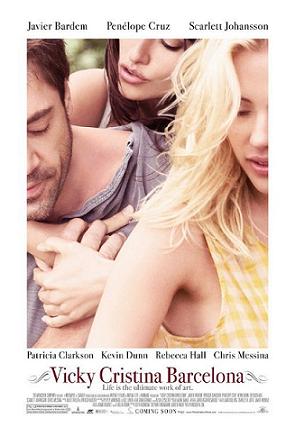
Vicky Christina Barcelona

Vicky Christina Barcelona (2008) is flirtatious and enchanting fun about two best friends whose extended stay in Barcelona one summer has unexpected effects on both of them, and all because they meet a charming, suave painter, a sort of modern-day Casanova, played by Javier Bardem, who invites them to spend the weekend with him. Fun-loving and curious Christina (Scarlet Johansson) is intrigued and immediately receptive, while cautious, level-headed (and engaged) Vicky (Rebecca Hall) balks at Bardem's outright proposition.

Of all Woody Allen's recent movies, this one--along with Scoop--is the most entertaining. Allen is currently on a quest to capture all the romantic European cities. With Barcelona, there isn't so much of an expectation--as there was with Paris in Midnight in Paris. This is breezy, undemanding entertainment that is clever and unpredictable enough to feel fresh and playful.

Penelope Cruz plays Bardem's ex-wife, a dramatic, neurotic painter who allegedly tried to kill him during one of their famously intense fights. When she enters the picture, things get even more complicated. Allen presents Barcelona as a kind of drink, and its effects on the two unsuspecting American girls are like the effects of alcohol, intoxicating the senses, making them falter in their once sure-footed plans for the future, and filling them with a new-found appreciation for the unpredictable. With Patricia Clarkson, Chris Messina, and Kevin Dunn. Narrated by Christopher Evan Welch. 97 min. ★★★

July 17, 2011

The Black Dahlia

The murder of Elizabeth Short in Los Angeles in January of 1947 still fascinates people today, including James Ellroy, whose novel this was based on. However, this 2006 crime-thriller, which promises to be akin to the knockout noir L.A. Confidential (1997), is a freaking mess. Brian De Palma directed, without the kinky excitement he brought to his early thrillers (Dressed to Kill and Carrie come to mind). The cinematography by Vilmos Zsigmond is first-rate. He captures beautifully the fact that there's nothing going on in this movie that you should care about. As luridly tingling as the Black Dahlia case is, this movie should have been an easy success. Instead, The Black Dahlia looks the other way, on purpose, as a matter of "style." Rather than focusing on the Elizabeth Short murder, it veers into other, fabricated directions.

Why, I'll never know.

Everything is contrived. If you come to this movie expecting an absorbing retelling of a scintillating true crime tale (even with the knowledge that Hollywood typically tinkers with historical fact), you've come to the wrong movie. If you've come looking for even a whisper of narrative logic, you'll also be left wanting. It's nonsensical. Big dramatic scenes are inflated and unexpected even. When they unfold, we laugh because they're so poorly conceived. (In one scene, Josh Hartnett, as one of the detectives investigating the Dahlia murders, pulls a table cloth off a table in a fit of passion with Scarlet Johansson. It seems a pity to make such a mess with a movie that's so carefully dull.)

De Palma has always been a manipulative little cheat of a director, playing with the audience in obvious ways, but in The Black Dahlia he doesn't even do that. We're supposed to sit back in awe of the "master" at work, but he isn't working, and neither is the movie. The blame should probably go also to the screenwriter, Scott Friedman, as well as James Ellroy (assuming his book is akin to Friedman's adaptation).

The main characters, two LAPD detectives (Hartnett and Aaron Eckhart) are involved in a love triangle with the boring, flirtatious Scarlet Johansson. Johansson was best in Woody Allen's Scoop. He brought out the passion in her, and the curious little pixie that she can turn into, the one who wooed Hugh Jackman, the handsome killer. But she tends to be uninteresting without a good director, and in The Black Dahlia, De Palma doesn't know what to do with her. Perhaps to him, her beauty is enough to maintain the audience's interest in her acting. But for anyone looking beyond the surface, there's little satisfaction.

De Palma is at a loss with the other actors, too. Eckhart's character becomes obsessed with the Dahlia case (he's the only aspect of this movie that stays focused on the Elizabeth Short murder, when the entire film should be reveling in Black Dahlia mania). And so quickly does he go bananas that we as an audience don't feel invested in his transformation. We can only jeer and laugh at a performance that falls flat and looks out of place. He's in the wrong movie. He's in the movie about the Black Dahlia murder, not the movie that pretends to be about the Black Dahlia murder.

As for Hartnett, he's never been that compelling of an actor, and using him in the lead is a miscalculation. He narrates clumsily the clumsy narration (not to mention the clumsy dialogue), and he's so scrawny and young that you don't really buy him as a detective--or as a contender in a boxing match that occurs early in the film (and feels just as out of place as everything else in this misfired movie).

There are some scenes where the police view screen tests of Elizabeth Short. They're meant to humanize the disfigured corpse left in grisly exhibition in an overgrown lot, but instead they just turn her into a bimbo who told fairy tells to get what she wanted. And maybe that's true of the real Elizabeth Short, but for a movie that gives little attention to the subject of its title, this adds yet another nail in the coffin. And Hilary Swank, who's desperately in need of a meal, shows up as another bimbo, someone for Josh Hartnett's character to sleep with in lieu of Johnasson, from whom he feels an obligation to abstain (since she's living with his partner).

Fiona Shaw gives the most overwrought performance as Swank's hopped up mother, a society woman who knows more than a bit about the Short murder. In fact, her performance is so hysterically bad, that I recommend watching this movie now. It was earth-shattering. The always exciting Rose McGowan has a cameo as one of Elizabeth Short's roommates. It's a pity that she had such a small part. She's far more interesting an actress than either Scarlet or Swank.

If only The Black Dahlia were as exciting as L.A. Confidential, or any of the old 1940's film noirs that it was modeled after. Instead, we're left with a labyrinthine mess of a movie that's shooting blanks after promising a bang.

July 11, 2011

The Prestige

100th Review
 
The Prestige (2006) is about two magicians in London at the end of the 19th century, both vying for the public's attention and acclaim. It's an interesting idea that was bungled, possibly before Christopher Nolan, the director and co-writer (along with his brother, Jonathan), ever began working on it. As a director, Nolan tends to inflate his movies. He enjoys hatching labyrinthine plots, and tinkering with time and manipulating the viewer's emotions. That's all fine and dandy, but the problem with most of his work has been a certain hollowness that may naturally proliferate as a result of his best intentions to be clever and grandly mysterious.

This is a movie about magic that's absolutely lacking in any sense of wonder or excitement. I didn't care about any of the characters, despite the interesting cast that was assembled (including Michael Caine, Rebecca Hall, Scarlet Johansson, David Bowie, and Andy Serkis). It was all lifeless, uninvolving. Christian Bale does his usual thing as one of the magicians, the darker, more obsessive one. Bale acts with his facial expressions, or should I say, expression. He rarely shows more than the one. He frequently plays dark, deeply disturbed characters, to the point that everything he does blends into something indistinguishable. There's not much difference between this and Batman Begins or even American Psycho, except that he laughed more in American Psycho. He was a certifiable sociopath there. Here he's just a mad genius.

Hugh Jackman plays his American rival and nemesis, and he's the more commercial of the two. Jackman has an engaging quality about him, but he's played as the heavy. He's in it for the money, and even admits, readily, that Bale is the better magician. Their careers and their lives mirror those of certain Hollywood directors: say, Orson Welles in the place of Bale's character, and Steven Spielberg in the place of Jackman's. One a masterfully intuitive filmmaker and the other a master, epic-scale showman. Welles's entire career was troubled because of studio tampering, financial turmoil, and inner-conflict. Spielberg has always been the darling of the studios because he's always been able to make a lot of money with his films, some of which are genuinely marvelous, and some of which are shamefully commercial and uninteresting.

The two magicians develop a deep and mutual rivalry, and the movie is full of the tricks they play on each other. The idea of The Prestige reminded me of Sleuth (1972), which was directed by Joseph L. Mankiewicz and starred an aging Laurence Olivier and a youngish Michael Caine. Olivier played a respected English mystery writer living in a beautiful, ornate mansion in the English countryside, and Caine was the young Italian immigrant (there's a great line where Olivier assures Caine's character that he could never become English) sleeping with Olivier's wife. The movie was mainly a series of elaborate tricks designed to titillate and terrorize the audience, and it worked. Sleuth was a fascinating entertainment. It wasn't inflated into some large scale dramatic epic, complete with courtroom scenes and a wife hanging herself in the attic. The Prestige wants to be all things to all people, and I suspect this is Christopher Nolan's temperament as a director seeping into the movie. He's certainly got it all, except for the kind of kinetic excitement this move requires. This is a soap opera between two magicians, and it's too stilted to generate any real movie magic.

Nolan continues to get hung up on big ideas to satisfy his baser cinematic instincts and passions. He clearly likes pulp, but doesn't approach it in the right way. He dresses it up with superficial sophistication. The thing that people enjoy about a Quentin Tarantino movie is its unashamed dedication to that low pulp entertainment. When I watch Nolan's movies, I sense the desire to deliver that kind of true enjoyment, but it's tainted by a need to be the smartest director in Hollywood, the one who "really makes you think," as more than one person has said to me about him.